

PoC case: Raising data analysis productivity for 150 SQL users at Company K
How a Text-to-SQL AI agent PoC with DFINITE DARVIS helped Company K, a financial data company, search credit profiles and automate reports for its SQL users.
Hello, this is DFINITE.
DFINITE recently ran a PoC with Company K, a financial data company. We want to share what we did and what we learned along the way.
A vast set of profiles, and how to find the right one
Company K is a credit information company. Its core business is analyzing credit information on individuals and businesses and supplying it to financial institutions.
Company K manages tens of thousands of credit analysis indicators: "credit card spending over the last six months", "loan delinquency records in the savings bank sector", "highest debit card spending within one year", and so on. The company calls each of these indicators a "profile".
The problem was finding these profiles.
Every day, 150 to 200 SQL users had to dig out the indicators they needed from among complicated profile names and codes. Profile names ran past 40 to 50 characters, and there were hundreds of indicators with similar names.
To see whether this could be solved, Company K ran a PoC to decide whether to adopt DFINITE DARVIS's Text-to-SQL AI agent.
Data analysis at a credit rating company
A complex profile structure
Company K's core work is credit risk assessment. It supplies very detailed indicators so that financial institutions can decide, before issuing a loan or a card, "Is it safe to lend this person money?"
Here are some examples of profile names:
Number of months within the last 6 months with cash advances of KRW 200,000 or more (including closed accounts)
Valid short-term card loans on credit cards used within the last 6 months (15th-day basis)
Total debit card spending within 3 months (15th-day basis, including closed accounts)
Names longer than 40 to 50 characters, conditions nested inside parentheses, codes mixing abbreviations and numbers. There are hundreds of near-duplicate profiles that differ only in the time period.
How the data analysts work
150 to 200 SQL users query and analyze data with these profiles every day.
A data analyst's routine looks like this:
Searching for and selecting profiles
Writing SQL queries
Querying and processing data
Summarizing analysis results
Building charts
Producing Excel reports
Every step needed a productivity boost. Profile search and report automation were the key challenges.
The approach Company K chose
Instead of replacing the whole system at once, Company K chose a PoC (proof of concept) with DFINITE. The strategy was to validate on a small scale first, then expand.
Five things were tested.
Accuracy of the Text-to-SQL agent
Report automation
Understanding of financial domain terms
Stability at the scale of 150 to 200 users
A system for continuous improvement
Five things DARVIS validated
What is the DARVIS Text-to-SQL agent?
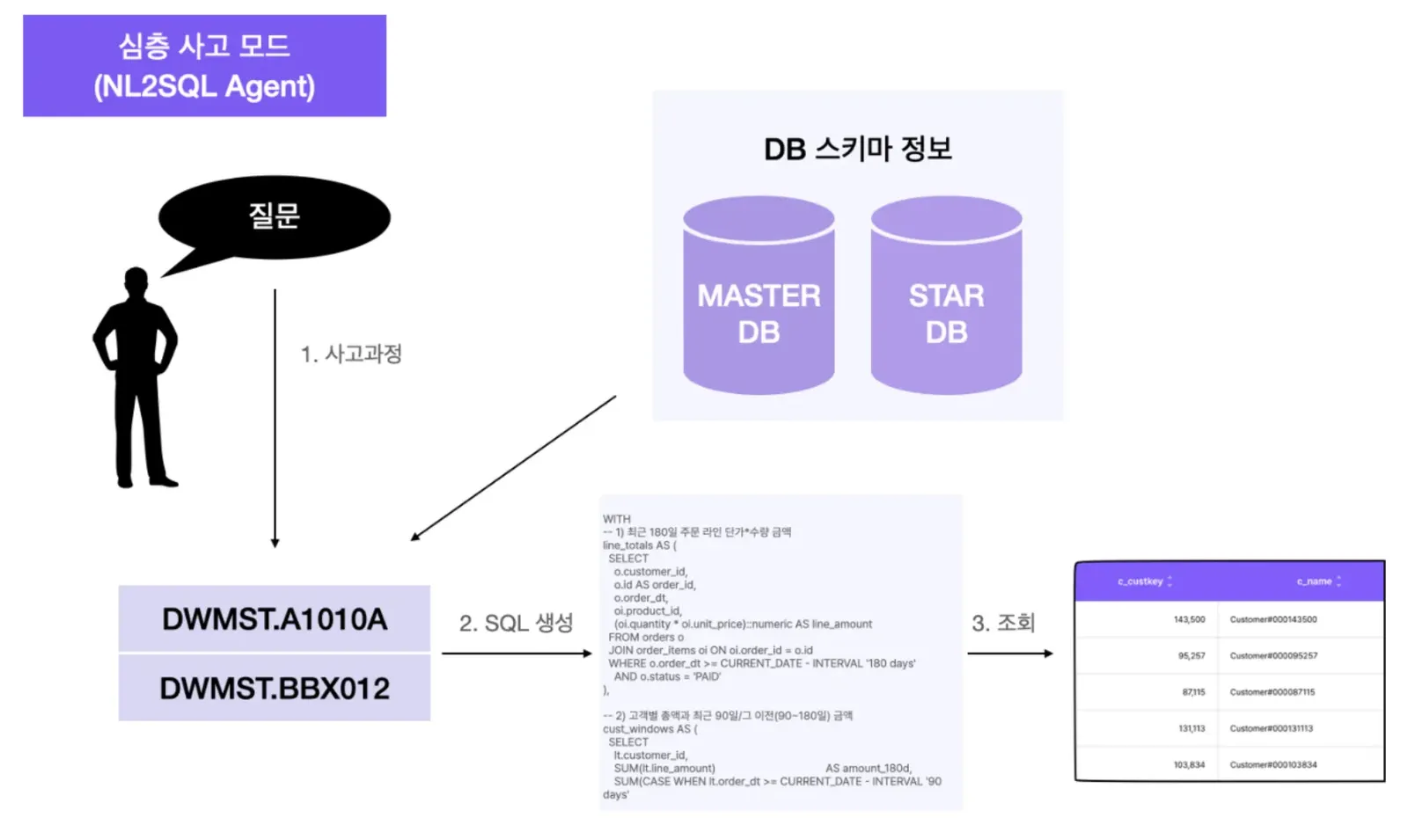
DARVIS's core function is automatically converting natural language into SQL.
How it works:
The user types a question in natural language
The AI analyzes the DB schema
A SQL query is generated automatically
The result is shown as a table
When a data analyst types "top 10 customers by card spending over the last 3 months", DARVIS finds the right tables, writes the JOIN clauses, and generates SQL with the aggregate functions applied.
It also supports multi-turn conversation. If the user says "change 3 months to 6 months", it revises the SQL right away. If an error occurs, retry logic kicks in automatically.
Profile search
Profile search was the core challenge of the PoC.
Finding the exact profile among complicated names and similar indicators took a lot of time. Users had to know the exact profile code, and there were hundreds of indicators with similar names.
DARVIS offers natural-language search. When a user types "find profiles related to the highest card spending", the related profiles are listed in order of time period:
Highest total card spending within 2 months (including closed accounts)
Highest total card spending within 3 months (including closed accounts)
Highest total card spending within 6 months (including closed accounts)
Users can search without knowing the exact code or profile name.
Report automation
Query results are turned into charts automatically. Bar charts, line charts, pie charts and other visualizations are chosen to fit the data.
Automatic Excel report generation was built as well. An Excel file containing the query results and charts can be downloaded in one click, in whichever format the user picks, such as CSV or XLSX.
Feedback loop and access control
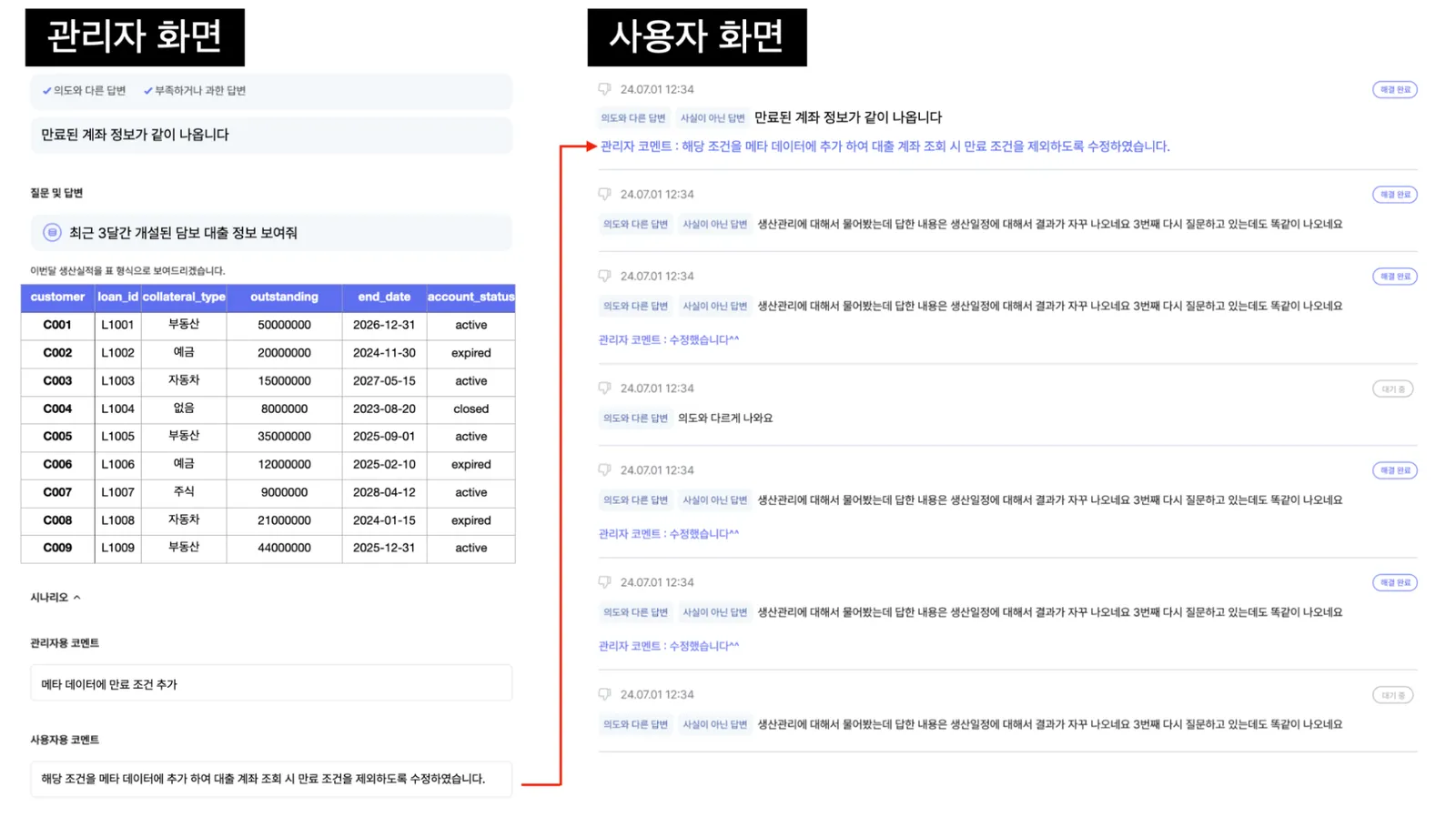
During the PoC we built a continuous improvement process.
When a user reports an unsatisfactory result, an administrator checks the query that was actually generated and its output. Once the problem is identified, the administrator fixes the metadata, and improved results appear automatically from the next search on.
Access control was also a must-have. With credit information in the financial sector, controlling data access matters.
DARVIS provides access control at three levels:
Table level: whether a user can access a given table
Department level: the data scope for each department
Column level: automatic masking of sensitive information
Data the user has no permission for is masked automatically, and users can request access from an administrator when needed.
Company K and DARVIS: results of the 1.5-month PoC
PoC complete
The 1.5-month PoC has wrapped up. Over that period, DFINITE validated the following.
Validated items:
✅ Text-to-SQL agent: converts natural language into accurate SQL
✅ Profile search: a huge set of indicators can be searched in natural language
✅ Report automation: chart rendering and Excel generation confirmed
✅ Domain specialization: financial terminology dictionary applied
✅ Large-scale environment: stable operation for an organization of this size
✅ Access control: meets financial-sector security requirements
✅ Continuous improvement: a process for collecting and applying feedback
Removing the SQL skills barrier, widening data access
The biggest change from adopting DARVIS was wider access to data.
In the old way of working, only people who could write SQL could query data. Everyone else had to ask a SQL expert and wait for the result. Even in an organization of 150 to 200 people, only a limited number could actually work with the data.
With DARVIS, employees who don't know SQL can query data in natural language. They simply type "customers with card delinquencies in the last 3 months". There is no need to know complex JOIN clauses or aggregate functions. DARVIS generates the SQL automatically and fixes it when an error occurs.
Data use across the organization is growing. SQL experts can focus on more complex analysis, while each department handles simple queries on its own.
Higher data analysis productivity
These are the four main effects confirmed in the PoC.
1. SQL expertise no longer required
Non-experts can now analyze data using natural language alone. The company used to depend on the few experts who could write SQL; now the whole organization can use the data.
2. Less time spent on work
Repetitive tasks such as profile search, SQL writing and report generation were automated. The quantitative effect is still being analyzed, but the change was clear.
3. Better accuracy
SQL writing errors went down. DARVIS analyzes the schema automatically and generates an optimized query. When an error occurs, retry logic delivers a corrected query. The syntax and logic errors that came with writing SQL by hand were kept to a minimum.
4. More efficient work
The workflow of the 150 to 200 SQL users improved.
Profile search: search a huge set of indicators instantly in natural language
SQL writing: complex queries generated automatically
Report writing: charts and Excel files generated automatically
Independence: self-service without help from colleagues or managers
As a result, data analysis productivity improved across the organization.
Adopting a custom enterprise AI solution? Validate it with a PoC first.
DFINITE's approach to adopting AI is not a forced, all-at-once rollout but a step-by-step one that keeps risk low while still delivering clear results.
Rather than introducing an AI solution suddenly, we recommend starting with a PoC and adopting it in stages.
Stage 1: PoC (2 weeks)
We run a proof of concept with two or three sample documents. As with a semiconductor manufacturer we worked with, we pick key documents used in day-to-day work and test how accurately the AI can understand them and answer questions.
Stage 2: Pilot (3 months)
Building on the technology validated in the PoC, we integrate around 50 key documents. We run a pilot with a specific department or process and measure the real improvement in work.
Stage 3: Full adoption
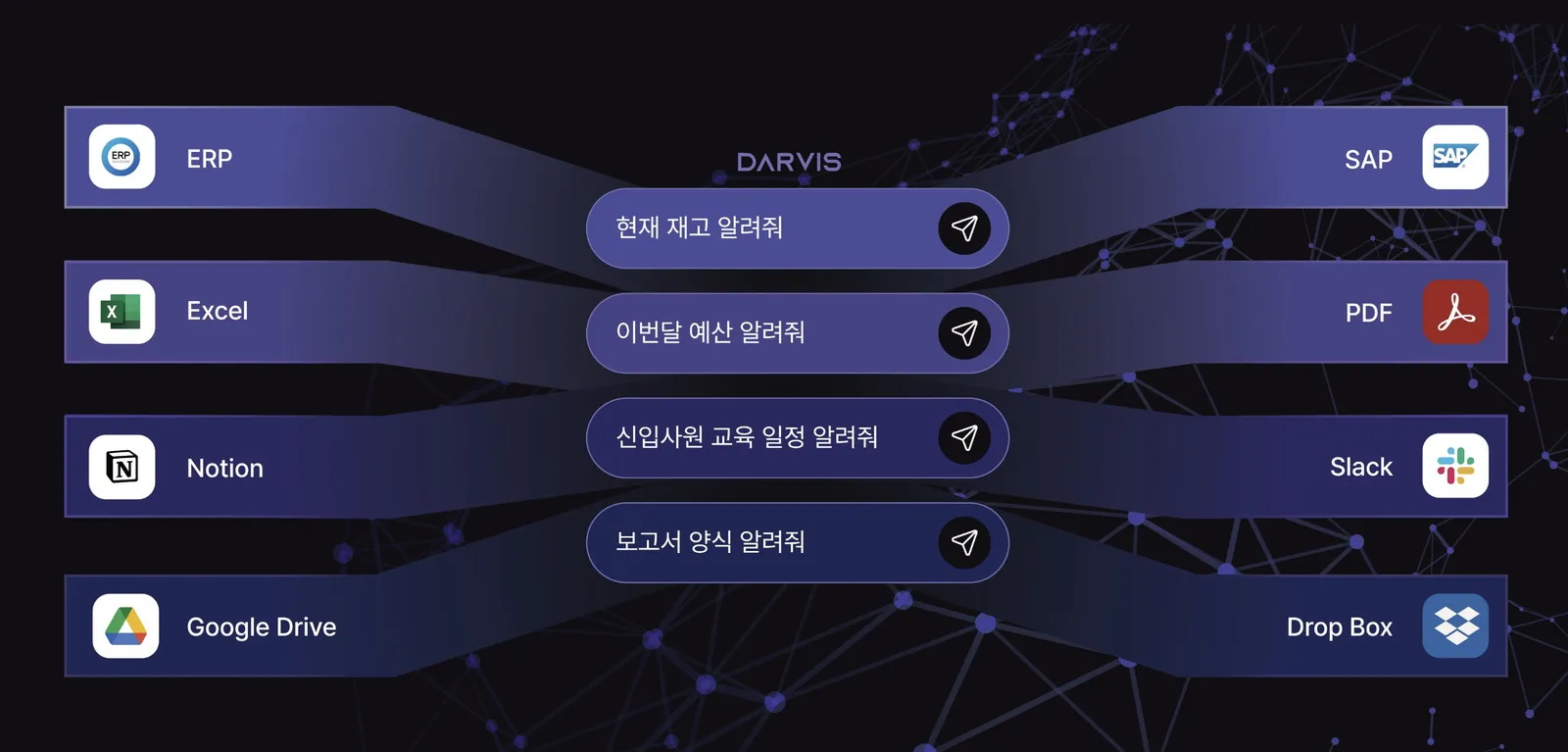
Based on the results confirmed in the pilot, we connect to company-wide systems. The service is delivered through links to existing systems such as ERP, MES and SCM.
The biggest advantage of this step-by-step approach is that results can be clearly verified at every stage.
AI can clearly raise your company's productivity and efficiency.
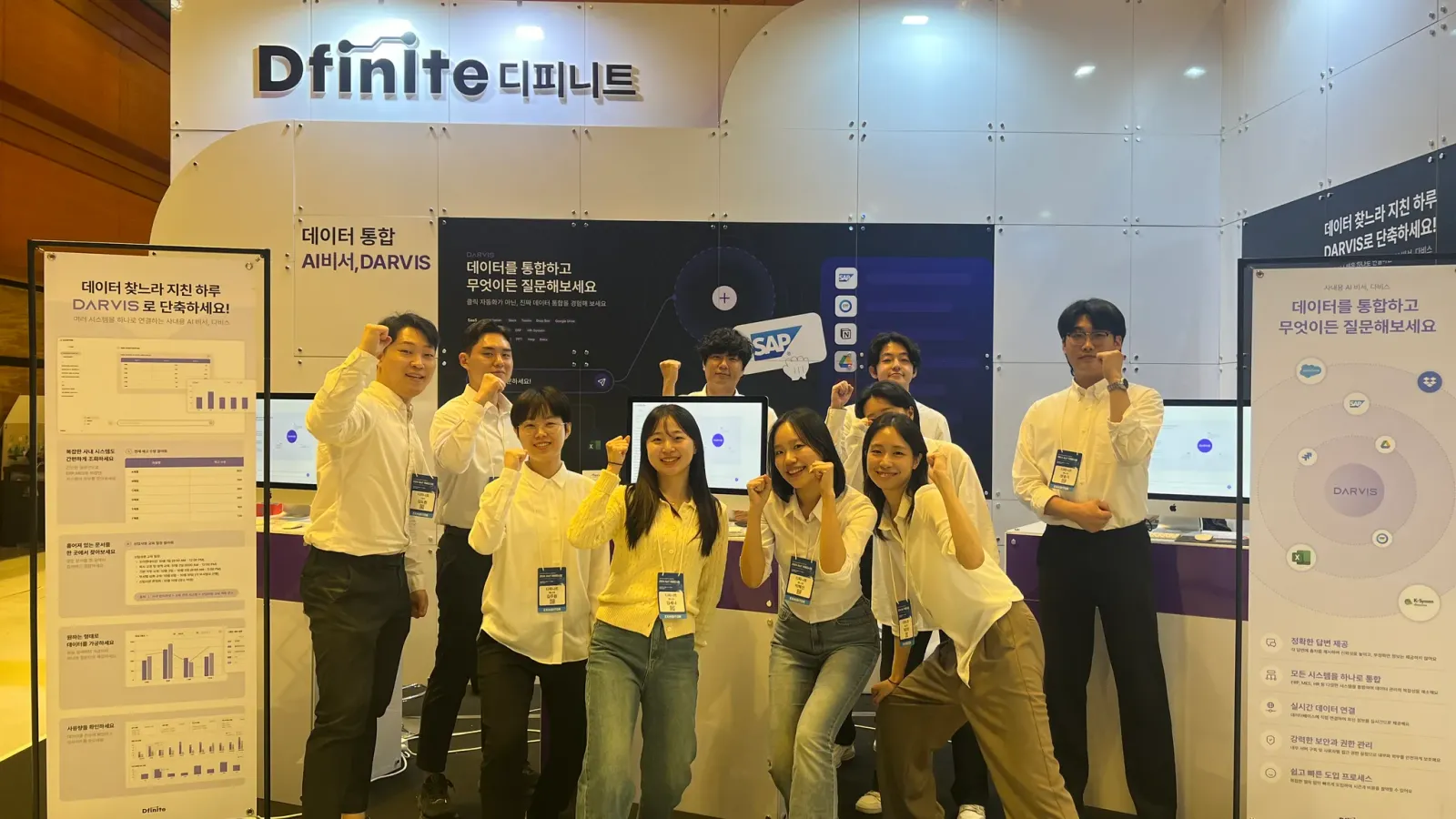
Company K chose DARVIS for its 150 to 200 SQL users. Through a 1.5-month PoC, it validated the core functions: the Text-to-SQL agent, report automation, financial domain specialization and access control.
Is your company dealing with something similar?
📊 Raising data analysis productivity for a large base of SQL users
🔍 Finding the information you need in complex data structures
💻 Giving non-SQL users better access to data
🔐 Managing access to sensitive data safely
⏱️ Low-risk validation through a PoC
DFINITE supports a structured AI adoption, from PoC to full contract.
Get the DARVIS brochure from the Brochures menu at the top of this page, or talk to us with the "Request a consultation" button below.
DFINITE is always open to a PoC.
We join scattered data with an ontology, flag what drifts first, and keep the evidence behind every decision.