

A system semiconductor company's DARVIS PoC for manufacturing AI
A 24-hour semiconductor plant struggled with complex, fast-changing manuals. See how DFINITE's DARVIS approached the problem in a PoC.
You hit a question about a procedure or standard in the middle of a job. The manual is so thick that it is hard to find what you need. The experienced senior colleague is away from their desk, so there is no one to ask.
What would you do?
On a manufacturing floor that runs 24 hours a day, moments like this come up all the time. With dozens of work instructions changing every week, it is practically impossible for every employee to know them all perfectly.
So can manufacturers with these characteristics solve the problem by adopting an AI solution?
This post presents a PoC that a Korean company specializing in system semiconductor testing ran with DARVIS, DFINITE's enterprise AI solution.
A semiconductor manufacturer's practical concerns
The company is a Korean specialist in system semiconductor testing.
Its technology is highly regarded in wafer testing. Even so, this technology specialist had a problem to solve.
The company was looking for ways to make its shop-floor operations more efficient. In particular, there was strong demand for a system that would make its large and complex work standards easier for floor operators to use.
The company had been growing steadily on the strength of its technology, but it had also reached a point where operations needed tighter management.
With 70 to 80 spec documents updated in an average week and a plant running 24 hours a day, a system that gave every employee real-time access to the latest information was becoming essential.
A 24-hour plant with manuals that keep changing

What the company's managers worried about was a real-time update system.
With a single spec revised as many as 15 times in a week, they were looking for a way to make sure every shift worker caught and applied each change. Because the plant runs around the clock, an automated learning system was a must.
The core issue was not simply the volume of documents. In manufacturing, information tied directly to safety and quality is updated in real time, and every shift worker has to catch and apply it.
Security constraints made it even harder. For security reasons, the standard documents could not be downloaded and could only be viewed through an internal system viewer. These were conditions that typical cloud-based AI solutions could not meet.
While reviewing several vendors, the company found DFINITE through a search for AI adoption. It judged that a document-based AI chatbot solution fit its needs best.
The approach of DARVIS, DFINITE's manufacturing AI solution
When DFINITE analyzed the company's problem, it was clear the situation called for an AI solution built for manufacturing, not just a document search system. It needed a completely different approach from a typical enterprise AI chatbot.
DARVIS understands what makes manufacturing AI different
One example shows the difference between manufacturing AI and general AI clearly.
Typical company: "Find last year's report."Manufacturing floor: "What is the work procedure when unloading the probe card equipment, depending on whether there is a stiffener?"DARVIS can understand and accurately answer complex, specific questions like this.
This difference is the core strength of DFINITE's DARVIS. It is an AI solution that fully understands the complex, specialized context of the manufacturing floor, rather than a tool that only finds documents.
A combination of three core technologies
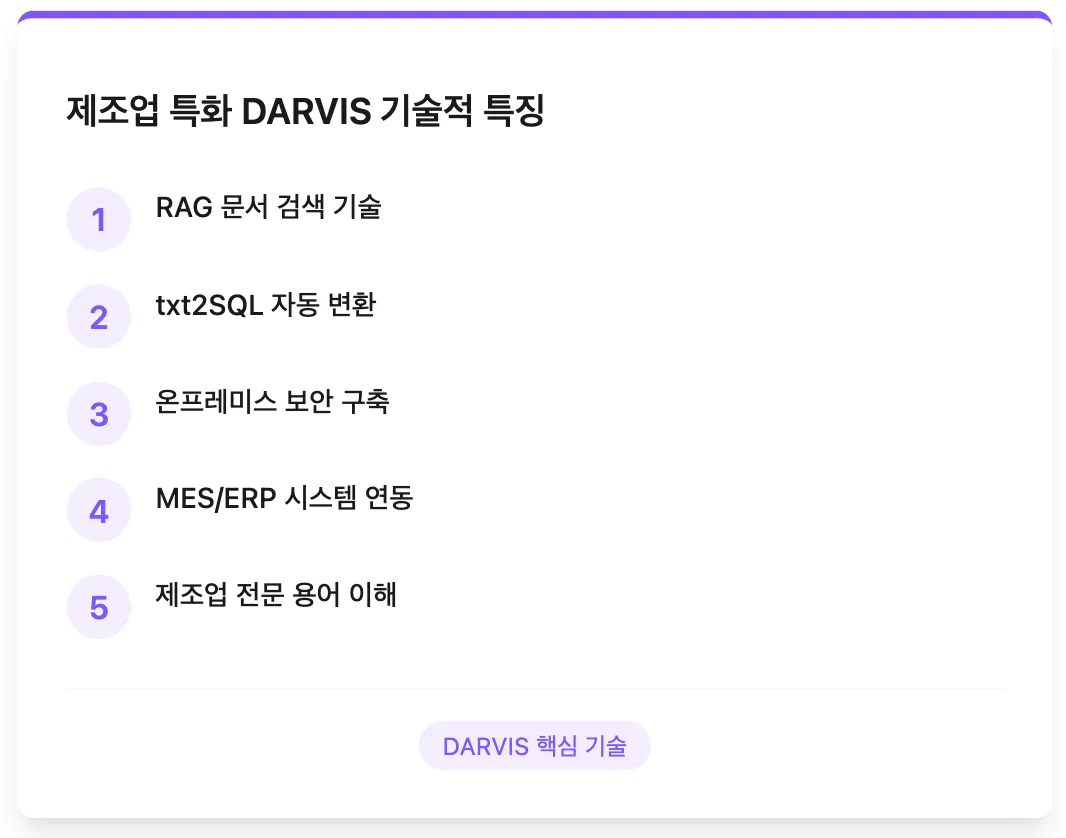
To meet the company's requirements, DARVIS combined three core technologies.
RAG-based document search
The first step was converting the manuals into a form the AI could understand. Documents running to dozens of pages were vectorized to enable semantic search. Rather than simple keyword matching, this approach grasps the intent and context of a question to find the most relevant information.
txt2SQL automatic conversion
Floor staff can ask in natural language, without knowing SQL, and get the right data back automatically. When a question is entered in natural language, the system converts it into an appropriate SQL query and retrieves the correct information.
On-premises deployment to meet security requirements in full
Security requirements mattered most. All of the company's technical documents and production data were sensitive information that could not leave the company. DFINITE built an on-premises environment so that all processing happened only inside the company.
Technical validation in two weeks
Two weeks after the PoC started, notable results came in. The AI system DFINITE built reached 93.58% document-retrieval accuracy.
The figure mattered because it was a concrete measure of how accurately AI could understand and handle the complex, specialized technical documents of a semiconductor manufacturing floor.
Thorough testing with 109 real work questions
The test used 109 real work questions that could come up on the floor. For many types of question, such as equipment inspection intervals, inspection criteria and complex work procedures, DARVIS gave detailed answers that referenced the exact page of the manual.
In particular, it showed it could accurately understand and answer with semiconductor terminology and complex procedures.
Ten days of testing in a real environment
DFINITE provided a demo server for 10 days, and the company's floor staff tested it themselves. The system, built on premises, ran reliably.
A safe way to adopt an AI solution through step-by-step expansion
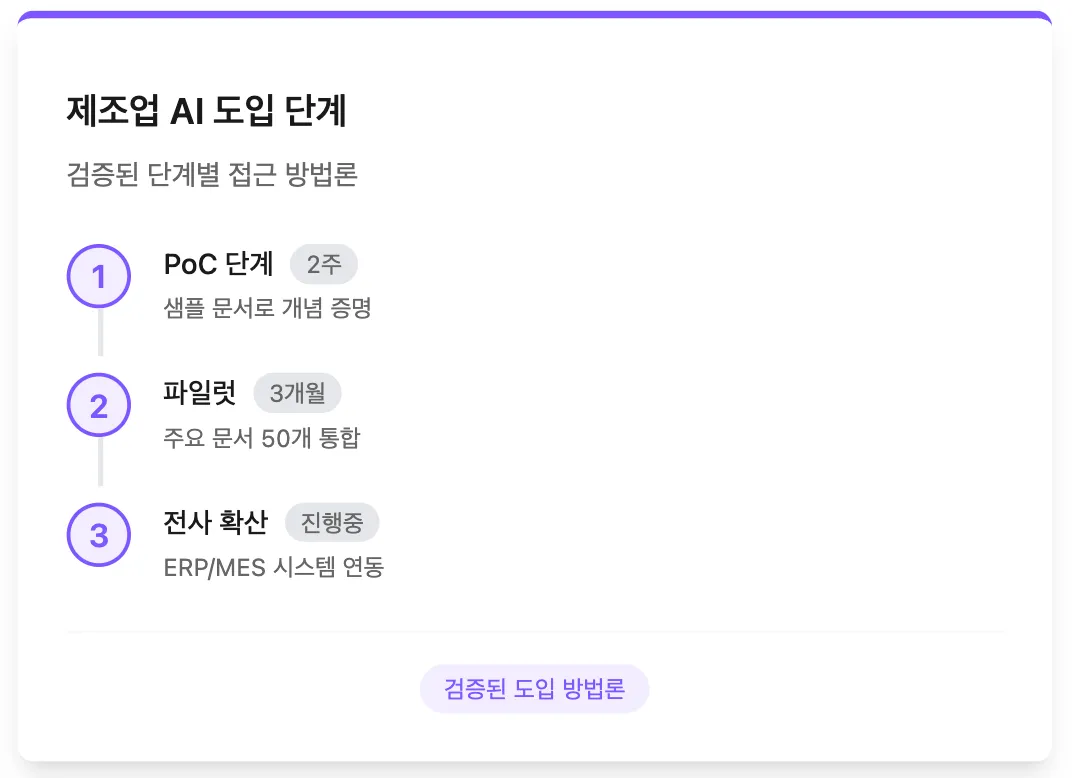
DFINITE's approach to adopting an AI solution avoids an overreaching full rollout and takes a step-by-step path that keeps risk low while still delivering clear results.
Rather than adopting an AI solution all at once, we recommend starting with a PoC and expanding step by step. The same applies to this company.
Stage 1: PoC (2 weeks)
A proof of concept with two or three sample documents. As with this company, key documents used in real work are selected to check how accurately the AI can understand them and answer.
Stage 2: Pilot (3 months)
Building on the technology validated in the PoC, about 50 key documents are integrated. A trial run with a specific department or process measures the actual improvement in work.
Stage 3: Full deployment
Based on the results confirmed in the pilot, the system is connected to company-wide systems. The service is delivered through links to existing systems such as ERP, MES and SCM.
The biggest advantage of this step-by-step approach is that results can be clearly verified at each stage.
An auto parts maker's choice: DARVIS, an enterprise AI solution
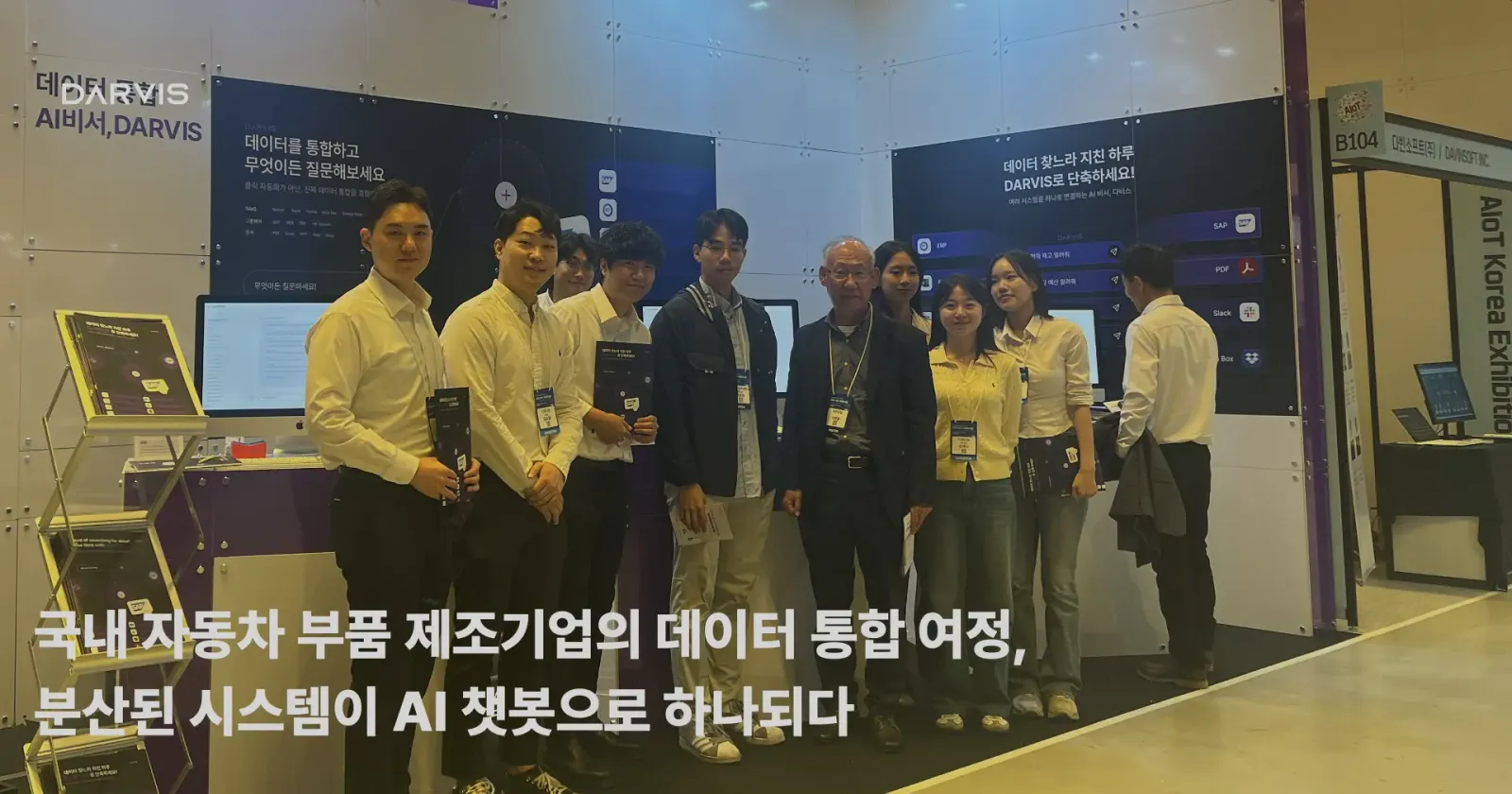
There is also a manufacturer that went beyond a PoC to full deployment.
That is Company W, a mid-sized automotive parts maker.
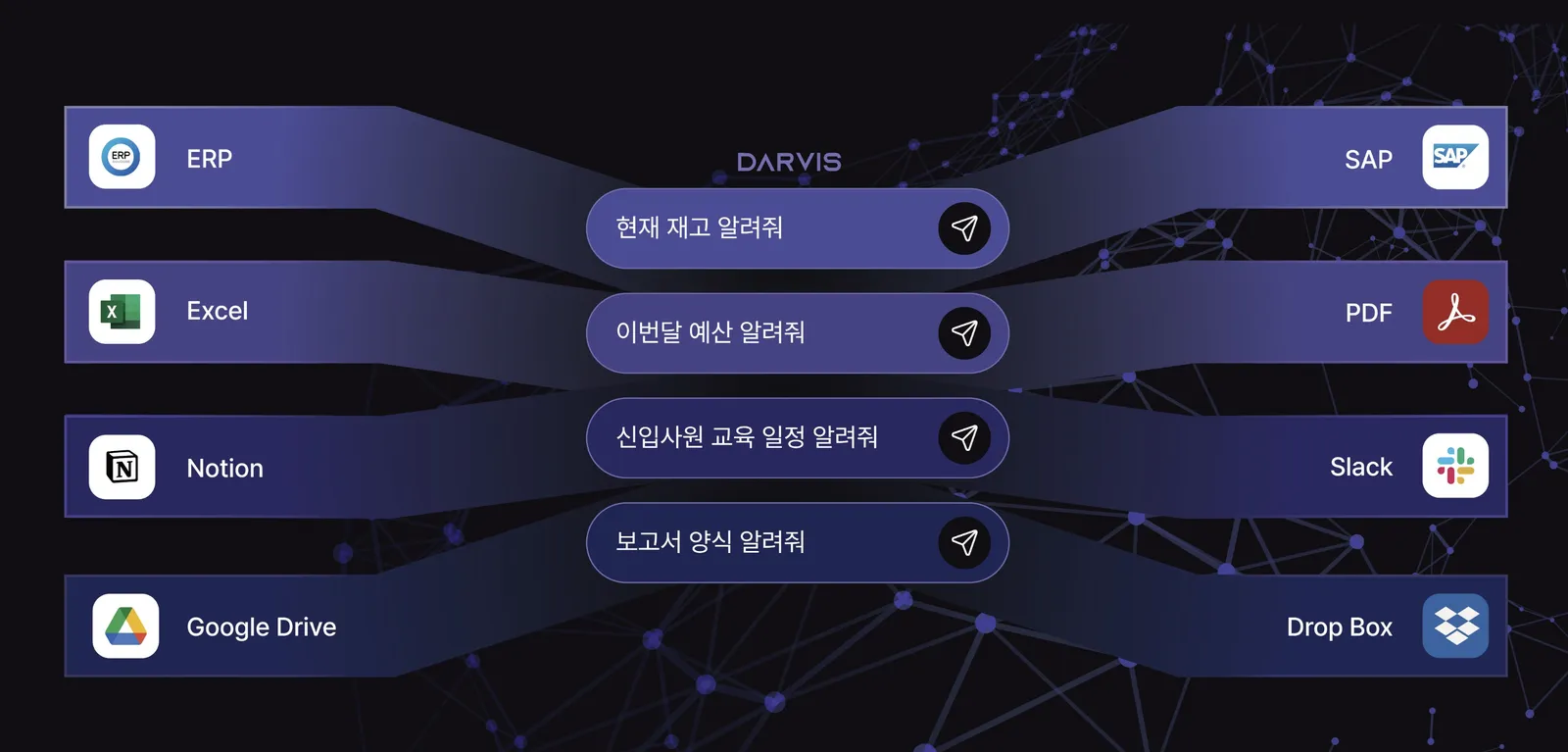
Like the semiconductor company, Company W was struggling to manage complex manufacturing data. It ran many systems, including ERP, MES and SCM, but their data was scattered, so staff had a hard time finding the information they needed.
You can read more about Company W's deployment here (in Korean).
Adopting a manufacturing AI solution, starting with a PoC
When it comes to adopting an AI solution tailored to your company, trying it directly in a PoC lets you decide faster than continuing to deliberate.
Take this opportunity to try it in a PoC with DFINITE.
DARVIS, DFINITE's enterprise AI solution, provides AI tailored to each company. With txt2SQL and RAG technology, it brings together data scattered across the company and makes instant analysis possible.
Does building an in-house AI chatbot still feel vague?
We are always open to PoC inquiries. Take a look at what DARVIS does and get in touch.
Use the "Request a consultation" button below to ask about DFINITE's AI chatbot solution DARVIS.
We join scattered data with an ontology, flag what drifts first, and keep the evidence behind every decision.