

A shipping company's AI path: explaining forecasts, then integrating data
How an LNG shipping company and DFINITE started by explaining an AI forecast model's predictions and found the case for company-wide data integration.
"Can we explain why the model produced this forecast?"
"Can we bring data from several departments together to make decisions?"
The company has long been one of the leaders in LNG transport in Korea. It operates a fleet of LNG carriers that moves millions of tonnes of LNG a year, and its long record of safe voyages has earned it a strong reputation for reliability in the shipping industry.
However, the shipping industry has recently faced new challenges as international environmental regulations such as IMO DCS, EEOI, EEXI, EU ETS and EU MRV have tightened. In particular, reducing carbon taxes under the global push for decarbonization has become a key task. The company set out to tackle these challenges with AI.
It had developed its own AI model to predict gas consumption in vessel operations, but a new challenge remained. To trust the AI's predictions and use them in actual decisions, it needed a clear explanation of "why the model made this prediction".
To solve this, the company and DFINITE took on a new challenge: interpreting the AI forecast model.
A new challenge: interpreting an AI forecast model
The company's challenge was not simple. Vessel operation has two perspectives, commercial operation and technical operation, and even a small decision involves six or seven departments. Reaching decarbonization targets meant taking all of these perspectives into account together.
DFINITE approached the problem this way. First, we focused on the specific task the company faced: interpreting the AI forecast model. We proposed a solution that analyzes prediction results with SHAP (Shapley Additive Explanations) values and generates natural-language explanations with ChatGPT.
AI forecast interpretation built on DFINITE's technology
The system was developed in three stages. First, we designed the data preprocessing and prompt construction algorithms and validated them in a local environment. Next, we built an API and a demo page for real testing, and finally deployed to a Microsoft Azure virtual machine environment.
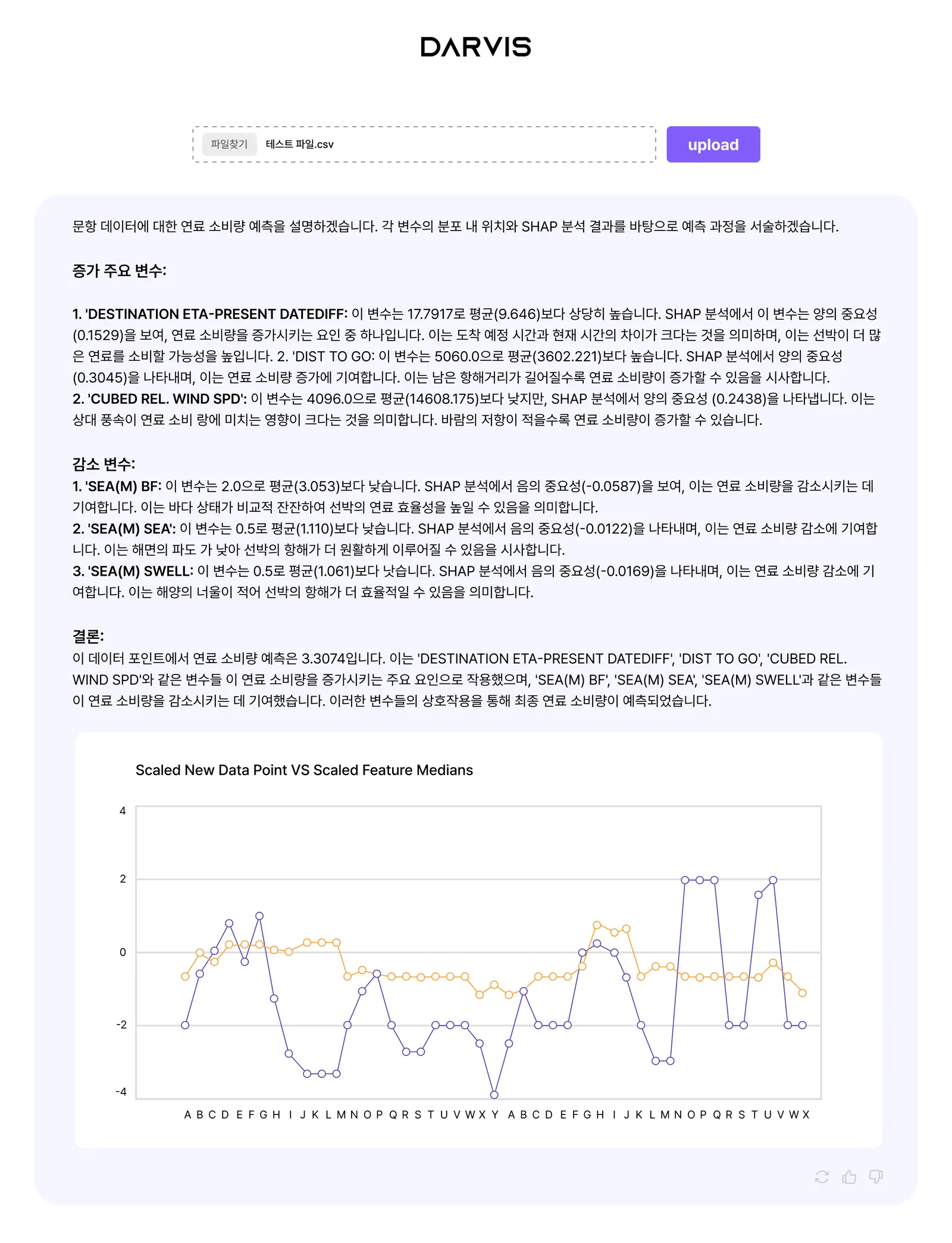
Here is how the system works:
1. Data input and analysis
Upload voyage data in CSV form (distance, wind speed, engine data, etc.)
Analyze each variable's statistical distribution and correlations
Calculate each variable's influence using SHAP values
2. Interpreting the prediction
Produce the gas consumption predicted by the AI model
Analyze in detail how each variable affected the prediction
Give concrete explanations, for example "DESTINATION ETA-PRESENT DATEDIFF is higher than average, so fuel consumption is expected to increase"
3. Visualization and validation
Visualize each variable's influence in a graph
Check the reliability of the prediction at a glance
Provide real-time data analysis results
Using the Microsoft Azure OpenAI API, we were able to explain specialist analysis results in natural language that is easy to understand.
Finding big possibilities in a small success
Through this project, both companies confirmed important results. The company was able to develop its in-house deep learning AI model to a level where it can be used in its actual ERP system. This was an important milestone, showing that many AI models could be integrated with a company's core systems in the future.
A change worth highlighting is in how information is shared. Before, getting a specific piece of information meant asking by email, phone or messenger and waiting for a reply; now the information needed can be checked right away. This is expected to save time and, beyond that, make work more efficient for all employees.
The company was already running its ERP system with both general company data and its vessels' safety management system integrated. That means the many kinds of data generated on its vessels and in the office are managed together on one platform. We expect that adding AI-based prediction and interpretation to this would make even better-optimized company management possible.
Next steps to advance the technology
This PoC confirmed that interpreting AI forecast models is feasible. Right now, predictions are interpreted from Excel data, but the plan is to go one step further.
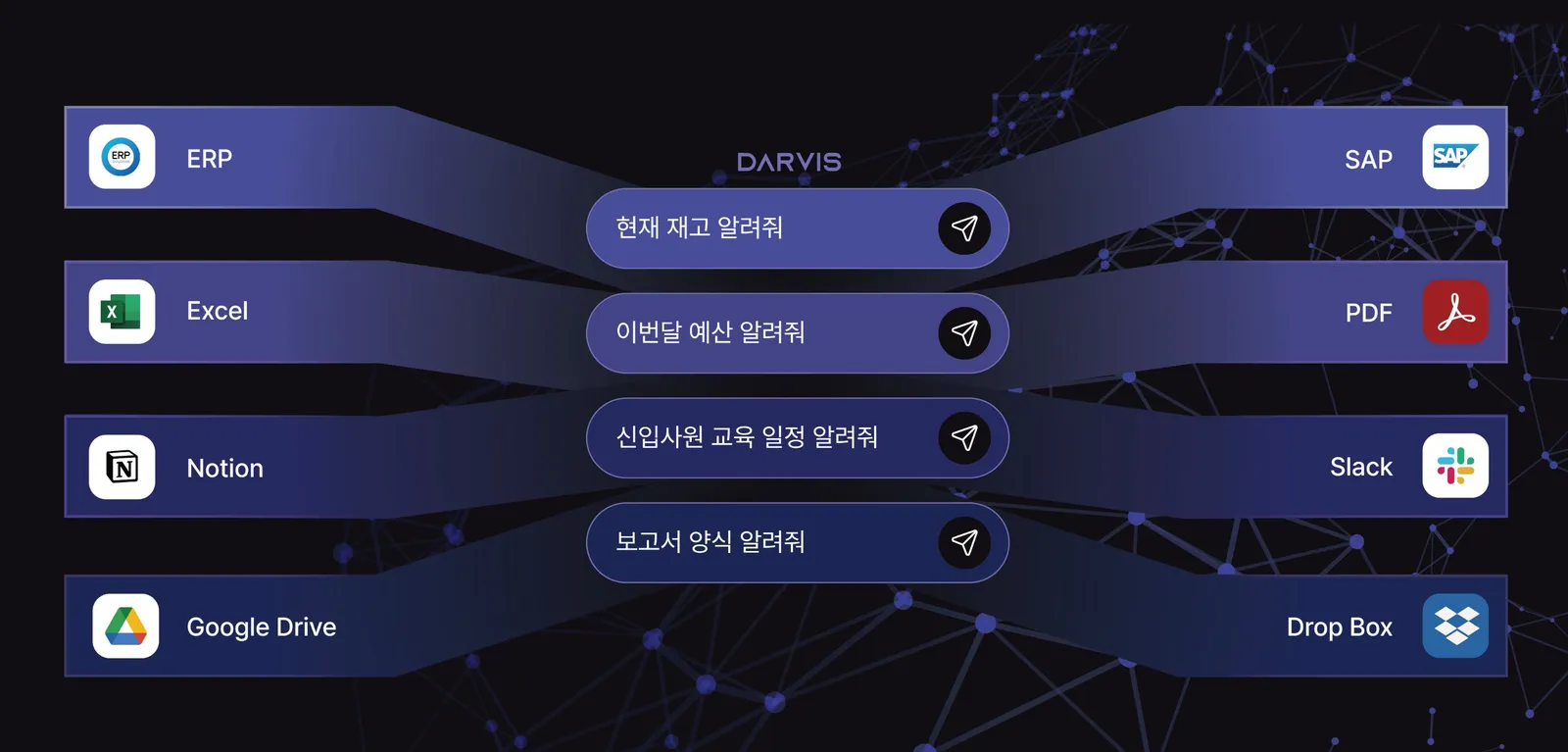
The next step is to connect directly to data in the ERP system. When a user asks in natural language, "Why did this model make this prediction?", the system will analyze real-time ERP data to answer. This will proceed alongside the company's plan to integrate its ERP by the end of 2025.
A bigger challenge built on trust
This project went beyond a technical validation and opened up new possibilities. The shipping industry has not yet fully benefited from the latest AI technology, including ChatGPT.
Through this collaboration, however, we became convinced that AI can solve the particular challenges of the shipping industry. Starting from a specific task, interpreting a forecast model, we built a relationship of trust that lets us take on bigger challenges together: company-wide data integration and building AI systems.
Does adopting AI feel vague?
Try it first through a PoC with DFINITE.
We will work with you to find the best approach for your company.
Take a look at the DARVIS brochure in the Brochures menu at the top of this page, and contact us any time with the "Request a consultation" button below.
We join scattered data with an ontology, flag what drifts first, and keep the evidence behind every decision.