

Types of AI agents: how to choose the right one for your company
AI agent types, seven selection criteria and vendor picks by company type: a guide to enterprise AI agents for work automation and data-driven decisions.

"I've tried ChatGPT. How do I connect it to our actual work?"
Manager Kim on the IT team was recently told at an executive meeting to look into "adopting AI agents." He has used ChatGPT on his own, but he has no clear idea which "enterprise AI agents" can connect to internal systems while keeping data secure, or how to choose one. On top of that, dozens of AI agent products are flooding the market, and each claims to be "the best."
Kim's problem is one that many people responsible for this decision are facing right now. Beyond generative AI, the era of "AI agents that act on their own" is now in full swing. Autonomous AI that goes past the simple conversational chatbot to handle work automation, document generation and even data analysis is becoming the new benchmark for corporate competitiveness.

Global big tech companies such as Google, OpenAI and Microsoft are actively adopting AI agents, and so are large Korean companies and public institutions. In Korea, the Seoul Foundation of Women and Family sharply cut document search time with an AI agent, and the education platform Business PT greatly reduced Q&A time.
What matters, though, is which AI agent you choose. The wrong choice can waste money and can also lead to a security incident.
This article covers the types of AI agents, the seven key criteria a company should weigh when choosing one, recommended vendors by situation, and a solution that meets both data security and data connection needs.
What is an AI agent, and why is it getting attention now?
An AI agent is an AI system that automatically carries out a series of tasks to reach a goal on its own. Put simply, it is "autonomous AI" that runs multiple steps by itself once you give it an instruction.
The biggest difference from a traditional chatbot is initiative. A chatbot only answers questions. An AI agent understands the question, searches for the information it needs, queries several systems, analyzes the results and produces the final output. Ask it "Show me the top five items by quality defect rate last month," and the AI agent connects to the quality management system, pulls the data, analyzes it and even builds a visualized report automatically.
The reason companies are paying attention is clear: less repetitive work, better cost efficiency and faster data-driven decisions, which are tangible results. Gartner forecast that by 2025, 30% of companies would adopt automation using AI agents.
Types of AI agents: which kind does your company need?
AI agents can be classified in several ways, by role and by technical level. To pick an agent that fits your company, first understand the characteristics of each type.

AI agents classified by function
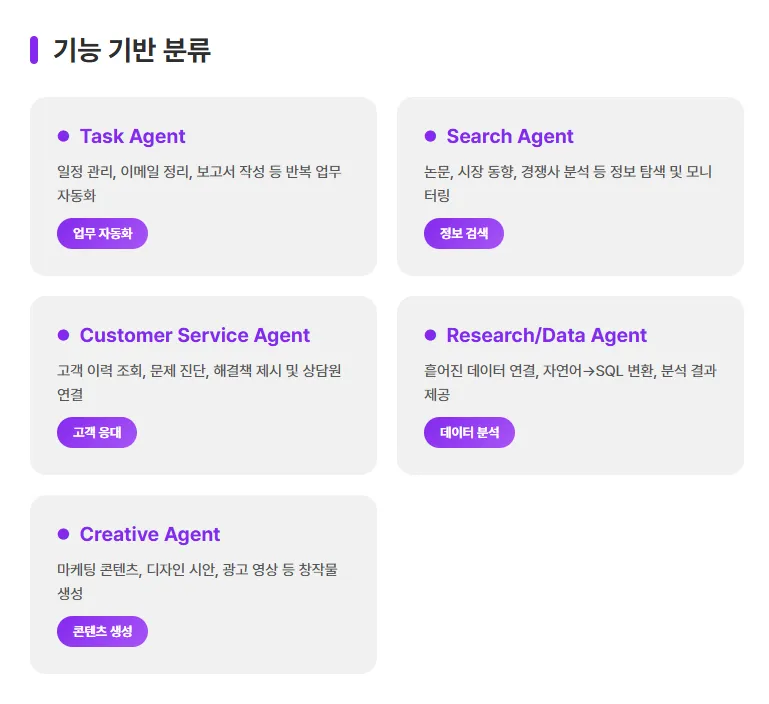
Classified by "what they do," AI agents fall into five broad types.
Task Agent is the most common form. It automates repetitive office work such as managing schedules, sorting email and writing simple reports. If employees set it up with "Every Monday at 9 a.m., create a summary report of last week's results," it gathers the data and produces the report on its own.
Search Agent specializes in finding what you need in large volumes of information. It is useful for departments such as R&D or strategic planning that must continuously monitor new papers, market trends and competitor analysis.
Customer Service Agent is the core of customer service automation. It goes beyond answering FAQs: it looks up a customer's purchase history, diagnoses the problem, proposes a solution and, when needed, automatically connects the customer to a human agent.
Research/Data Agent specializes in analyzing a company's internal data. It connects data scattered across multiple systems, and when you ask a question in natural language, it automatically writes the SQL query and returns the result. DARVIS is a representative example.
Creative Agent generates creative work such as marketing content, design drafts and ad videos. It is mainly used for external communication rather than for automating internal work.
AI agents classified by level of autonomy
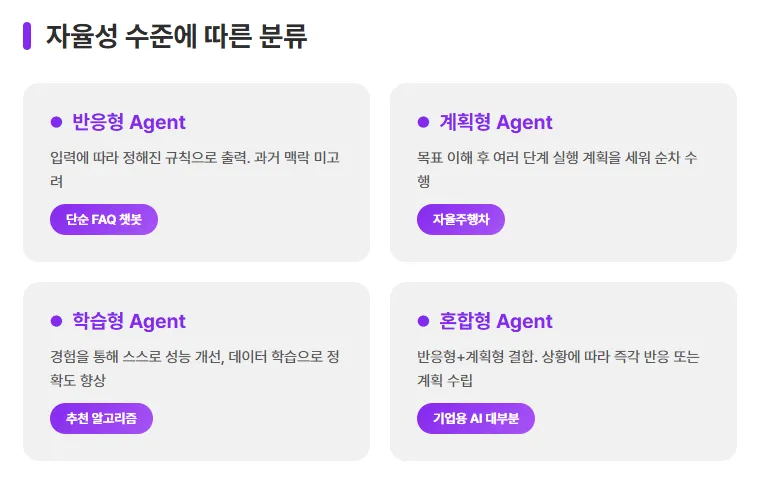
Classified by "how much they judge and act on their own," AI agents fall into four types.
Reactive agents are the simplest. When input arrives, they produce output according to fixed rules. They do not consider past context; a simple FAQ chatbot is an example.
Deliberative agents understand a goal, build a multi-step plan and carry it out in sequence. A self-driving car planning a route to its destination and driving it is a typical example.
Learning agents improve their own performance through experience. Like the recommendation algorithms at Netflix or YouTube, they learn from user behavior data and make increasingly accurate recommendations.
Hybrid agents combine the reactive and deliberative types, responding immediately or making a plan depending on the situation. Voice assistants such as Siri and Alexa are typical examples, and most enterprise AI agents fall into this category.
In enterprise settings, hybrid agents built on RAG (retrieval-augmented generation) are the most widely used. RAG searches internal documents or databases first and then generates an answer based on that information. This greatly reduces the "hallucination" problem, where AI makes up content with no basis.
Multi-agent systems are also drawing attention lately. Like AutoGPT or CrewAI, they are structures in which several specialized agents work together to solve a complex problem. For example, a "market research agent" collects data, an "analysis agent" draws insights from it, and a "report-writing agent" produces the final document.
In short, AI agents can be divided by function and autonomy into task, search, customer service, analysis and creative types, and for enterprise use, RAG-based hybrid agents are the most common.
Seven key checks before your company chooses an AI agent
An AI agent is not a tool; it is a work partner. Adopting one simply because it is "the latest technology" leads to failure. Gartner has reported that 85% of AI projects fall short of expectations. For a successful rollout, check the following seven points.

1. Define the purpose clearly
A vague hope that "things will get better once we have an AI agent" is a shortcut to failure. The first question to ask is "What exactly are we trying to solve?"
Do you want to automate repetitive work? Speed up data analysis? Improve the quality of customer service? Only with a clear purpose can you choose the right type of agent and measure results after rollout.
The Seoul Foundation of Women and Family is a good example. It identified a clear problem, "staff spend too much time looking for internal rules and documents," adopted an AI agent specialized in document search, and cut search time sharply.

2. Put data security and access first
For an enterprise AI agent, security matters most. If sensitive customer information, financial data or trade secrets leak, the company faces financial loss and even legal liability.
These are the points you must confirm:
Can it be installed on-premises? Check that data is processed only on the internal network and does not go out to an external cloud.
Can access rights be managed in detail? You should be able to set different data access rights by department and job level.
Does it keep an audit log? You must be able to trace who looked up which data, when and for what purpose.
General-purpose AI services (ChatGPT, Claude and others) are powerful, but the data you enter is sent to external servers. Organizations where security is critical, such as finance, manufacturing and the public sector, should choose an enterprise solution that supports on-premises installation.

3. Check integration with existing systems
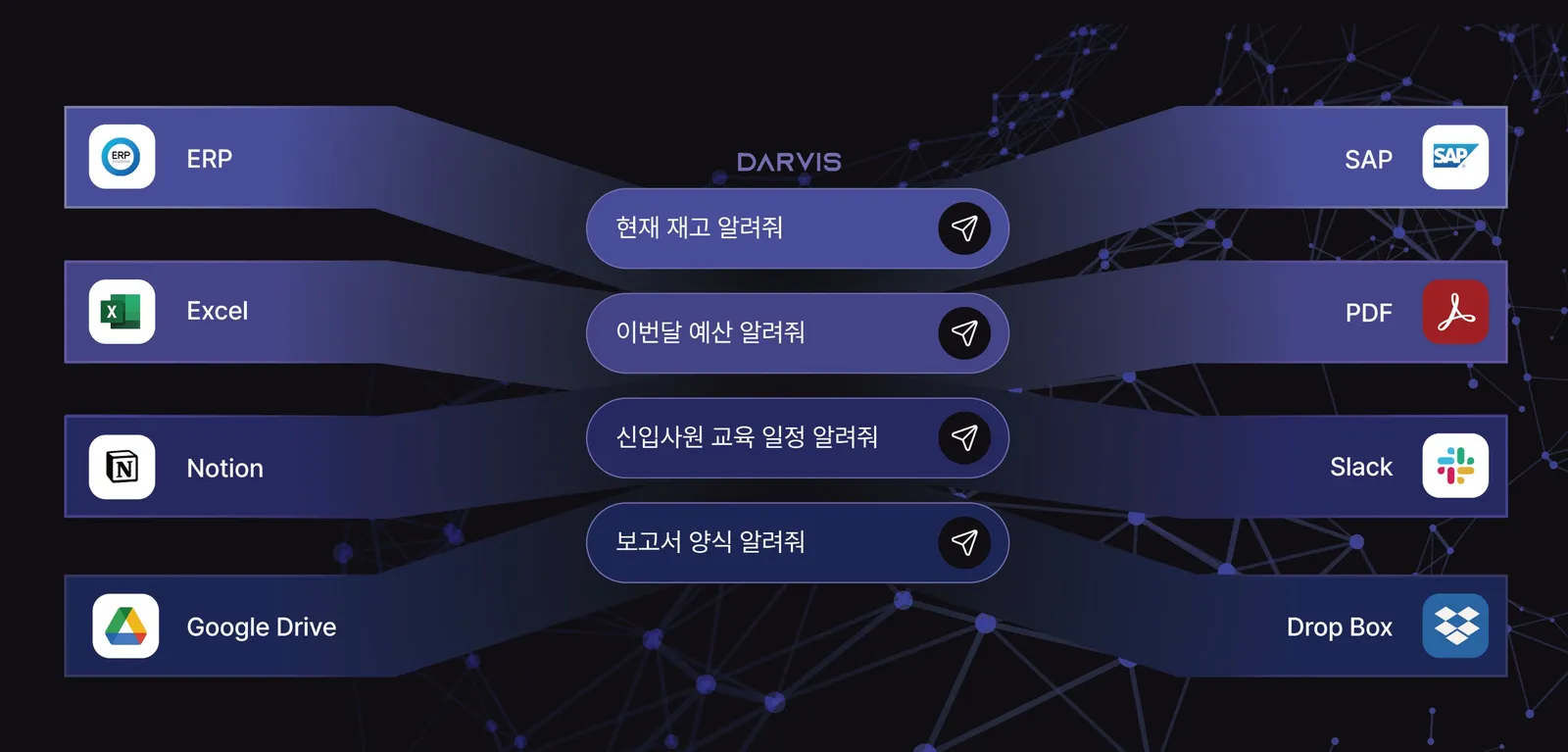
However smart an AI agent is, if it is not connected to the company's internal systems, it is only an "isolated chatbot." Real productivity gains come from integration with existing systems such as ERP, CRM, groupware and document repositories.
These are the integration capabilities to check.
API integration: Can it exchange data in real time with the company's main systems?
Database querying: When you ask a question in natural language, does it generate SQL automatically and query the database?
Document integration: Can it search and use documents stored in Google Drive, SharePoint, Notion and similar tools?
DARVIS's text2SQL technology is a good example. Ask in natural language for "the top five items by quality defect rate last month," and it converts the question into an SQL query and returns an accurate result. Data scattered across multiple systems (ERP, MES, HR and others) can be queried in one go, with AI connecting it logically rather than physically merging it.

4. Context awareness: understanding your company's language
Every company has its own "language": industry jargon, internal abbreviations, names of processes. General-purpose AI does not understand this context, so it either gives off-target answers or has no choice but to say "I'm not sure."
Enterprise AI agents solve this with a RAG (retrieval-augmented generation) structure and domain-specific training. Once trained on internal documents, manuals and past reports, they can answer company-specific questions accurately, such as "Show me last month's defect rate trend in WQMS."
The key is the ability to state the basis for each answer. When the agent cites its source, as in "This information comes from page 17 of the Q3 2024 quality management report," the data becomes reliable enough even for executive reporting.

5. Ease of operation and scalability
An AI agent is not a one-time installation. It has to be managed continuously, expanded to new departments and kept stable as the number of users grows.
The vendor should give clear answers on these three questions.
Can non-developers manage it? Editing prompts, adding documents and setting permissions should be possible without IT specialists.
Is it modular? You should be able to add or remove functions by department, such as quality, HR and sales.
Can it handle more users? Performance should hold when you start with 50 people and expand company-wide to 500.
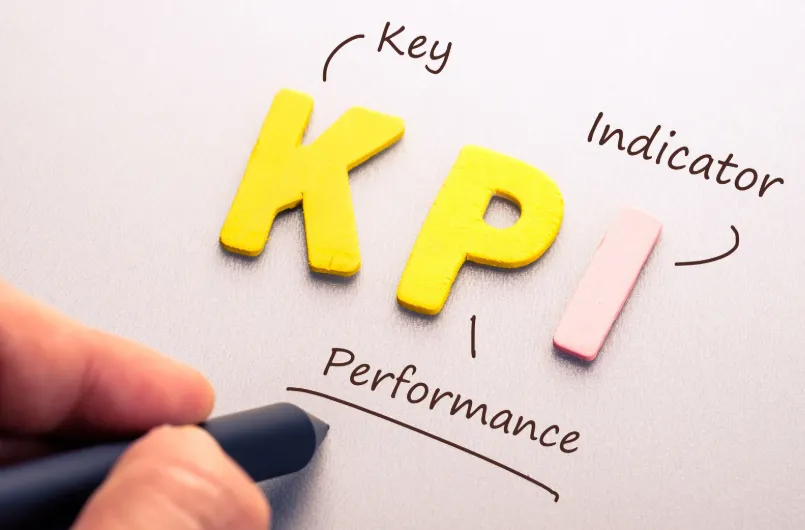
6. Can you measure and improve results?
"Since we adopted an AI agent, staff find their work easier" is good feedback, but not enough to convince executives. You need to prove results with concrete numbers.
There are four KPIs to measure.
Time savings: less time spent searching for information and writing reports
Automation rate: the share of repetitive tasks handled by AI
Accuracy: how correct the AI's answers are (pass rate under human review)
User satisfaction: how much staff actually use it and how satisfied they are
Business PT used an AI agent to cut its trainers' Q&A time and measured the change. Data like this is what justifies further investment or expansion.
7. Cost structure and return on investment (ROI)
AI agent pricing varies widely. There are monthly subscriptions (SaaS), one-time builds (on-premises) and usage-based billing (per token), and each has pros and cons.
Initial costs: licenses, implementation, training
Monthly operating costs: subscription fees, usage charges, maintenance
Hidden costs: customization, system integration, staff training
What matters is an ROI (return on investment) analysis rather than a simple cost comparison. JinPyung Accounting Corporation used an AI agent to sharply reduce repetitive work in tax and accounting consultations for more than 1,000 client companies, which led to lower labor costs for its consultants.
The lesson here is that when choosing an AI agent, "context intelligence" matters more than "technical capability". Success depends on how well the agent understands and responds to your company's language, processes and security requirements.
Recommended AI agent vendors: a guide by company type and situation
The AI agent market has many players competing, from global big tech to Korean startups. What matters is not who is famous but whether it fits your company's situation. Below are solutions worth reviewing by company size and purpose.
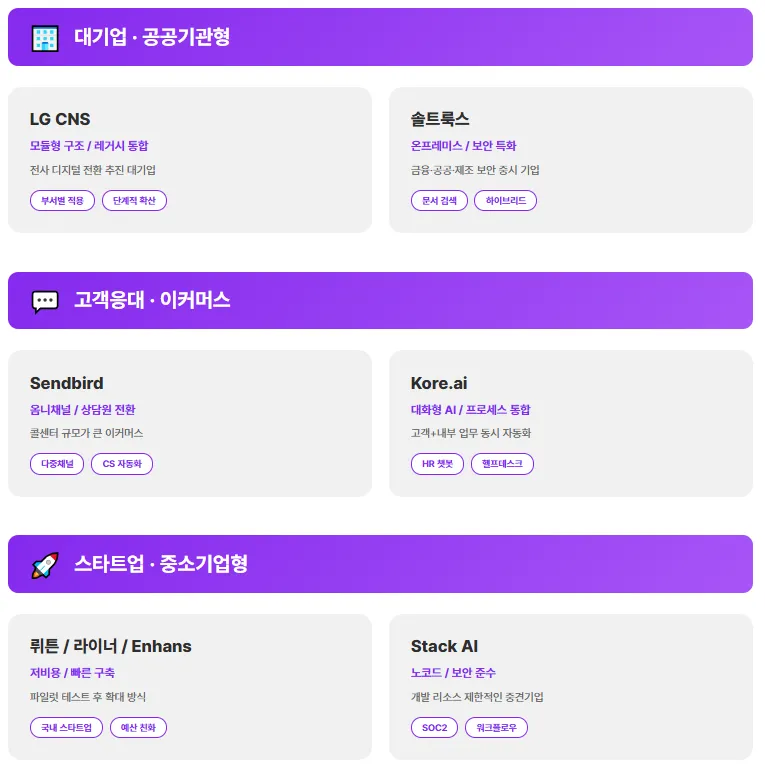
Large enterprises and public institutions: organizations that need complex system integration
LG CNS - AgenticWorks
Released in August 2025, LG CNS's AgenticWorks has a modular structure as its biggest strength. Companies can apply only the functions each department needs, such as HR, sales, customer support and production management. LG CNS has carried out many large system integration projects, which gives it an edge with large companies that run complex legacy systems.
Good fit: large companies pursuing company-wide digital transformation, and organizations that want to roll out AI agents to departments in phases
Saltlux
Saltlux, a Korean AI company with long experience in enterprise search and knowledge management, supports on-premises, cloud and hybrid deployment through its Goover Enterprise product. Its on-premises option is a particular strength in security-sensitive sectors such as finance, the public sector and manufacturing.
Good fit: organizations where internal document search and report automation are important, and financial and public institutions under strict security regulations
Companies focused on customer service and e-commerce
Sendbird
Sendbird, originally a communication API company, has recently strengthened its AI customer service agent features. It manages multiple channels such as web, app and messenger in one place, and handles the switch between AI responses and human agents smoothly.
Good fit: e-commerce, finance and healthcare companies with large call centers or customer support teams
Kore.ai
The global chatbot platform Kore.ai is strong in conversational AI and business process integration. Beyond customer service, it also covers chatbots for internal staff (HR inquiries, IT help desk and so on).
Good fit: mid-sized and larger companies that want to automate customer service and internal work at the same time
Startups and SMEs: fast experiments and low-cost adoption
Wrtn, Liner, Enhans
Korean AI agent startups have low initial costs and fast setup. They suit an approach where you run a pilot in a few departments and expand once the results are clear.
Good fit: startups with limited budgets that want to try AI agents first, and SMEs that want to start with a specific team
Stack AI
Stack AI lets you build workflows with no-code/low-code tools and can be set up quickly while meeting security standards such as SOC2 and GDPR.
Good fit: mid-sized companies where security matters but development resources are limited
DFINITE's DARVIS: an enterprise AI agent that covers both security and data connection
If you are considering the companies above, reviewing DFINITE's DARVIS as well will help you compare. For security-sensitive companies in particular, it can serve as a good reference point.
"Our company's data can't leave the building. So how do we use AI?"
This is the biggest concern for many people in charge of the decision. The more security matters to an organization, as in manufacturing, finance and the public sector, the more it hesitates to adopt AI. DARVIS is the answer to exactly this problem.
What makes DARVIS different?
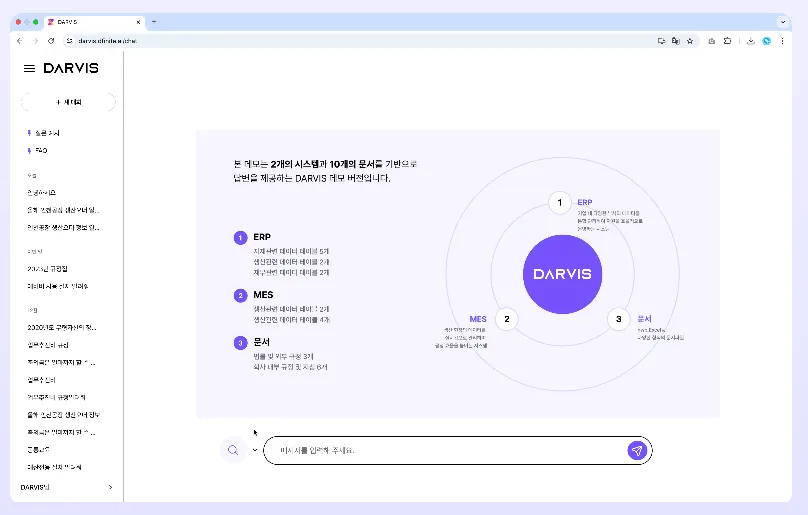
DARVIS is not a simple chatbot but an "enterprise data intelligence system". Without physically merging the data in a company's scattered systems (ERP, MES, HR, quality management and others), AI connects it logically and answers immediately when you ask in natural language.
For example, if someone on the quality team asks, "Show me the defect rate trend on Line A over the past three months and the main causes," DARVIS will
pull defect data from the quality management system (WQMS),
pull production volume data from the manufacturing execution system (MES),
combine the two to calculate the defect rate,
search past reports for patterns in the main causes, and
generate a summary report with visualized charts.
The whole process is automatic. In the past, querying each system separately, organizing the data in Excel and writing the report would have taken at least two to three hours.
Three key differentiators of DARVIS
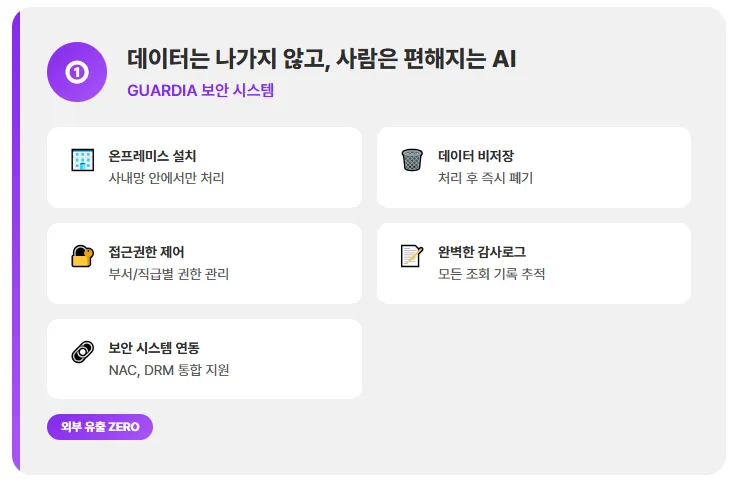
① AI that keeps data in and makes work easier for people: the GUARDIA security system
DARVIS's biggest strength is the GUARDIA security system. Many companies avoid general-purpose AI services because the data they enter is sent to external servers. DARVIS solves this problem as follows.
On-premises installation: All processing happens inside the internal network. Data does not leave.
No data storage: DARVIS returns only the result after processing a question and discards the source data immediately. It does not keep data for training or storage.
Fine-grained access control: Different data access rights can be set by department and job level. HR staff can see only HR data, and the quality team only quality data.
Complete audit log: Every record is kept of who asked what, when, and using which data. This makes tracing possible during a security audit.
Integration with existing security systems: It works with existing security infrastructure such as NAC (network access control) and DRM (digital rights management). Access is possible only from registered devices and IP addresses.
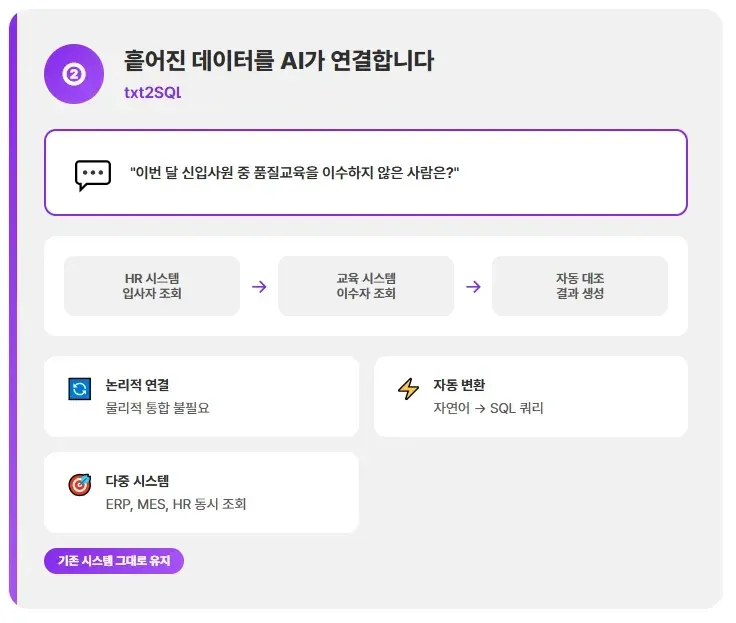
② AI connects scattered data: txt2SQL technology
Most companies run several systems such as ERP, CRM, MES, HR and quality management. The problem is that these systems are not connected to one another, so to see combined data you have to query each one by hand and merge the results manually.
DARVIS's txt2SQL technology solves this. It automatically converts natural-language questions into SQL queries and logically connects data from multiple systems.
For example, if you ask, "Which new hires this month have not completed quality training?"
it pulls the list of this month's new hires from the HR system,
pulls the list of people who completed quality training from the training management system, and
compares the two to produce a list of those who have not completed it.
All of this happens automatically. The important point is that this is a logical connection, not a physical integration. The existing systems are left untouched, and the AI reads and connects the data whenever it is needed.
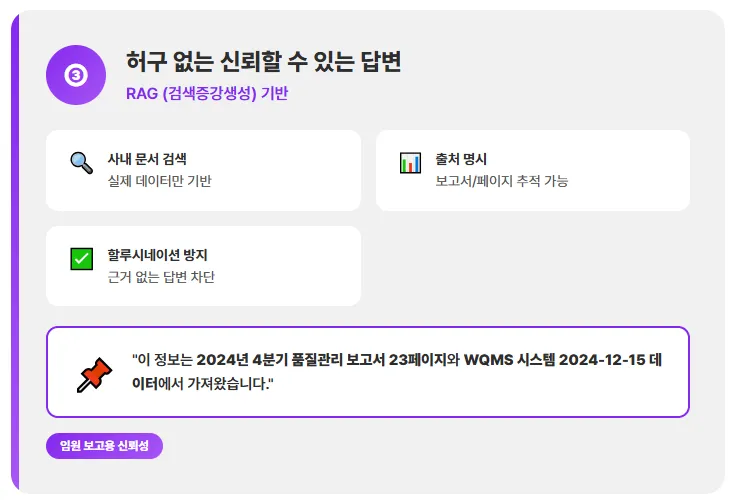
③ Reliable, fabrication-free answers based on RAG
The biggest problem with generative AI is "hallucination": producing plausible-sounding content with no basis. For data used in management reporting or decision-making, this is simply unacceptable.
DARVIS solves this with a RAG (retrieval-augmented generation) structure. When a question comes in, it first searches internal documents and databases, then generates an answer based only on information that actually exists. It also cites the source in every answer.
"This information comes from page 23 of the Q4 2024 quality management report and WQMS system data from 2024-12-15."
With the basis this clear, the answer can be trusted even for executive reports.
Results from DFINITE DARVIS deployments
📌 Seoul Foundation of Women and Family: administrative efficiency at a public institution

Background: Headcount grew from 100 to 220 and the budget from KRW 10 billion to KRW 40 billion, yet administrative staff were actually short. Employees wasted time several times a day just looking for internal rulebooks, ordinances and budget materials.
The DARVIS solution: The AI was trained on more than 60 internal documents (rulebooks, ordinances, manuals, reports). Staff can now ask questions in natural language, such as "What is the procedure for applying for parental leave?" or "What is this year's budget execution rate?"
Results with DARVIS
More accurate document search
Information search time cut sharply
Many repeat inquiries to the welfare department automated
Working time freed up for the staff in charge
📌 Business PT: supporting instructors on an education platform

Background: On this education platform, which runs more than 200 VOD courses, trainers spent a lot of time answering students' questions. The same questions came up again and again, and trainers had to check course content one item at a time.
The DARVIS solution: The AI learned the content of the 200 courses and now answers student questions automatically or gives trainers a draft answer.
Results with DARVIS:
Q&A time cut sharply
Much lighter workload for trainers
Higher student satisfaction (faster responses)
📌 JinPyung Accounting Corporation: automating consultations in professional services

Background: At this large accounting firm, with more than 1,000 client companies including Woowa Brothers and Krafton, repetitive tax and accounting questions (how to keep books, tax filing schedules and so on) took up a large part of consultants' work.
The DARVIS solution: The AI was trained on tax and accounting expertise. It answers general questions automatically and routes only complex cases to expert consultants.
Results with DARVIS:
Far less repetitive work for consultants
Expert consultants focus on difficult cases
Shorter wait times for clients
Which companies DARVIS fits
DARVIS is especially well suited to the following organizations.
Manufacturing: environments that need to query and analyze data from multiple systems, such as quality, production and equipment, in real time
Finance and public institutions: organizations where security comes first and data must never leave
Large enterprises: organizations that run complex ERP, MES and HR systems and struggle with data silos between departments
Knowledge-intensive companies: organizations with huge volumes of internal documents, manuals and reports, where staff spend a lot of time searching for information
AI agents are a matter of competitiveness, not technology
AI agents are no longer a "future technology." Right now, many companies are using AI agents to work more efficiently, cut costs and make faster decisions.
What matters is which AI agent you choose. Don't be swayed by flashy demos. Evaluate these three things with a cool head.
1. Is our company's data safe? Check that on-premises installation, access control and audit logs are provided.
2. Does it connect to our existing systems? Without integration with ERP, CRM and document systems, you cannot expect real productivity gains.
3. Does it understand our company's language? It has to be AI that understands the context of your industry and your company, not general-purpose AI.
Corporate competitiveness from here on will be decided by how well companies use AI agents. Beyond short-term work automation, the organizations that survive will be those that achieve three things at once: reliable data + efficient work + a better employee experience.
AI agents like DARVIS, which understand a company's context deeply, keep data secure and logically connect scattered data, are what create real competitiveness. "Faster work for staff, more accurate decisions for leaders, and systems left as they are." That is the all-around ROI DARVIS delivers.
If you'd like to learn more about AI and DARVIS, see the related posts below or use the "Request a consultation" button below. We will keep working to bring you useful information. Thank you.
We join scattered data with an ontology, flag what drifts first, and keep the evidence behind every decision.