
2025 guide to internal-network generative AI: security and performance
How to run generative AI inside a separated internal network, with cases from Shinhan Bank, KISTEP and others, and the on-premises DARVIS solution.
You want to use generative AI, so why the hesitation?
It has been two years since generative AI with remarkable performance, such as ChatGPT, Claude and Gemini, took the world by storm. It is showing real impact in almost every area: writing documents, analyzing data, answering customers and even creative work.
Yet many companies and public institutions are still hesitant to adopt generative AI. The reason is clear: they worry about sensitive information leaking.
Financial firms, medical institutions and public agencies have no choice but to be especially careful. They cannot accept the risk of customer personal data, corporate secrets or important national information leaking through an external AI service.
The bigger problem is network separation. Employees who work on an internal network fully separated from the internet for security reasons simply cannot use external cloud-based generative AI services. In a network-separated environment, access to AI services is blocked altogether.
As the security requirement that "our data must be processed only inside our walls" keeps getting stronger, do these organizations have to give up on the benefits of generative AI?
Can you build generative AI on an internal network?
The answer is "yes." The way to do it is generative AI built on-premises for the internal network. The AI model is installed and run directly on the company's own servers, with no external internet connection.
By using open-source LLMs and connecting them to the company's internal data, you can build a fully in-house generative AI environment on the internal network. An on-premises AI system built this way gives you all the same functions you get with ChatGPT.
Intelligent chatbot: answers questions about internal rules and work manuals
Document summarization: automatic summaries of meeting minutes, reports, contracts and more
Data search: queries complex databases in natural language
Report writing: generates documents automatically from data analysis results
Idea generation: supports creative work based on company-specific data
This solution, which you could call an internal-network GPT, delivers the full generative AI experience inside the company with no external dependencies.
Why does running on the internal network matter?

Complete data security
The most important reason is information security. With an AI service built on the internal network, all data is processed only on the company network, so information leaks can be blocked at the source.
Because you can use the AI service with no transfer to the cloud at all, there is no need to worry, "Did our company secrets just go outside?"
Full integration with existing systems
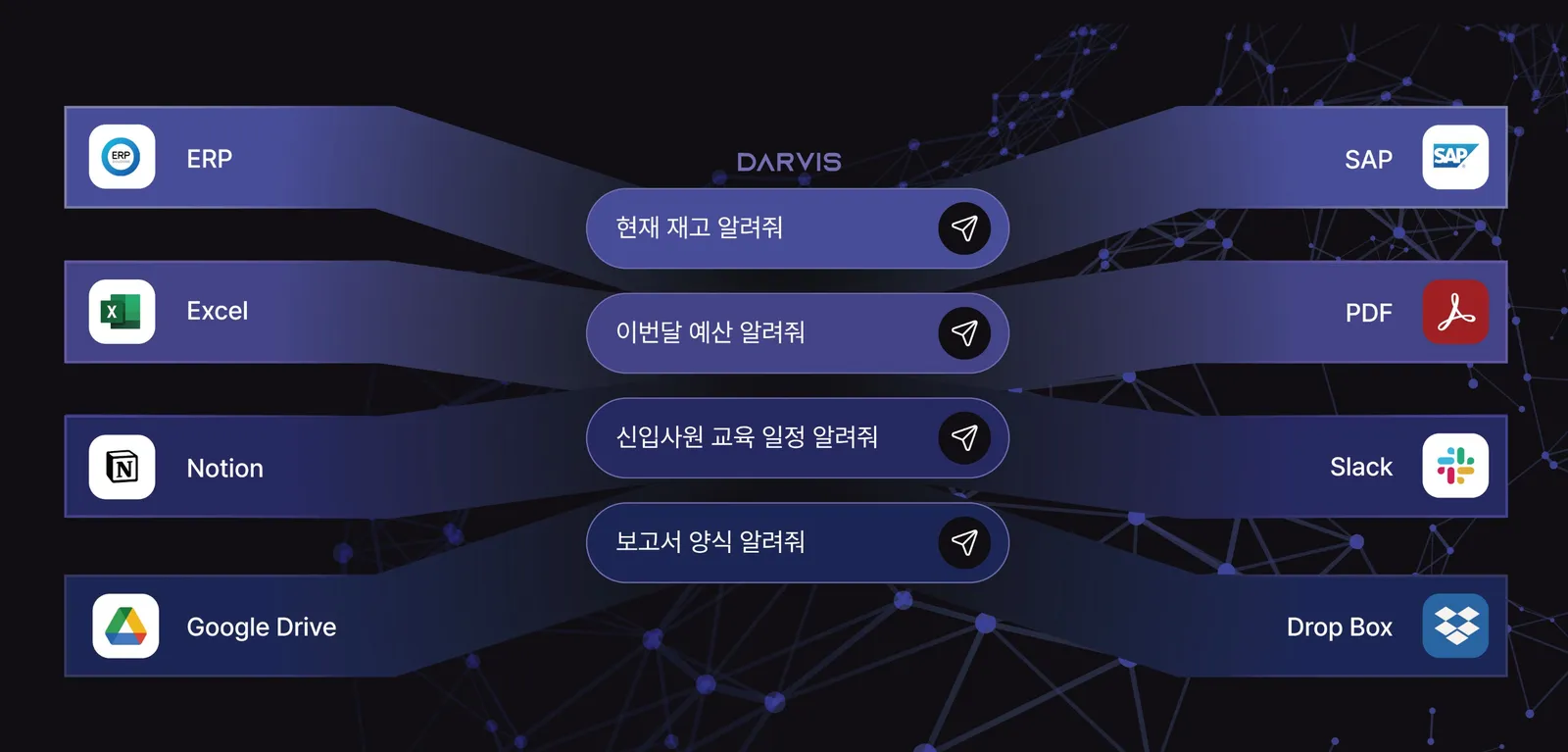
Another advantage of internal-network AI is natural integration with existing infrastructure. It can connect directly to the internal systems the company already uses, such as ERP, CRM and groupware.
Ask it to "analyze last year's sales data," and it can pull the data from the ERP system in real time and give you the analysis.
Consistent security policy
You can add AI functions while keeping internal security rules, access-rights policies, audit-log systems and the like exactly as they are. There is no need to build a new security framework; you simply apply your existing information security policy to the AI.
This is the most reliable way to prevent AI data leaks.
Examples of generative AI on internal networks
Many companies and institutions already use generative AI on their internal networks, and the number of cases keeps growing.
Finance leads the way
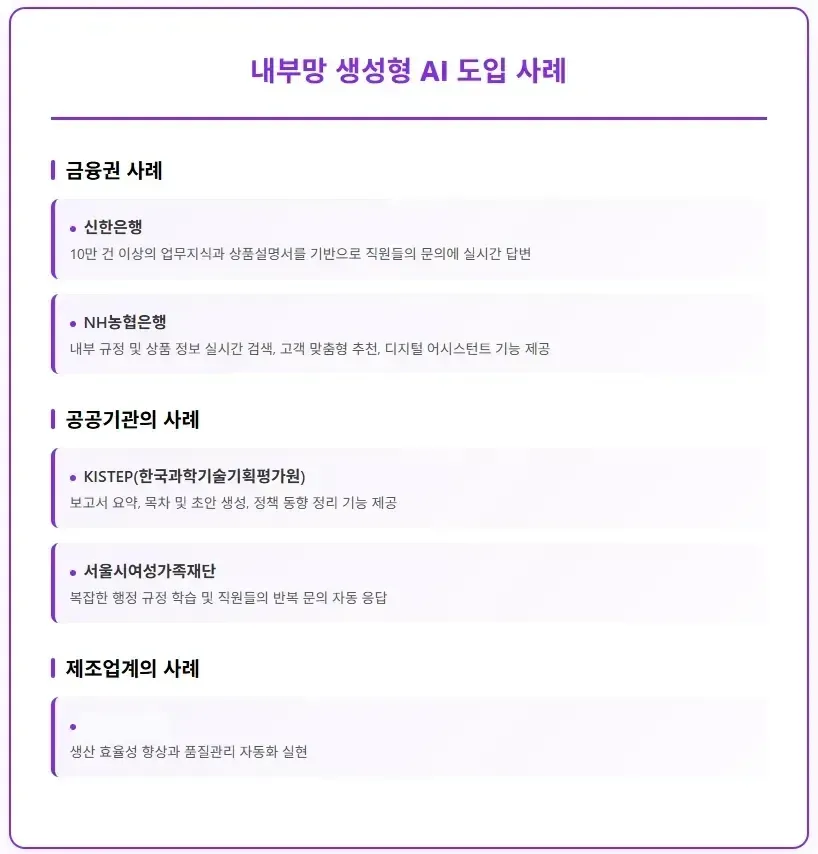
Shinhan Bank brought a ChatGPT-based enterprise generative AI service onto its internal network. It answers staff questions in real time based on more than 100,000 items of work knowledge and product descriptions.
The bank upgraded its old keyword-search chatbot with ChatGPT and retrieval-augmented generation (RAG), which greatly improved work efficiency, and it also strengthened its security infrastructure under a special exemption from the network separation rules.
NH NongHyup Bank has also adopted a generative AI platform that runs on its internal network. It brings the bank's own accumulated financial work data and experience into the AI system, offering real-time search of internal rules and product information, personalized customer recommendations and digital assistant functions.
Staff are reportedly using AI agents actively in their daily work, for example to write work reports quickly.
A new approach in the public sector
In February 2025, KISTEP (Korea Institute of S&T Evaluation and Planning) introduced its own generative AI service, KISTEP-GEN, on its internal network. Built on the specialized language model SPARK, it is used for summarizing reports, generating outlines and drafts, summarizing policy trends and more.
Notably, all data processing happens only on the internal network, and no external APIs or commercial clouds are used at all. Because it runs in a closed network cut off from the outside with no risk of information leaks, it is regarded as a leading example of building GPT securely.
The Seoul Foundation of Women and Family has also introduced an internal-network chatbot: the AI learned more than 60 complex administrative rules, and the system answers staff's repeat questions automatically.
Practical use in manufacturing
Company W, an auto parts manufacturer, uses internal-network AI to analyze data from systems spread across several plants and its headquarters in one place, improving production efficiency and automating quality management.
Deployments like these, which secure both security and real-world results, keep growing across industries.
The best solution for internal-network generative AI: DARVIS
At the core of these success stories is a well-tested technical solution: DFINITE's DARVIS. DARVIS provides a complete solution for building generative AI on an internal network. Its main features are as follows.
A complete combination of core technologies
DARVIS fully supports TEXT2SQL + RAG + on-premises environments.
TEXT2SQL: "Show me this year's top 10 products by sales" → SQL generated and run automatically
RAG: learns all internal documents to give accurate answers
On-premises: a fully secure environment that runs on the internal network
A dedicated GPT agent that works with your company's data
Rather than a simple chatbot, you can set up a dedicated GPT agent trained on the company's own data and knowledge. It learns the company's rules, manuals, customer information, product data and more, and can be used as an AI assistant built for your business.
Complete security and management
Internal system integration: connects fully with existing systems such as ERP, CRM and HRM
Data disposal principle: all input data is deleted immediately after processing
Fine-grained permission control: different access rights by department and job level
Complete audit log: every AI request and response can be traced
Field-tested deployments
DARVIS is already in real use in finance, the public sector and manufacturing.
The Seoul Foundation of Women and Family cut information search time sharply, and Business PT greatly reduced Q&A handling time.
Considering generative AI on your internal network?
Building generative AI on the internal network is how you get the innovative benefits of generative AI while keeping security airtight.
There is no longer any need to deepen your dependence on the cloud or to worry about data leaks. The time has come when companies can achieve AI innovation while protecting their digital sovereignty.
Build a safe, smart internal-network GPT environment with DARVIS. We will fully support your company's AI transformation with well-tested technology and extensive deployment experience.
If you would like information on DARVIS along with more AI insights, use the "Request a consultation" button below. We will help you through the whole process, from adopting and building AI to putting it to work. Thank you.
We join scattered data with an ontology, flag what drifts first, and keep the evidence behind every decision.