
2026 AI Voucher guide for applicants: from choosing a supplier to applying
Preparing for Korea's 2026 AI Voucher: finding a pool supplier, eligibility, schedule, process, and selection. Up to KRW 200 million; mid-sized firms eligible.
This guide covers the 2026 application round, which closed on March 30, 2026. Dates, amounts and procedures may differ in later rounds; check the current notice before applying.

Applying for the AI Voucher and not sure where to start?
You know the AI Voucher program (a Korean government subsidy run by NIPA) exists, but when you actually try to apply, you hit a few walls.
You have to apply in a consortium with a supplier, but you don't know where to find one.
Hundreds of companies are registered in the pool, so picking one that fits your industry is not easy.
You hear the business plan has to be written with the supplier, but you have no idea how to begin.
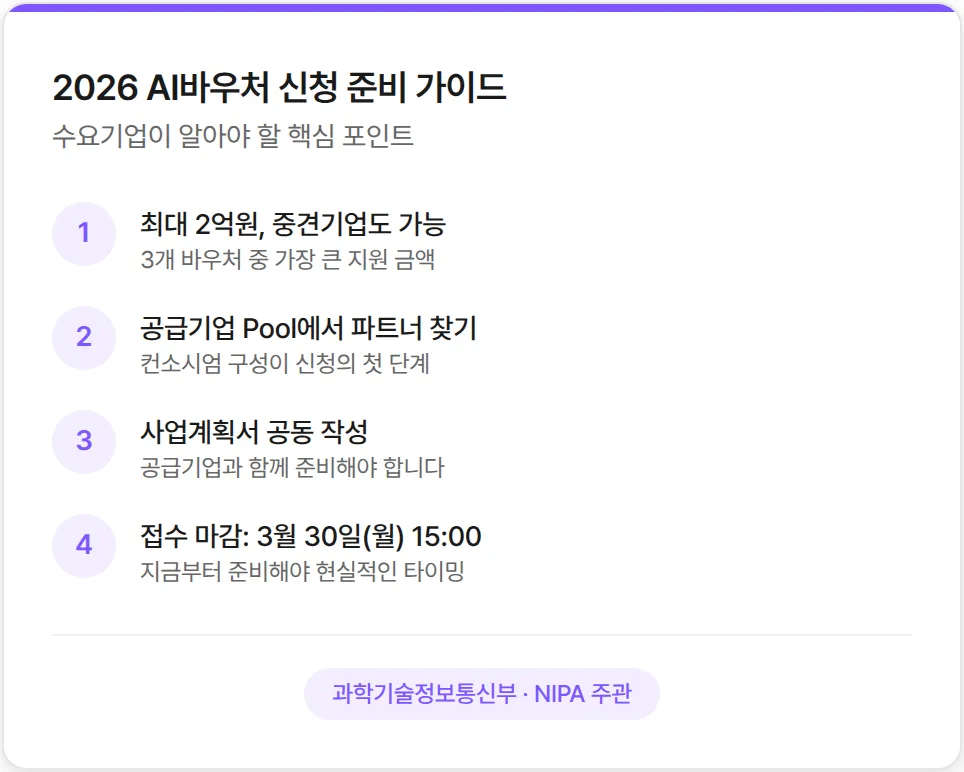
The AI Voucher offers up to KRW 200 million, and mid-sized companies can apply too, so it has a wide range of uses. But you cannot apply alone. You need to find a suitable supplier and prepare together.
This article covers, from the demand company's point of view, what exactly the AI Voucher is, who can apply, how to find and choose a supplier, and the application process and selection criteria.
What is the AI Voucher?
The program's official name is the "AI Voucher Support Program, part of the 2026 Integrated AI Voucher Support Program". It is overseen by the Ministry of Science and ICT and run by the National IT Industry Promotion Agency (NIPA).
Under the AI Voucher, the government provides up to KRW 200 million to demand companies, meaning businesses that want to adopt an AI solution. When a demand company applies in a consortium with a specialist company that has its own AI solution (the supplier), the government supports the cost of adopting the solution with a voucher.
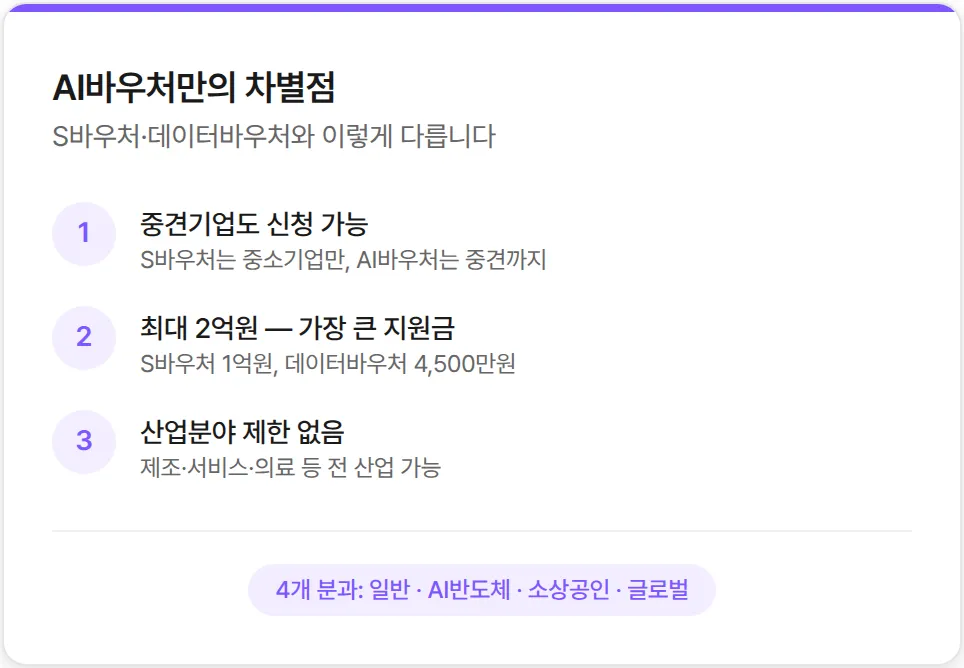
The structure is similar to the S-Voucher and Data Voucher programs that run at the same time, but the AI Voucher has its own distinguishing features.
First, mid-sized companies can apply. The S-Voucher is open only to startups, venture companies, and SMEs, but the AI Voucher also accepts mid-sized companies as demand companies. For a manufacturer with sizable revenue, the AI Voucher may be the better fit.
Second, at up to KRW 200 million, it offers the largest funding. Compared with the S-Voucher (up to KRW 100 million) and the Data Voucher (up to KRW 45 million), the AI Voucher lets you run the largest-scale projects.
Third, there are no industry restrictions. Companies in any industry, including manufacturing, services, and healthcare, can apply.
The AI Voucher runs in four tracks (General, AI Semiconductor, Small Business, and Global), and manufacturers that want to adopt an AI-based solution usually apply to the General track.
What benefits does the AI Voucher offer?
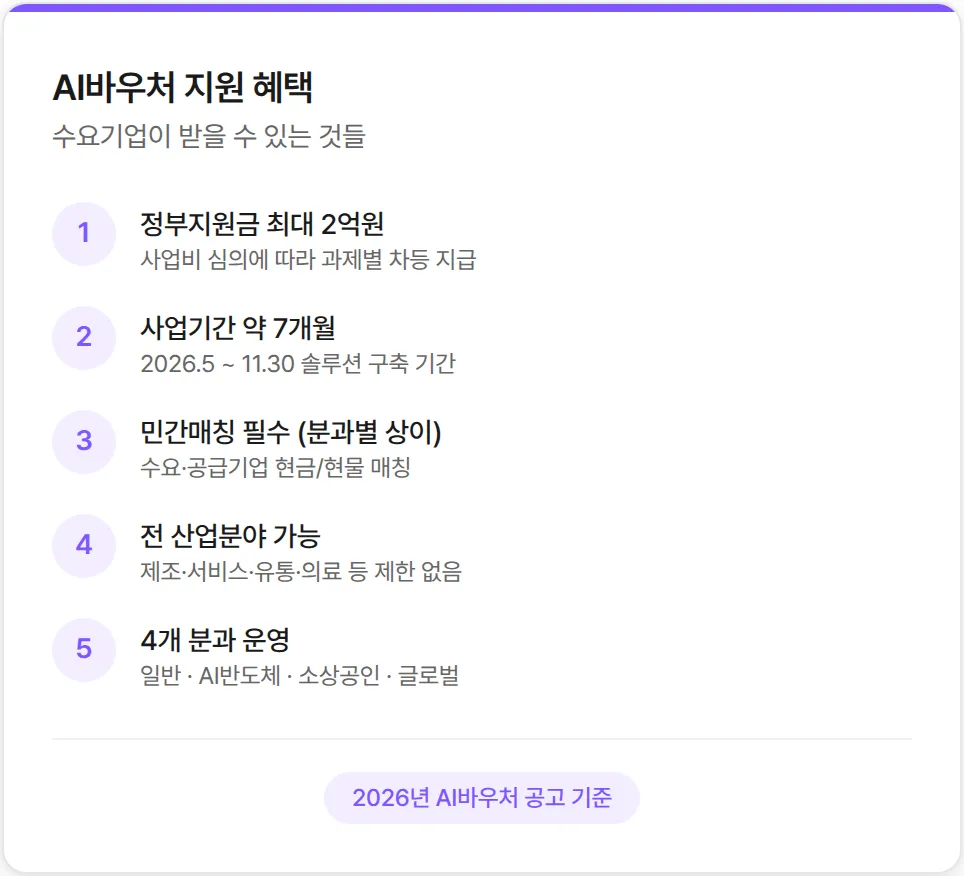
Government funding under the AI Voucher is up to KRW 200 million per project. Demand companies can use the voucher to adopt a supplier's AI solution. The project period runs from May 2026 to November 30, about seven months in total.
The scope of support is broad as well. Labor costs and cloud fees for developing and customizing the AI solution can be charged to the project budget. With no industry restrictions, companies in any sector, not only manufacturing but also retail, logistics, and healthcare, can apply if they need to adopt an AI solution.
However, demand companies and suppliers must provide private matching funds (cash or in kind). The exact matching ratio differs by track, so be sure to check the application guide for your track.
One thing to keep in mind: after a project is selected, the actual amount paid can be adjusted based on the budget review. The maximum of KRW 200 million is not granted automatically.
Key points
Government funding: up to KRW 200 million per project
Project period: May 2026 to Nov. 30 (about 7 months)
Private matching: cash/in-kind matching by demand and supply companies required (varies by track)
Industries: no restrictions; all industries eligible
Four tracks: General, AI Semiconductor, Small Business, Global
Who can apply for the AI Voucher?
Demand companies
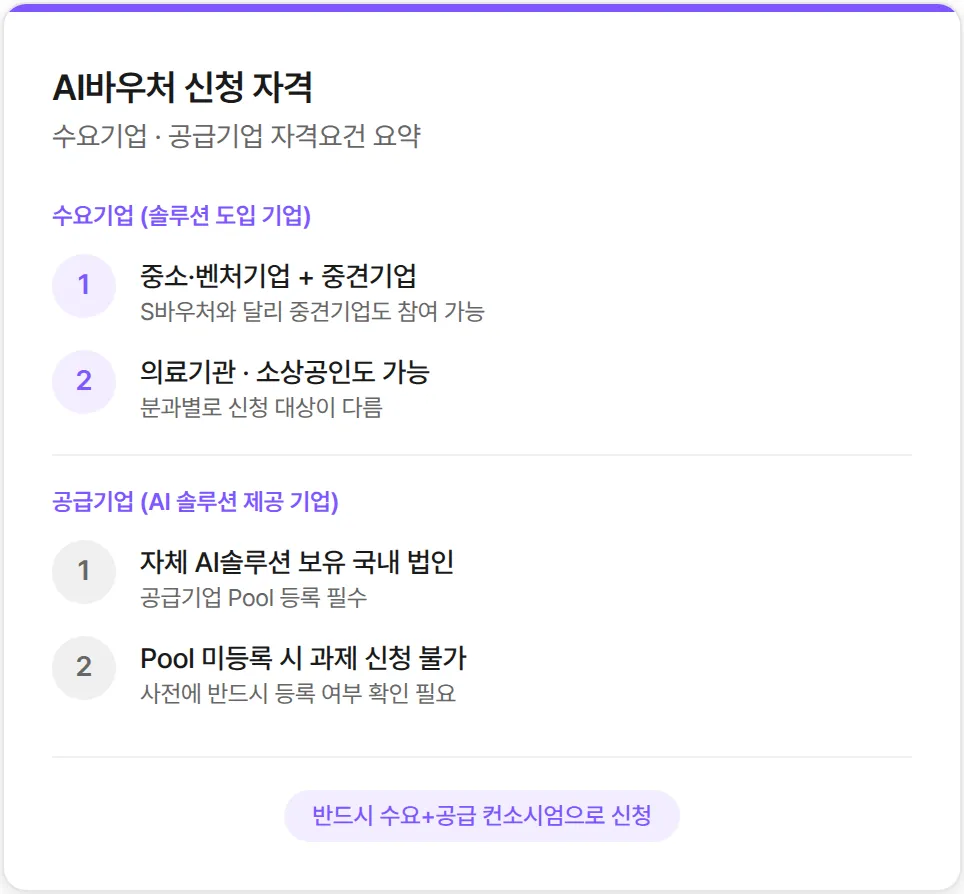
Companies eligible to apply as AI Voucher demand companies are those that want to buy an AI solution and use it in their own products and services. The range of eligible demand companies is wide. Specifically, it includes Korean SMEs and venture companies, mid-sized companies, medical institutions as defined by the Medical Service Act, and small businesses.
The important point here is that mid-sized companies can take part. The S-Voucher is limited to startups, venture companies, and SMEs, so mid-sized companies could not join, but the AI Voucher includes them. A manufacturer with revenue of KRW 50 billion or more should consider the AI Voucher.
Demand companies must apply in a consortium with a supplier. Applying alone is not allowed.
Suppliers
A supplier is a Korean AI company (a corporation) with its own AI solution, and it must be registered in the supplier pool run by NIPA. You cannot apply for a project with a company that is not in the pool.
DFINITE has carried out a variety of projects at sites across a range of industries with DARVIS, its AI solution for solving operational problems.
Disqualifications
You cannot take part if the demand company and supplier share the same representative or have representatives who are related parties, if either has unpaid national or local taxes, or if either already receives support from another government ministry for the same or a similar project.
Eligibility at a glance
Demand companies: SMEs and venture companies, mid-sized companies, medical institutions, small businesses, etc.
Suppliers: Korean corporations with their own AI solution + supplier pool registration required
Must apply as a demand + supply consortium (no solo applications)
Not eligible: same representative, tax arrears, duplicate funding for the same or a similar project, etc.
2026 AI Voucher application schedule and process
Schedule
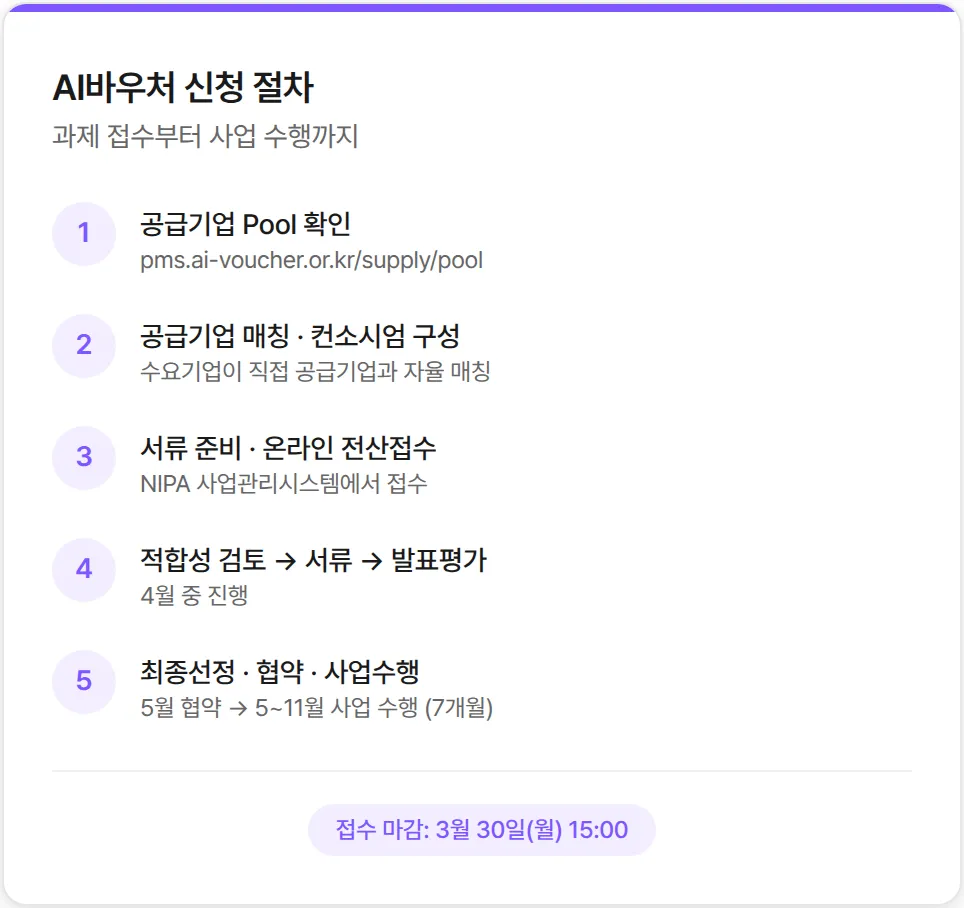
Stage | Date |
|---|---|
Announcement | Feb. 27, 2026 (Fri) |
Online applications open | Mar. 16, 2026 (Mon) |
Application deadline | Mar. 30, 2026 (Mon), 15:00 |
Evaluation and agreements | April (eligibility, document, and presentation reviews) |
Final selection and agreements | May |
Project execution | May to November (about 7 months) |
The deadline falls three days after the S-Voucher's (March 27), but once you allow time to match with a supplier and prepare documents, there is not much slack. The AI Voucher application deadline is Monday, March 30, 2026, at 15:00. Starting now is the realistic choice.
How do you find and choose an AI Voucher supplier?
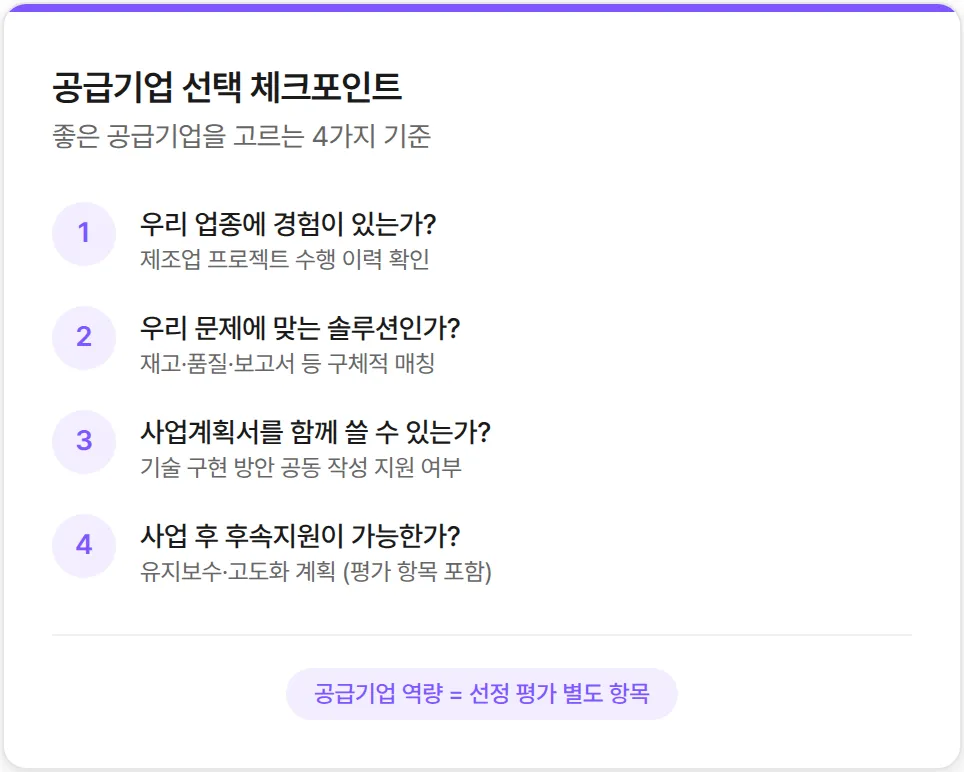
To apply for the AI Voucher, you must form a consortium with a supplier. But when you actually open the AI Voucher supplier pool, you find hundreds of registered companies. Naturally, you start wondering which one is right for you.
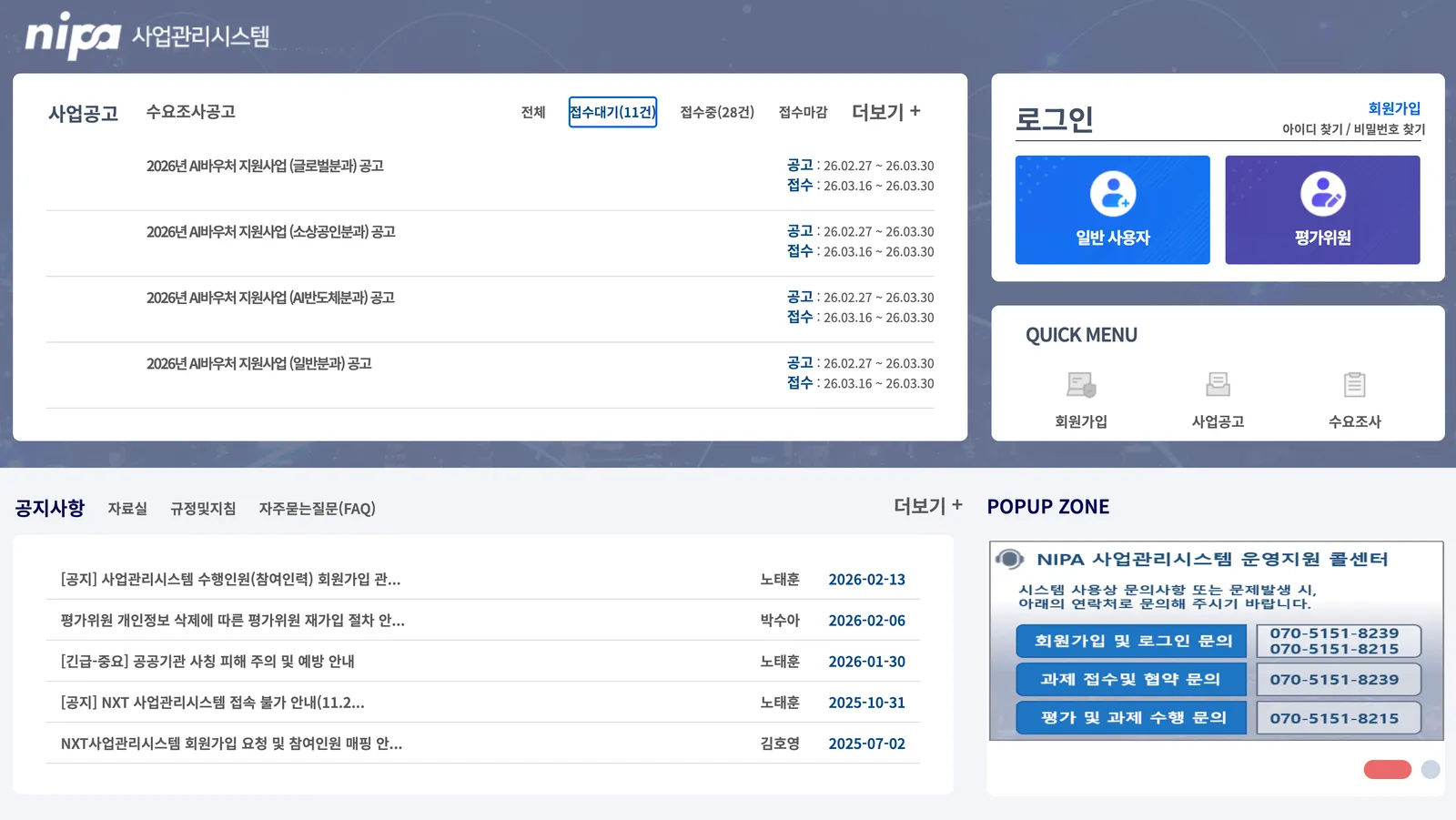
You can browse the AI Voucher supplier pool in NIPA's AI Voucher project management system (pms.ai-voucher.or.kr/supply/pool). You can search by company name, solution name, application area, and more.
There are a few things to check when choosing a supplier.
First, does it have experience in your industry? Not all AI solutions are the same. A company that understands manufacturing data structures and operational problems delivers results of a different quality from one that does not. It is worth checking whether it has a track record of manufacturing projects.
Second, is the solution right for the problem you want to solve? "AI solution" covers a lot of ground, so the right order is to first pin down the specific problem your company wants to solve (inventory optimization? quality analysis? report automation?) and then look for a supplier with a solution for that problem.
Third, can it write the business plan with you? An AI Voucher application requires a project execution plan, which is hard for a demand company to write alone. Because the plan has to spell out how the solution will be implemented technically and what benefits to expect, it is usually written together with the supplier. Check whether the supplier actively supports this process.
Fourth, can it provide follow-up support after the project? Building the solution during the seven-month project period is not the end; maintenance and upgrades are needed afterward. It matters enough that a "follow-up support plan" is one of the evaluation items.
It is no exaggeration to say that the choice of supplier decides whether the project succeeds. In the selection evaluation, "supplier capability" is scored as a separate item. Finding a good supplier is the first and most important step in applying for the AI Voucher.
DFINITE has experience carrying out a range of AI projects, including quality analysis, inventory optimization, and report automation, at sites across many industries. We can prepare with you from forming the consortium and writing the business plan through to carrying out the project.
What projects are possible with the AI Voucher?
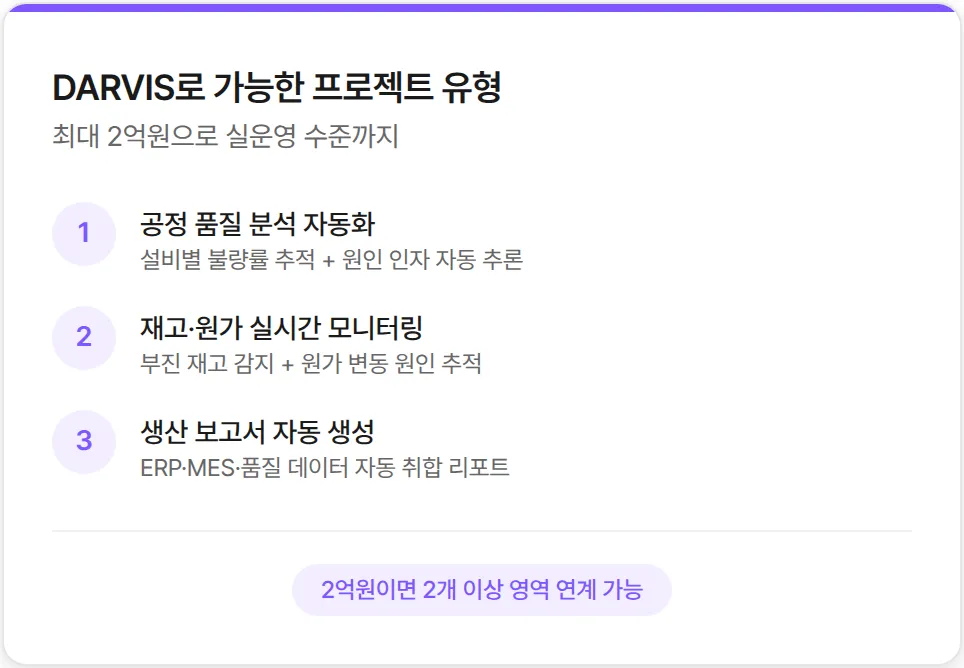
Here are some examples of projects you could carry out with DFINITE through the AI Voucher.
With up to KRW 200 million and seven months to work with, the AI Voucher lets you go beyond a PoC (proof of concept) that only checks whether AI works, and build a system good enough to run in day-to-day operations.
For example, these are the project types in highest demand in manufacturing.
First, automating process quality analysis. This means building a system in which AI automatically tracks defect rates by equipment and process, infers the most strongly correlated factors, and recommends actions. AI takes over the manual Excel analysis that engineers used to do.
Second, a real-time inventory and cost monitoring dashboard. It connects data scattered across ERP, MES, quality systems, and more, and sets up an environment for detecting slow-moving inventory and tracing the causes of cost changes in real time. Ask in Korean, "Which materials saw operating margin fall from last month?" and the AI runs the query automatically and analyzes the cause as well.
Third, an automatic production report system. AI automates the repetitive work of pulling data by hand from several systems every time a monthly or weekly report is due.
With the S-Voucher (up to KRW 100 million), you have to focus on one of these areas, but with the AI Voucher (up to KRW 200 million), you can link two or more. For example, you could bundle "quality analysis automation + automatic report generation" into a single project.
You can find more about DARVIS, DFINITE's AI solution, in our service brochure (in Korean).
DFINITE is solving these problems in the field
Here are projects DFINITE has actually carried out at manufacturing sites.
Company H: carbon fiber manufacturing
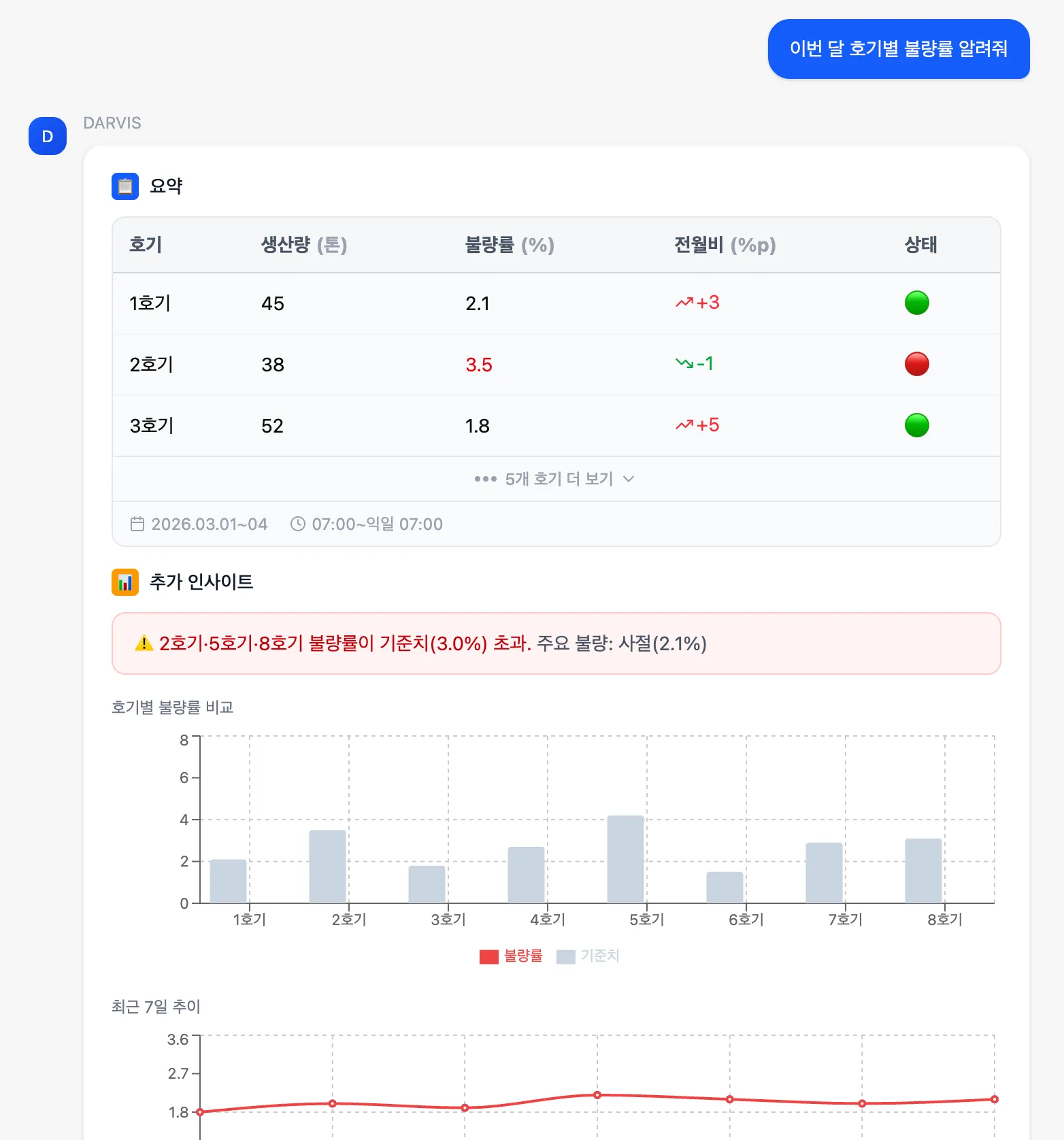
Company H had already invested heavily in an integrated big data system. Plenty of data had accumulated. The problem was actually putting that data to use.
When a defect occurred, the cause had to be traced, and the process went like this: pull defect data from the quality system, pull equipment data for that point in time from the process system, pull raw material information from yet another system, then paste it all into Excel and compare. The data was in the systems, but there was no way to connect it and see it in one place. Tracing the cause of a single defect often took half a day or more.
The biggest change after adopting DARVIS was in this tracing time. Work that used to take hours became much faster.
In the chat interface, you can now ask "Show me this week's defect rate for Unit A" and the AI automatically queries data from several systems, with a detailed analysis by defect type and action guidance for items over the threshold, all on one screen.
The production department in charge said its efficiency had improved beyond comparison with before.
Company L: electronic components manufacturing
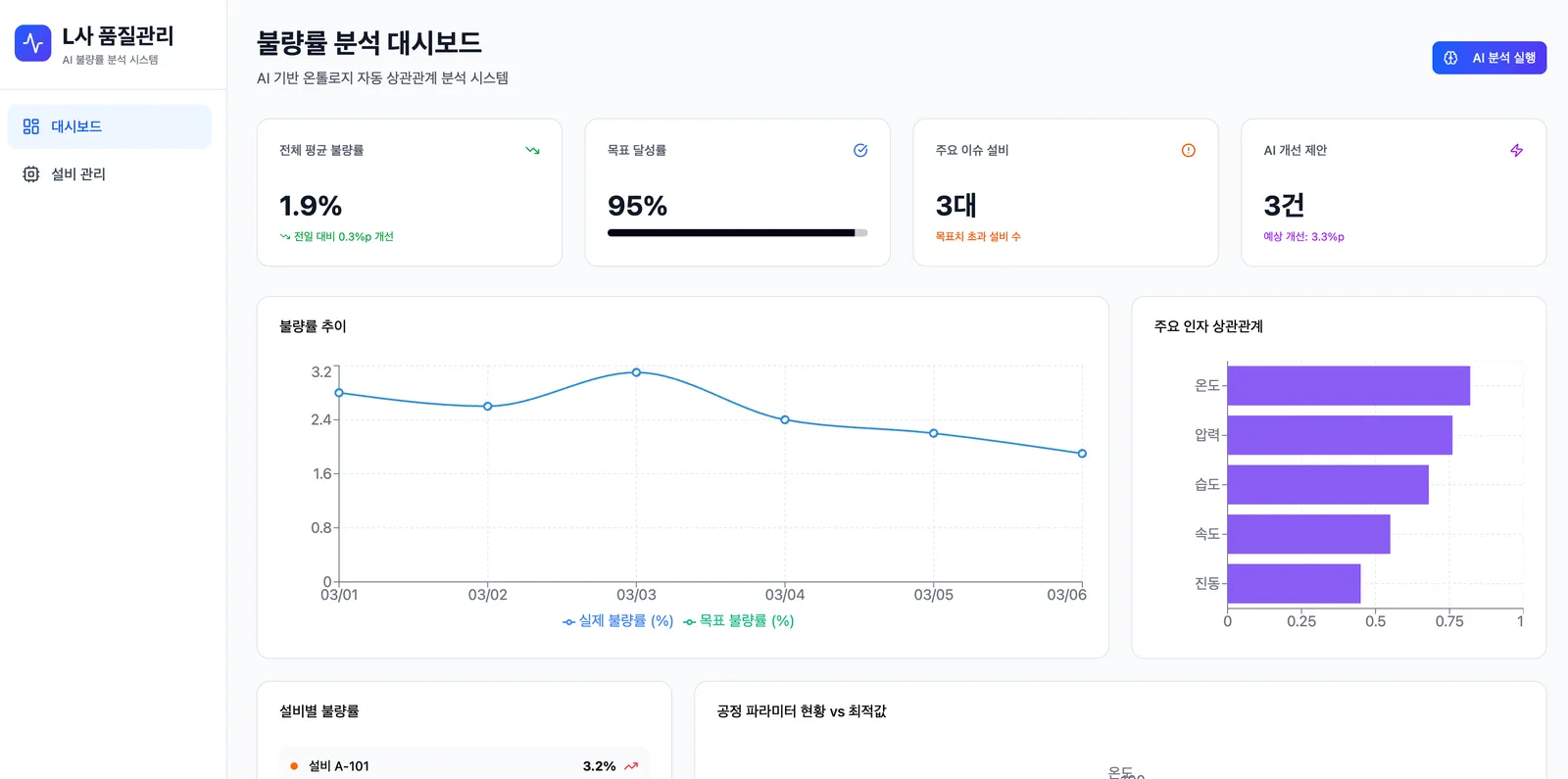
Company L's core task was lowering defect rates by equipment, but each process had dozens of related factors, which made causes hard to trace. Applying DARVIS at the technical design stage, the team designed a structure in which AI automatically infers the most strongly correlated factors and recommends actions. The company is moving toward a setup where people can focus on judgment and action.
Company L: food manufacturing
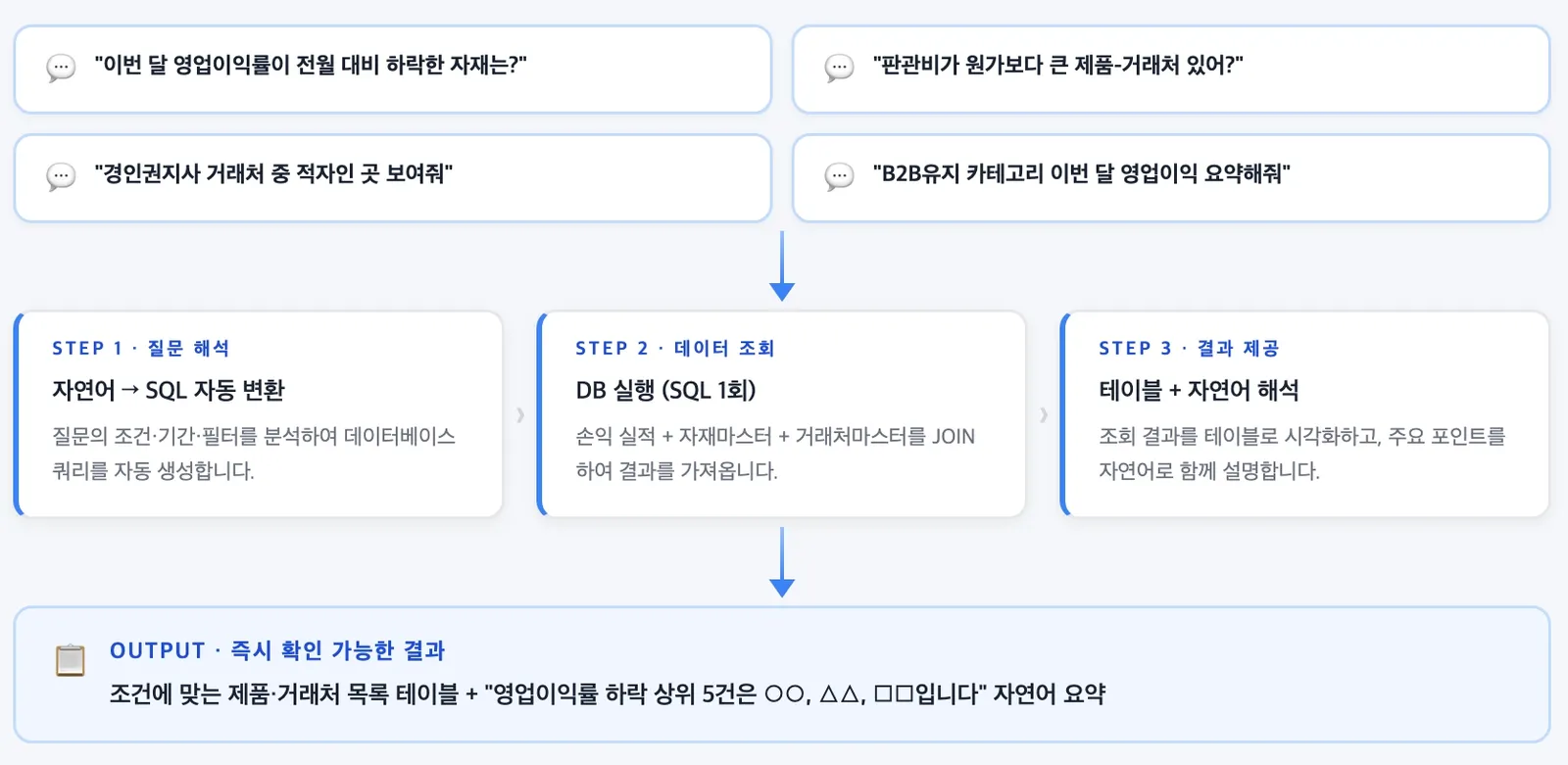
Company L was looking at its data in BI tools, but it could not analyze causes: why costs had risen, or where the changes came from.
In the PoC stage, DARVIS was used to build an environment for monitoring slow-moving inventory and tracing the causes of cost changes, laying the groundwork for data-driven decisions.
How are AI Voucher projects selected?
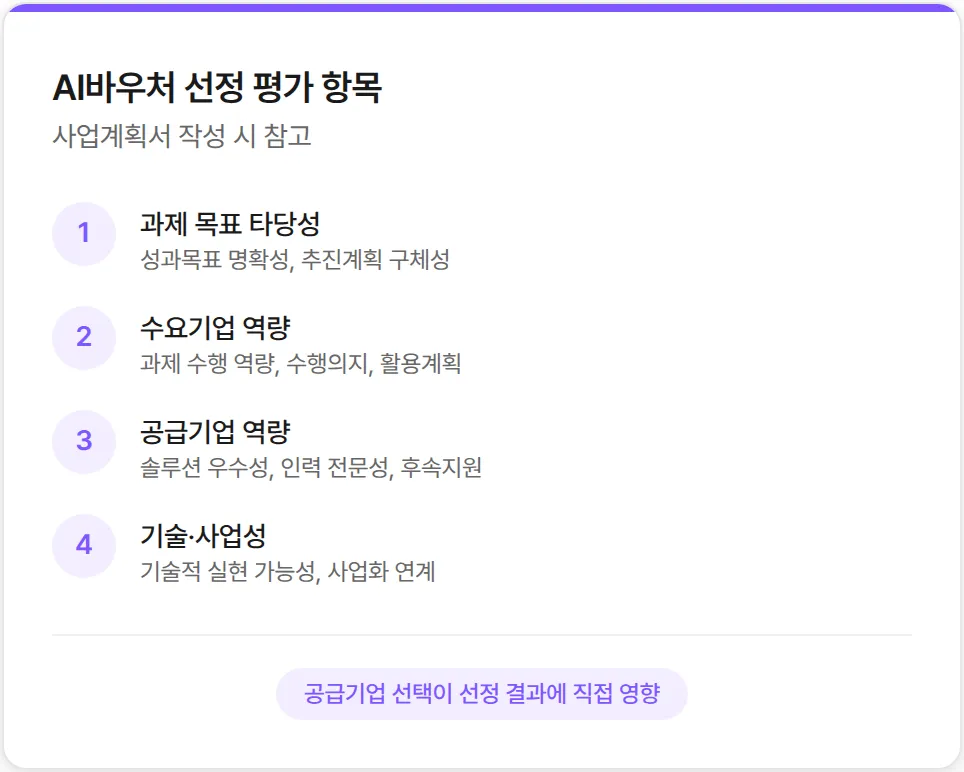
Projects go through an eligibility review (checking basic qualifications), then the selection evaluation (document review + presentation review), then a budget review and adjustment before the final projects are confirmed. Projects that pass the document review move on to the presentation review, and selection is in order of evaluators' scores, highest first.
To know where to focus when writing the business plan, it pays to understand the evaluation items in advance. The main evaluation items for the AI Voucher (General track) are as follows.
Evaluation item | Key points |
|---|---|
Validity of project goals | Clear performance goals, economic ripple effects, concrete execution plan |
Demand company capability | Capacity to carry out the project, commitment, plan for using the solution |
Supplier capability | Solution quality, expertise of participating staff, follow-up support plan |
Technology and business viability | Technical feasibility, potential link to commercialization |
As noted in the supplier selection criteria above, supplier capability is a separate evaluation item. Evaluators look at the quality of the solution itself, the expertise of participating staff, and even the follow-up support plan after the project ends, so the choice of supplier directly affects the selection result. Forming a consortium with a good supplier is like finishing half of the business plan.
What to know before you apply
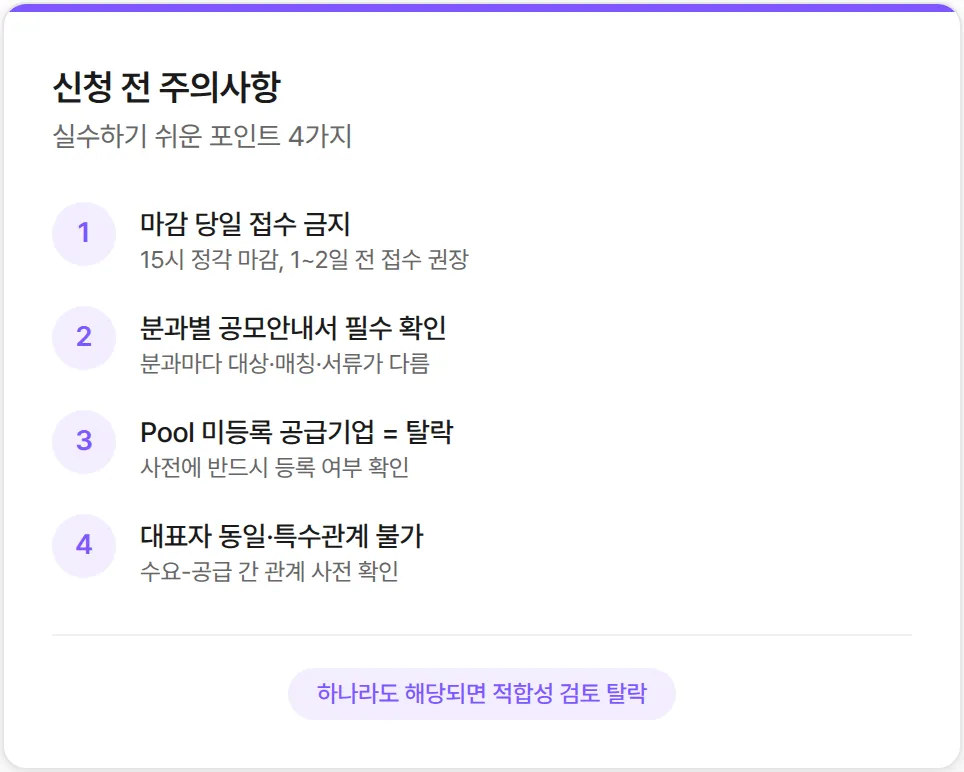
Here are the parts that are easy to get wrong while preparing an AI Voucher application.
First, don't submit on the deadline day. Submissions pile up on the last day, and there have been cases of the system slowing down or failing. We recommend finishing your submission at least one to two days early. Once 15:00:00 passes, you can no longer submit, so keep exact time.
Second, be sure to check the application guide for your track. The AI Voucher runs in four tracks (General, AI Semiconductor, Small Business, and Global), and eligible applicants, private matching ratios, and required documents differ by track. If you apply based only on the main announcement, you may miss track-specific requirements.
Third, you can form a consortium only with companies registered in the supplier pool. If you apply with a supplier that is not in the pool, you are rejected straight away at the eligibility review. Always confirm pool registration in advance.
Fourth, if the demand company and supplier have the same representative or a special relationship, they cannot take part. This can also apply to consortiums between subsidiaries or affiliates, so check the relationship in advance.
Why you should start preparing for the AI Voucher now
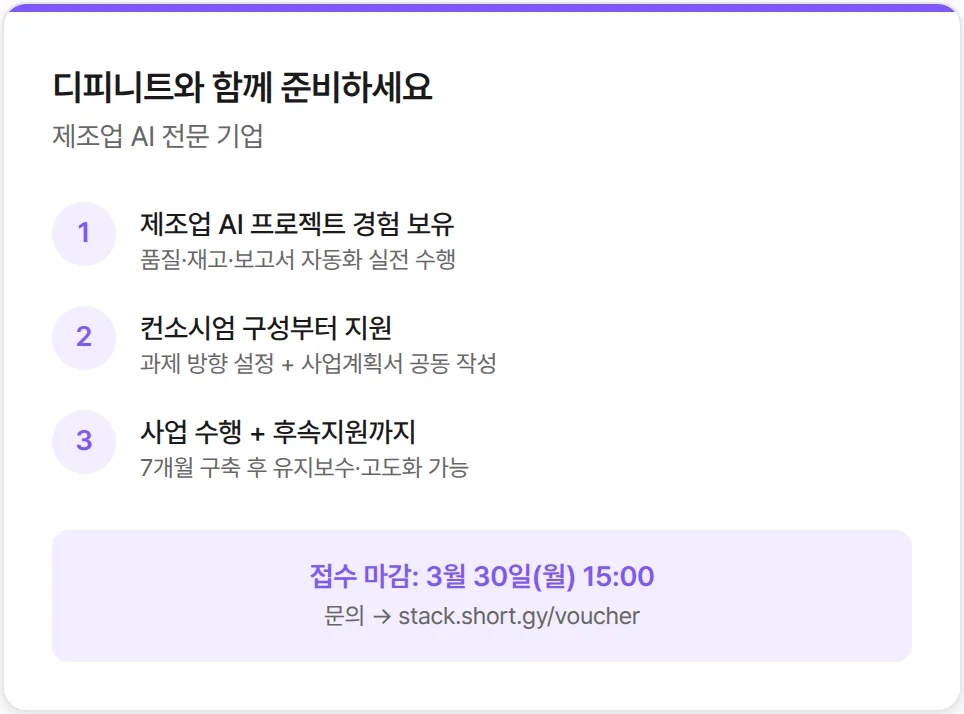
The AI Voucher application deadline is Monday, March 30, 2026, at 15:00.
The date may look comfortable, but it isn't. You have to find a supplier, set the project direction together, form a consortium, and write the business plan. If you start all of this just before the deadline, you will not have enough time. Now is the realistic time to start.
DFINITE is an AI company specializing in manufacturing. We have used AI to solve a range of operational problems at manufacturing sites, including quality management, inventory optimization, and production report automation. We can prepare with you from forming the consortium and writing the business plan through to carrying out the project.
If you are considering adopting AI through the AI Voucher, please leave a few details at the link below. When the inquiry form opens, note in the "Message or inquiry" field that your inquiry is about the AI Voucher. Our team will review it and contact you as soon as possible.
👉 AI Voucher inquiries: https://stack.short.gy/voucher (in Korean)
📌 Consider other vouchers as well
S-Voucher (up to KRW 100 million, for SMEs, deadline March 27) (in Korean)
Data Voucher (up to KRW 45 million, deadline March 31)
We join scattered data with an ontology, flag what drifts first, and keep the evidence behind every decision.