

Korea's AI service startups: a guide by category and how to choose
Korean AI startups by category: chatbots, generative AI, enterprise AI platforms and industry AI. Compare them and find the right fit for your organization.

The spread of generative AI is quickly changing how companies and individuals work. Two years after ChatGPT appeared, AI has moved from a lab technology to an everyday work tool. Many companies are thinking, "We need to adopt AI too...," but have no idea which AI service to choose.
Korea alone has hundreds of AI startups, and each claims to offer "the best AI" or "an innovative solution." What matters, though, is not how impressive the technology looks but "which of our organization's problems it can solve."
This article sorts Korea's AI service startups into six categories and introduces the characteristics and leading companies in each. It is meant as a practical guide to finding the AI that fits your organization.
How we classify Korea's AI service startups
Compare AI startups on technology alone and they all look alike. Terms such as "deep learning-based," "LLM-powered" and "natural language processing" are now used by almost every AI company.

The classification criteria that actually matter are these three.
Where the AI is applied - internal work, customer service or content production
What data it handles - internal company data, public data or industry-specific data
How far the automation goes - document search, data analysis, decision-making or physical work
Using these criteria, Korea's AI service startups fall into six categories: enterprise AI platforms; AI chatbots and customer support automation; AI content generation and marketing automation; industry-specific AI; AI data and model building; and AI robots and human interaction.
Six categories of Korean AI service startups
1. Enterprise AI platforms
Purpose: internal data search, decision support, work automation
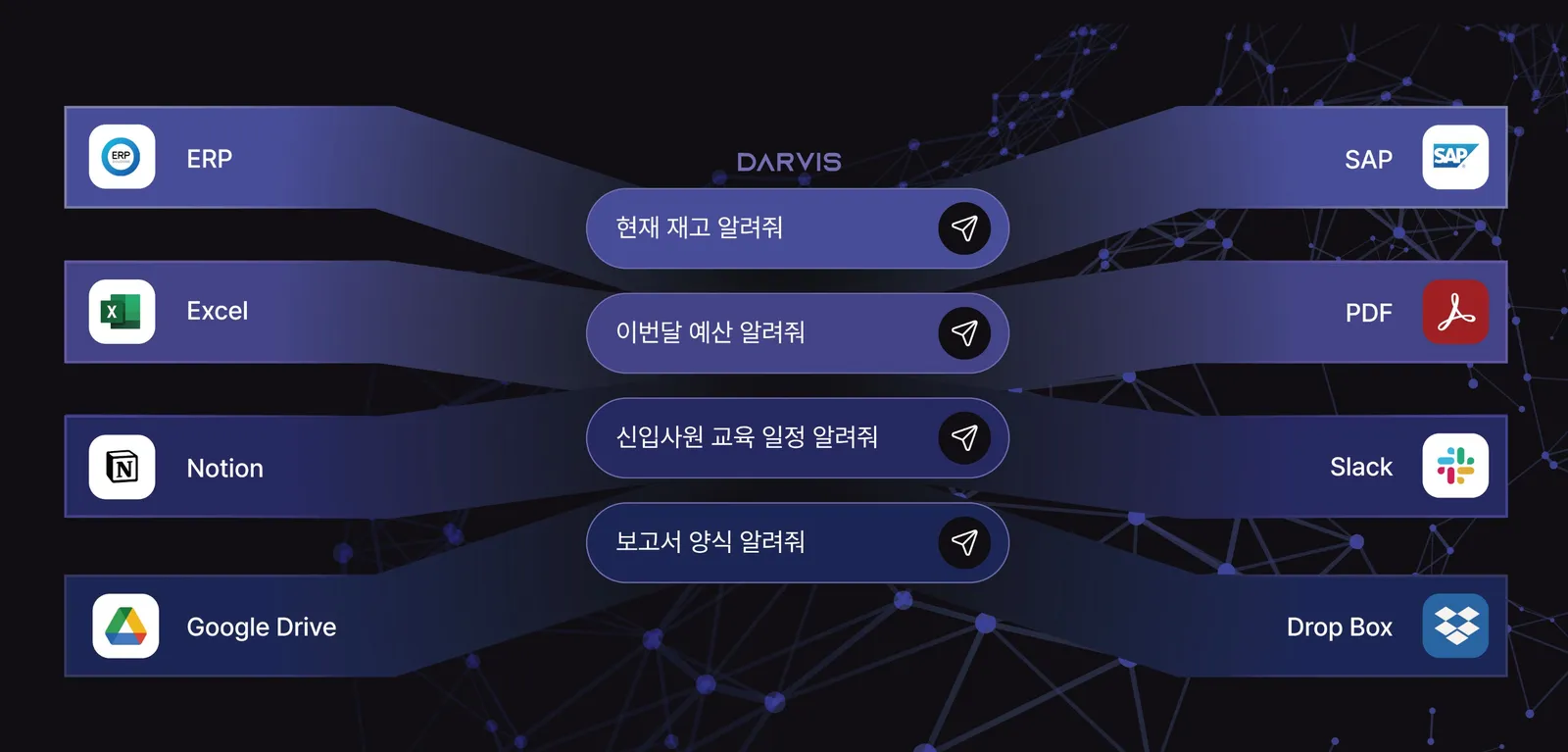
Enterprise AI platforms connect to internal systems such as ERP, MES and CRM to help employees with their work. For questions such as "What was Product A's defect rate last month?" or "What was the average purchase amount of VIP customers in the first half of this year?", you ask in natural language and the AI automatically generates and runs the SQL and gives you the answer. The companies below are typical examples.

DFINITE (DARVIS)
Uses Text2SQL technology to turn natural-language questions into SQL queries automatically. It specializes in manufacturing and the public sector and strengthens security with on-premises installation. Its distinguishing feature is that it connects data logically, without physically merging it, across scattered systems such as ERP, MES and WMS.Upstage
Strong in OCR and document intelligence. It makes unstructured data such as contracts, certificates and internal documents readable and searchable by AI. It is widely used in finance and the public sector.Ploonet
Offers a user-friendly, AI-assistant-style UI. Its strength is an interface employees can use right away without complex setup.
With AI like this, employees feel a real gain in work efficiency, spend less time searching for information and use data more.
There are a few things to consider, however: first, "security policy and whether on-premises installation is available"; second, "whether frontline staff need training to adopt it"; and third, "whether it can be customized for each company".
2. AI chatbots & customer support automation
Purpose: lower contact center costs, consistent response quality, 24-hour customer service
When a customer calls or chats with a question, the AI answers automatically. AI handles simple, repetitive questions and passes only complex issues to human agents, which improves efficiency. Leading examples include MINDs Lab, SK Telecom's A. (A-dot) and Naver CLOVA.

MINDs Lab
Strong in financial-sector call centers. It uses speech recognition and natural language understanding to work out what a customer is asking and respond.
SK Telecom A. (A-dot)
Started as a personal AI assistant and is expanding into enterprise use. It works well on mobile.
Naver CLOVA
An enterprise chatbot platform built on HyperCLOVA X. It understands Korean well and is widely used by public institutions and large companies.
AI chatbots and customer support automation are used mainly in finance, telecom, online retail and public civil-service inquiries.
3. AI content generation and marketing automation (creative AI)
Purpose: automating writing, images and video production
AI automatically generates blog posts, social media ad copy, landing pages and short-form videos. It is useful for marketers, one-person businesses and organizations short on design resources. Leading examples include Wrtn, Retina AI and Round Eight.

Wrtn
Strong in LLM-based automated writing. You can quickly draft blog posts, press releases and planning documents.
Retina AI
Generates social media image ads automatically, and the AI recommends which designs are likely to perform well.
Round Eight
Edits short-form and branded video with AI. It focuses on optimizing video creative.
With AI like this, you can produce blog content at volume and easily create assets for A/B testing social media ad images. You can also use it for many kinds of content, such as auto-generated product landing pages and automatically edited YouTube Shorts.
4. Industry-specific AI (vertical AI)
Characteristics: specialized for specific industries such as manufacturing, healthcare, construction and law
Unlike general-purpose AI, this AI is trained on the expert knowledge and data of a specific industry. The quality of domain-specific data is its core competitive edge. These are fields that demand expertise. Leading examples include DFINITE, The VM, Lunit, VUNO, Angelswing, SAIGE Safety, Amicus Lex and Wanted Lab.

Manufacturing / quality management
DFINITE (DARVIS): decision support based on production and quality data
The VM: manufacturing process optimization
Healthcare
Lunit: early cancer detection from X-ray and CT images
VUNO: medical image analysis AI
Construction / safety
Angelswing: captures construction sites by drone and automatically analyzes construction progress
SAIGE Safety: on-site safety monitoring
Legal
Amicus Lex: AI reviews case law and contracts and analyzes risk
HR
Wanted Lab: AI-based hiring matches and candidate recommendations
These companies understand their industry's terminology, regulations and workflows in depth, so they tackle problems that general-purpose AI struggles to solve.
5. The AI data and model-building infrastructure layer
Characteristics: chosen by organizations that want to build AI themselves
These are B2B infrastructure companies that develop AI models themselves or support data labeling and LLM building. Leading examples include Saltlux, Skelter Labs, Crowdworks and AIMMO.

Saltlux
Provides an end-to-end solution, from model development to consulting and implementation.
Skelter Labs
Supplies its natural language understanding engine to other companies. It acts as the "engine" of conversational AI.
Crowdworks / AIMMO
Data labeling specialists. People clean and tag the data needed to train AI.
Most companies don't choose this layer directly; they use finished AI services instead. But large companies and research institutes with their own AI development teams sometimes use this infrastructure and adapt it to their company.
6. AI + robots / human interaction
Characteristics: AI extends into the physical world
These companies go beyond the digital screen to perform physical work or provide interfaces that look human. It is also a field that will have a big impact on future industries. Leading examples include Neuromeka, Dogugonggan, Rebellions and VAIV Company.

Neuromeka
Manufactures collaborative robots: robot arms that work alongside people.
Dogugonggan
Automates manufacturing processes with autonomous assembly robots.
Rebellions
Develops Korean-made AI accelerator chips, hardware that speeds up AI computation.
VAIV Company
Provides digital humans and customer-service avatars. The AI talks to customers with a human-looking face.
In this field, AI is combined with hardware and applied to logistics, manufacturing and guidance services.
What companies should watch for when adopting AI today
So far we have looked at the types of Korean AI service startups by category. Now, before you make a choice, here is what to watch for.
Don't choose an AI startup on technology alone. These are the checkpoints that matter in real operations.
What to check | Why | Question to ask |
|---|---|---|
Security / data storage | Risk of internal information leaking | Where is the data stored and used for training? Can it be installed on-premises? |
Fit with frontline work | It's pointless if nobody uses it | Can employees learn it within five minutes? Is it fast to respond? |
Scope of customization | Each industry needs different features | Can it be adjusted to our company's terms and processes? |
System integration | Isolated AI has limited impact | Does it connect to ERP, MES and CRM? |
Adoption support | Getting people to use it is harder than installing it | Is there a training and onboarding program? |
As shown by Samsung Electronics banning generative AI use company-wide and Air Canada being sued over a wrong chatbot answer, adopting AI without security and quality controls turns the AI itself into a risk.
Which AI fits our company? A selection guide
The most important question before adopting AI is "Which work takes up the most time in our organization?" Use the situation-by-situation guide below to find the AI category that fits your organization.

When you need to automate customer service
If repetitive questions such as "Where is my delivery?" and "How do I get a refund?" make up more than 70% of all inquiries at your call center, and agent labor costs are a burden but you still need 24-hour service, then an AI chatbot is the answer.
AI handles the repetitive questions and only complex inquiries go to agents. In finance, a security-focused solution like MINDs Lab fits; for online retail, platforms that can be set up quickly, such as SK Telecom's A. (A-dot) or Naver CLOVA, are a better match.
Recommended: AI chatbots & customer support automation (MINDs Lab, SK Telecom A. (A-dot), Naver CLOVA)
When you have a lot of documents, reports and materials to produce
If your marketing team has to produce blog and social media posts every week, drafting reports and plans takes a lot of time, and you need several versions of each ad but are short on designers, you need content-generation AI.
Give Wrtn "a draft press release for a new product launch" and it sets up the basic structure within three minutes; Retina AI generates multiple versions of social media ad images. Starting from a blank page and polishing a draft move at completely different speeds.
Recommended: AI content generation tools (Wrtn, Retina AI, Round Eight)
When decisions based on production, quality or sales data matter
If you have plenty of data in ERP, MES and CRM but can't put it to use, have to ask the IT team to look up "last month's defect rate" or "VIP customer buying patterns," and managers who don't know SQL can't see the data themselves, an enterprise AI platform is the answer.
Ask a question in natural language and the AI writes and runs the SQL automatically. DFINITE's DARVIS specializes in manufacturing and provides on-premises security, while Upstage suits document-centric businesses (finance, legal, public sector). Decisions get faster and employees gain more autonomy in their work.
Recommended: enterprise AI platforms (DFINITE, Upstage, Ploonet)
When you need expert knowledge of a specific industry
For work that requires expert knowledge, such as reading medical images, checking construction progress on site, reviewing legal contracts for risk or predicting equipment failures, industry-specific AI is the right fit.
Lunit marks suspected lung cancer areas on X-rays, Angelswing calculates construction progress automatically from drone photos, and Amicus Lex finds unfavorable clauses in contracts. You get support for expert-level judgments that general-purpose AI can't make.
Recommended: industry-specific AI (Lunit, Angelswing, Amicus Lex, OnePredict)
When the goal is automating physical work
If you want machines to take over repetitive tasks on the production line, warehouse organization or dangerous work, you need AI robots.
Neuromeka's collaborative robots lift heavy parts next to workers, Dogugonggan's autonomous assembly robots work around the clock, and VAIV Company's digital humans guide customers at banks and airports. The up-front investment is large, but you get 24-hour operation and keep people out of dangerous work.
Recommended: AI + robots (Neuromeka, Dogugonggan, VAIV Company, Rebellions)
The key is not "the AI everyone is talking about" but "the AI that fixes the most frustrating point in your work": that is the one to choose. If agents spend all day answering the same questions, choose a chatbot. If content production leaves no time for strategy, choose generative AI. If you have plenty of data but still make decisions on gut feel, choose an enterprise AI platform.
The surest way to decide is to see in a demo how it works when applied to your actual work.
Start with the problem, not the technology
Korea's AI service startups are very diverse, and each has different strengths. What matters is finding "AI that fits how your organization works."
If you want to automate customer service and adopt a document-generation AI, it won't help. If you need to analyze internal data and use a content-production AI, it's no use at all.
If you are looking at automating work based on your company's internal data, review the enterprise AI platform category. This is especially true in environments like manufacturing or the public sector, where data is scattered across several systems (ERP, MES, HR), security is important and frontline staff need to look up data themselves.
When data scattered across internal systems is brought together so frontline staff can ask questions in natural language and get answers right away, real productivity and decision speed change. Solutions such as DFINITE's DARVIS, which combines Text2SQL with RAG and offers on-premises security, meet this need.
To sum up.
If you are considering AI, first get clear on "what problem we want to solve." Then work out which of the six categories in this article it falls into, and compare the leading companies in that field. That is the first step toward AI adoption that doesn't fail.
We join scattered data with an ontology, flag what drifts first, and keep the evidence behind every decision.