
2025 enterprise AI use cases: results and strategies of top Korean firms
From Samsung, LG and Hyundai Motor to startups: what 2025 enterprise AI use cases show about the real effects of adopting AI.

Why are companies paying attention to AI?
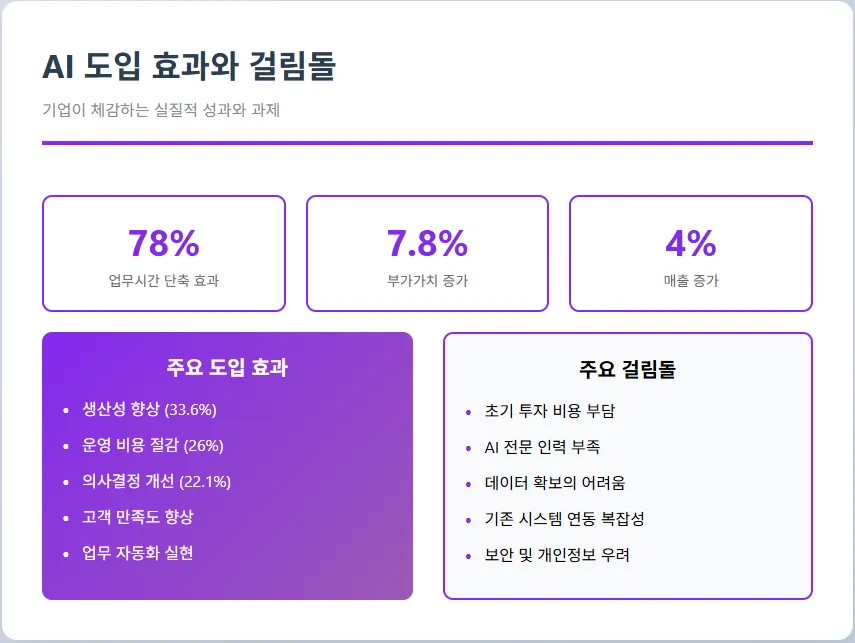
AI is now a matter of survival, not a choice. 78% of Korean companies have seen working hours fall after adopting AI, and companies that adopted AI have achieved concrete results: 7.8% higher value added and 4% higher sales than companies that have not.
Looking at enterprise AI use cases, companies of many kinds are investing actively in AI to raise productivity, cut costs and improve the customer experience. More recently, with the arrival of generative AI and LLMs (large language models), "in-house GPT" has been spreading quickly.
AI adoption is no longer just a technology trend. It is producing real business results, which makes it a strategic investment that can't be put off any longer. Through enterprise GPT adoption, major changes are happening in almost every area of work, including document work, customer service and data analysis.
In this post, we look at major enterprise AI use cases in 2025 and discuss the results and strategies of companies that have adopted AI.
Enterprise AI use cases at major conglomerates
Samsung Electronics: its own generative AI, Samsung Gauss
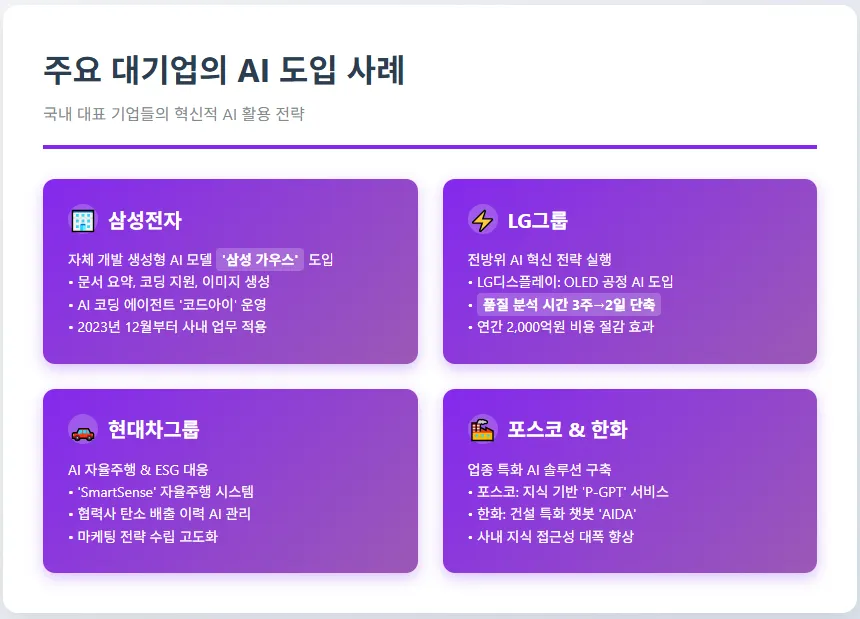
Samsung Electronics unveiled its in-house generative AI model, Samsung Gauss, in November 2023 and began applying it to internal work in December. Samsung Gauss consists of three models that support text, code and image generation, and it has made document work such as drafting emails, summarizing documents and translation far more efficient.
In particular, its AI coding agent "code.i" supports internal software development, helping developers code easily and quickly. It is drawing attention as a case of adopting in-house AI instead of external AI services because of security concerns.
LG Group: AI innovation on every front
LG Electronics introduced AI-based STT (speech-to-text) and TA (text analytics) into its AI contact center (AICC) to make customer service more efficient. It also plans to expand unmanned customer service by introducing an AI voicebot.
LG Display brought AI into its OLED processes and automated the analysis and management of manufacturing data, cutting the time needed to analyze and fix quality problems from three weeks to two days. It also achieved annual cost savings of KRW 200 billion, making it a model case of smart factory deployment.
LG CNS provides AI-based smart factory solutions to manufacturers, maximizing production efficiency and minimizing errors in manufacturing processes.
Hyundai Motor Group: autonomous driving and ESG response
Hyundai Motor improved both driver convenience and safety through Hyundai SmartSense, an AI-based autonomous driving system. It is strengthening its global competitiveness with AI voice recognition and personalized driving assistance features.
Hyundai Motor Group also introduced AI modeling to manage suppliers' carbon emission records, making ESG regulatory response and carbon emission management more efficient. The group's advertising agency, Innocean, has built its own solution based on in-house GPT to sharpen its marketing strategy planning.
POSCO: the knowledge-based P-GPT service
POSCO Group launched "P-GPT," a service that combines internal knowledge with a GPT language model, in September 2024. It answers employees' questions and has greatly improved access to internal knowledge.
It also built a high-performance RAG system that analyzes secondary battery market news in near real time and handles technical terminology, putting AI governance into practice in a secure internal environment.
Hanwha Group: an AI assistant specialized in construction
In the second half of 2024, Hanwha Group introduced "AIDA," an internal chatbot based on ChatGPT. It instantly provides information on the Subcontracting Act, the Serious Accidents Punishment Act and lessons learned in construction, and lets staff search tips from similar work, greatly reducing the time spent looking up regulations and tips for construction projects.
Enterprise AI use cases in IT and internet companies
Naver: service innovation based on CLOVA X
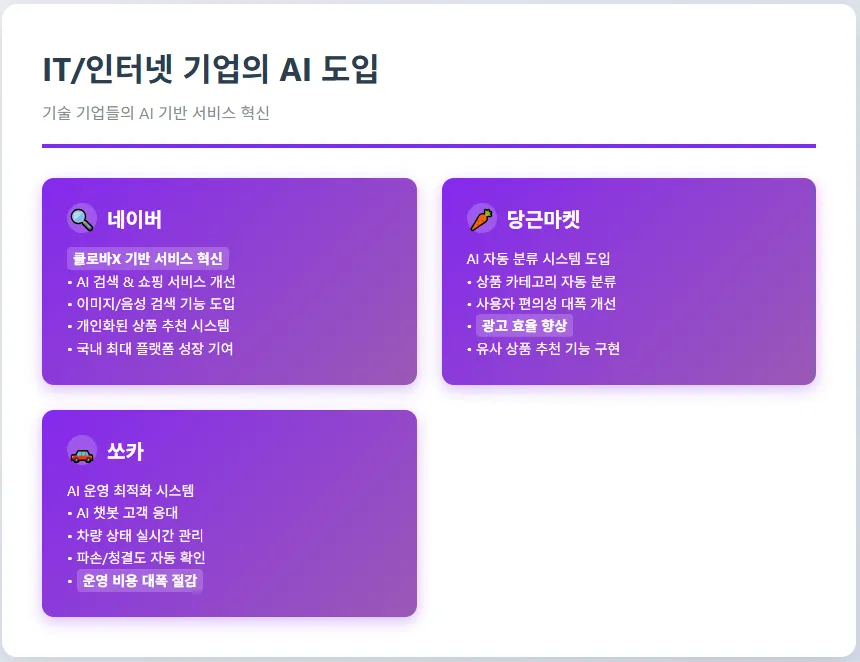
Naver has substantially improved its AI search and shopping services using its in-house AI model, CLOVA X. It has introduced image and voice search and offers personalized product recommendations through an AI recommendation system.
By delivering personalized search results and making it easier to find the products people want, it is contributing to the growth of Korea's largest search and shopping platform.
Danggeun Market: an AI automatic classification system
Danggeun Market introduced an AI system that automatically classifies product categories, removing the hassle of users assigning categories themselves. Automating category classification based on product titles let it build a similar-product recommendation feature and raise ad efficiency.
SOCAR: AI for operations optimization
SOCAR built an AI customer service system using an AI chatbot and automated vehicle management. It introduced an AI system that checks vehicle damage, washing and cleanliness in real time, significantly reducing operating costs.
Enterprise AI use cases and trends by industry
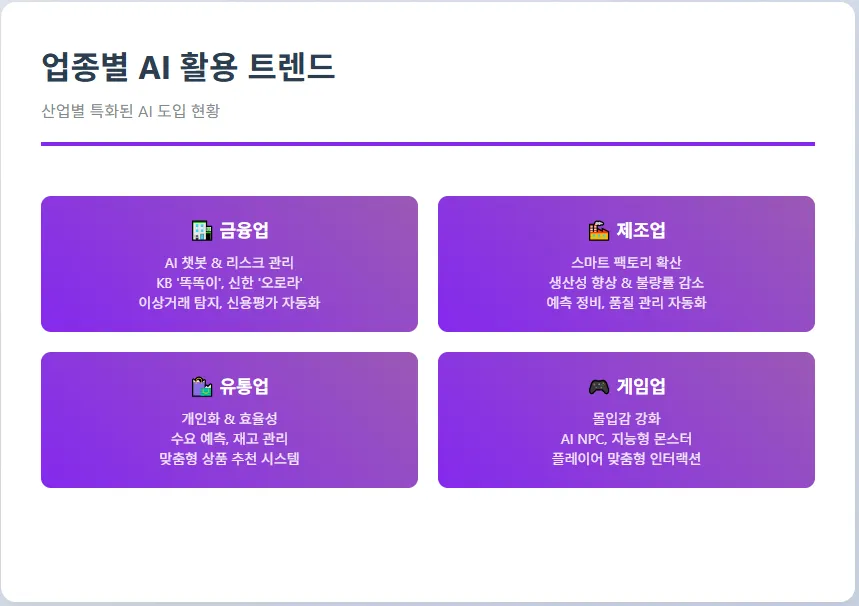
Finance: leading the way in customer service innovation
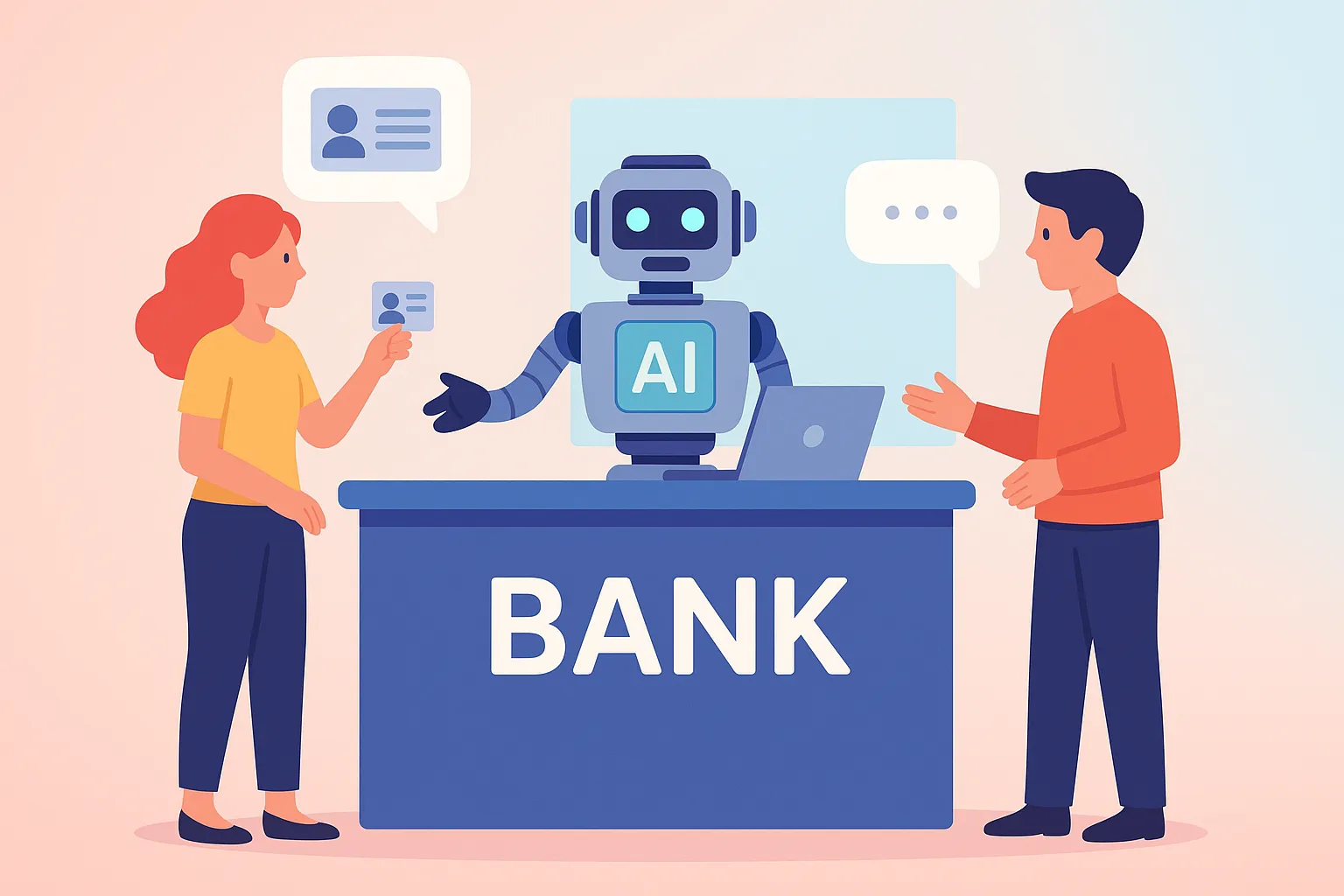
The financial sector has been the most active in adopting AI chatbots. Leading examples include KB Kookmin Bank's "Ttokttoki," Shinhan Bank's "Aurora," Hana Bank's "HAI" and Woori Bank's "WiBee Bot."
These AI chatbots provide customer service, transaction processing and product recommendations, raising customer satisfaction and easing the workload of human agents. Banks are also actively using AI in risk management, such as fraud detection and automated credit scoring.
Manufacturing: smart factories are spreading
In manufacturing, the main results are higher productivity and lower defect rates through smart factories. In semiconductors, companies use AI to analyze process miniaturization and the causes of wafer loss, improving yields.
AI-based predictive maintenance, automated quality control and production planning optimization are strengthening manufacturing competitiveness.
Retail: balancing personalization and efficiency
Retailers are optimizing product recommendations and inventory management through AI-based demand forecasting and customer data analysis. Their strategy is to offer personalized shopping experiences while maximizing operational efficiency.
Gaming: AI for deeper immersion
Game companies use AI to give NPCs and monsters intelligence and change their behavior patterns based on the player's skill and situation, making games more fun. Player-tailored interactions are greatly increasing immersion.
The benefits of enterprise AI, and why companies still hesitate
Verified benefits of AI adoption
Here are the benefits Korean companies have actually seen from adopting AI:
Higher productivity: cited as the biggest benefit by 33.6% of companies
Lower operating costs: 26% of companies saw real cost reductions
Better decision-making: 22.1% of companies improved data-driven decision-making
Above all, companies that adopted AI show clear numerical results: 7.8% higher value added and 4% higher sales than companies that have not.
Main obstacles to adoption and how to address them
Still, AI adoption faces the following obstacles:
Initial investment cost: the cost of hardware, software and people is the biggest barrier.
Shortage of AI specialists: it remains hard to hire specialists who can plan, develop and run AI.
Difficulty securing domain data: preparing high-quality training data and managing data quality are difficult.
Solving these problems will require ongoing government support for workforce training programs, R&D funding and AI infrastructure.
Can our company use enterprise AI too?
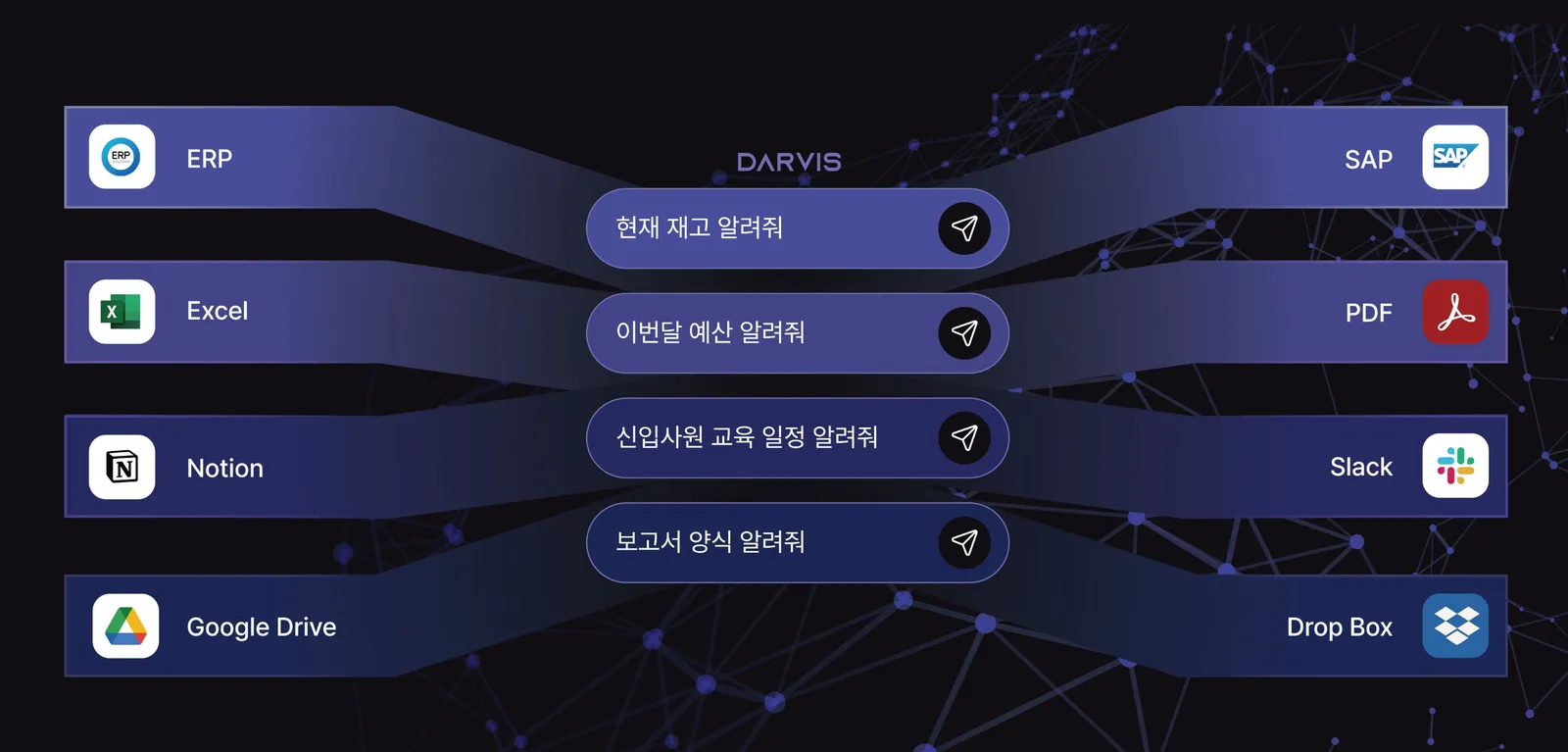
The challenges are real, but what we should focus on is that AI adoption is already a reality across many industries. And it is well within reach not only for large companies but also for small and mid-sized ones.
In particular, solutions such as on-premises AI and GPT that runs only on the internal network let you get the benefits of generative AI without security worries. With solutions now available that add AI capabilities without changing existing systems, the burden of adoption is also falling sharply.
Enterprise-tailored AI solutions such as DFINITE's DARVIS make it possible to adopt AI that fits your organization exactly. What matters is setting clear goals and taking a step-by-step approach.
AI adoption is no longer something for the future. Companies that start now can secure their future competitiveness.
Need more on enterprise AI use cases and adoption?
If you would like deeper insights into AI trends and adoption strategies, including more enterprise AI use cases and information you can apply in practice, see the related posts below. Thank you.
We join scattered data with an ontology, flag what drifts first, and keep the evidence behind every decision.