

LLM ontology: a knowledge blueprint to get enterprise AI past its limits
Why ontology is central to enterprise LLMs: defining logical links between data curbs hallucinations and makes answers on company data more accurate.

"We rolled out ChatGPT, so why does it give strange answers about our own company's results?"
This is the first surprise for many companies that adopt generative AI. The LLM (large language model) is supposed to be smart, yet ask it "How did our department's sales do last month?" and it can't give a proper answer. Why?
An LLM knows a vast amount about the world, but it knows nothing about how your company works inside. It knows the word "sales," but it can't know which system and which table hold your company's sales data, or which organization code "our department" actually refers to.
The key technology that closes this gap is the LLM ontology.
What is an ontology?
Ontology originally means "the study of being" in philosophy, but in AI and data technology you can think of it as a "map of knowledge." Put simply, it is a knowledge system defined so that a computer can understand the relationships between things and concepts the way a person does.
What makes it meaningful is that it defines the "relationships" between data, not just search terms. Take the entry "Manager Kim Cheol-su." An ordinary AI sees only text: a name and a job title. An AI with an ontology also understands the connections: "Kim Cheol-su belongs to the quality team, is in charge of Project A and has completed Six Sigma training." It sees the "relationships."
The three components of an ontology
An ontology is made up of three core elements.
Classes (concepts) A class is a set of things: concepts the business deals with, such as "part," "employee" and "department."
Properties (characteristics) These are the information a concept carries. They define the attributes of each concept, such as a part's "price," an employee's "job title" or a department's "budget."
Relationships (connections) These describe the interactions between concepts. They create logical links between data, such as "an employee belongs to a department," "a part is included in a product" and "a project is carried out by a team."
As an analogy, an LLM has a huge vocabulary list, and an ontology adds reading comprehension and logical reasoning on top of it.
Why do LLMs need an ontology?
The core value of an LLM ontology comes down to three things.

1. Preventing hallucinations
The biggest problem with LLMs is unfounded answers, known as hallucinations. An ontology gives the AI guidelines so it answers only within a defined logical structure. Asked about "last month's sales," it doesn't make up a number; it pulls the exact value from the table where the real sales data is stored.
2. Understanding what data means
When an ordinary AI sees the Korean word "sagwa," it can be unsure whether it means the fruit (apple) or the act of apologizing. An LLM ontology reads the context and understands the meaning precisely.
Ask, "How many defects did we have?" and an AI with an ontology reasons as follows: "This user is on the quality team. At this company, 'defect' means the quality-defect table in the MES, and 'how many' calls for the Count function." It gets the context exactly right.
3. Handling complex queries
It can also handle complex questions that span several systems, such as "Compare last month's defect rate for Process A with Team B's headcount." That is because the ontology creates the links between scattered data.
Even if the defect rate lives in the MES and headcount lives in the HR system, the ontology tells the AI the logical relationship: the entity "Manager Hong Gil-dong" took part in the "production process," which is linked to its output, "Part A." As a result, a single question can pull together data from several systems.
The decisive advantages of an LLM ontology
An LLM combined with an ontology becomes more than a simple AI: it becomes an intelligent data partner for the company. Here are the specific advantages.
Advantage 1. Higher accuracy
An LLM ontology minimizes data lookup errors through txt2SQL technology that reflects business logic. Ask, "Show me the list of defects that occurred at the Seoul office last month," and the ontology interprets it like this.
It maps "Seoul office" precisely to code "LOC_02" in the branch master database, "list of defects" to the "AS_RECORDS" table in the defect management system, and "last month" to a filter for the previous month based on today's date. The AI doesn't wander; it goes straight to the right data fields and returns the results.
Category | Standard LLM | LLM with ontology |
|---|---|---|
How it understands | Word matching (keyword search) | Grasps context (understands relationships) |
Data processing | Separate lookups in each system | Logical links across multiple systems |
Accuracy | Risk of hallucination | Accurate answers within a defined structure |
Complex questions | Hard to handle | Multi-system queries possible |
Advantage 2. Faster decisions
In the past, downloading data from several systems and processing it in Excel took hours. With an LLM ontology, a single natural-language question gets you the insight you need right away. Data preparation time shrinks to seconds.
Advantage 3. Turning knowledge into an asset
An ontology systematizes a company's expert knowledge. Even when a veteran employee leaves, the work processes and data relationships they knew remain stored in the ontology. New employees can also learn the company's tacit knowledge quickly through the AI.
How ontology works in enterprise AI
So how is an LLM ontology used in a real enterprise environment?

Enterprise generative AI systems use an ontology to connect existing systems such as ERP and MES only logically, without touching them. Rather than physically merging the data, they read from each system when needed and connect it. This keeps the adoption burden low, and a system can be built quickly.
Security is another important consideration. Systems that support on-premises installation also work in closed-network environments, which removes the worry that "we can't use AI because of security." The data never leaves the company; it is processed only on in-house servers.
Real deployments show clear results. The Seoul Foundation of Women and Family turned more than 60 internal regulations into an ontology and cut information search time sharply. The education company Business PT trained the AI on 200 pieces of lecture content and greatly reduced the time to respond to learners' questions.
A company-specific glossary feature matters too. Even within the same industry, every company uses its own terms. Many call a "voucher" a "posting," or refer to product codes by internal nicknames. An LLM ontology can reflect a company's own jargon and abbreviations right away.
AI is moving beyond generation to understanding and connection
LLMs are powerful tools, but to use them well in a business you have to teach them your company's context. That is exactly what an LLM ontology does. It turns AI from something that simply generates text into an intelligent system that understands your company's data relationships and connects them logically.
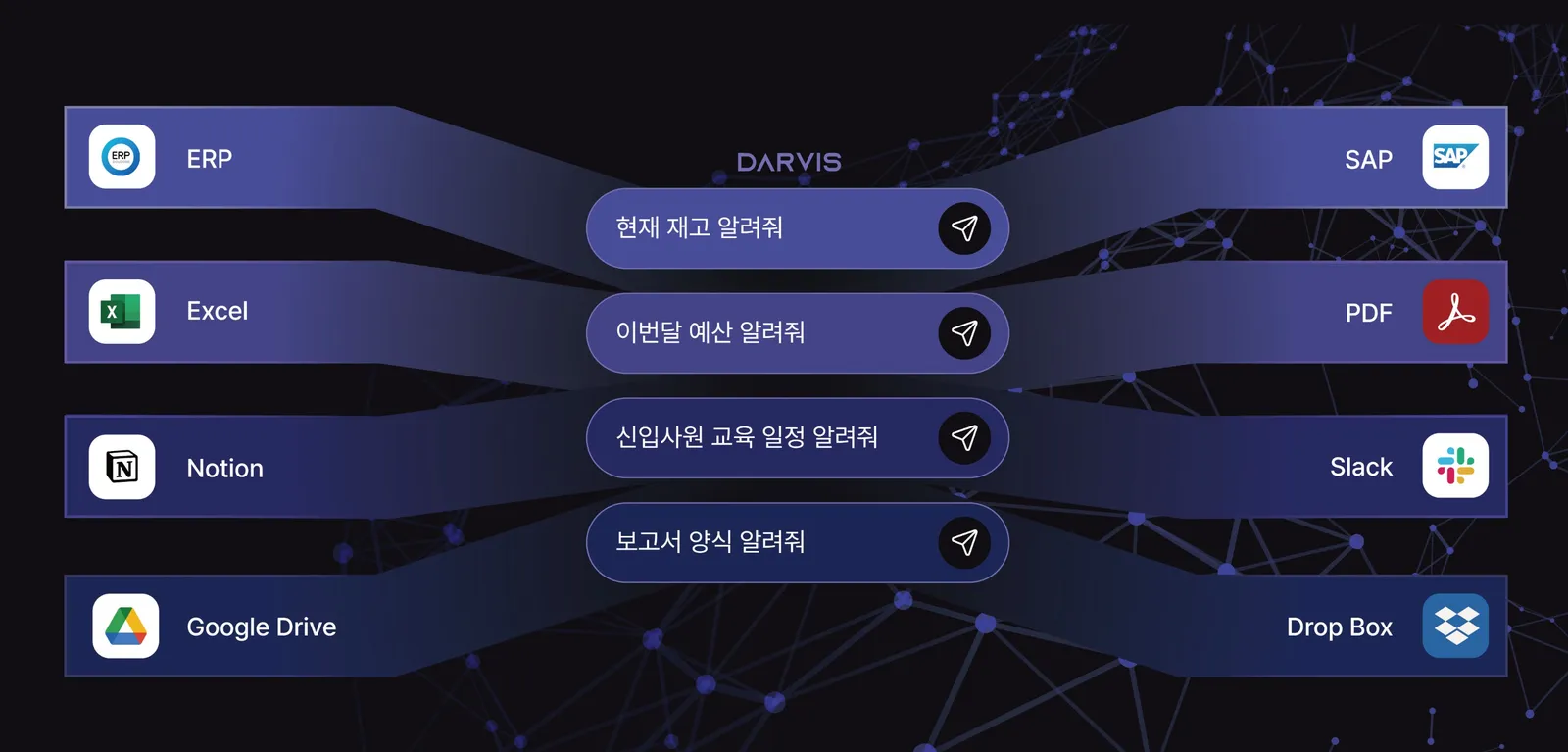
Do you have plenty of data but can't make good use of it? Do you want to connect information scattered across systems? LLM ontology technology may be the answer.
Start connecting your company's data in the safest, smartest way now.
If you'd like practical insights on using AI and the latest trends, keep reading the DFINITE DARVIS blog. We share AI know-how and real cases that show how to raise productivity at work.
For more AI insights, see the related posts below. Thank you.
We join scattered data with an ontology, flag what drifts first, and keep the evidence behind every decision.