

Why ontology decides whether enterprise AI adoption succeeds
Billions invested, yet under 5% of AI agent rollouts succeed. The root cause is a missing ontology. Why it is AI's guardrail and how to build one.

"We asked the AI about 'customers,' and the sales team and the finance team got completely different answers."
That is how the CTO of one manufacturer put it. The word is the same, "customer," but the sales CRM counts prospects as customers, while the finance system counts only customers who have actually paid. AI cannot tell the two apart. So it reports the wrong numbers and offers the wrong insights.
Is your company running into the same problem?
Same word, different meaning in every department. Why?
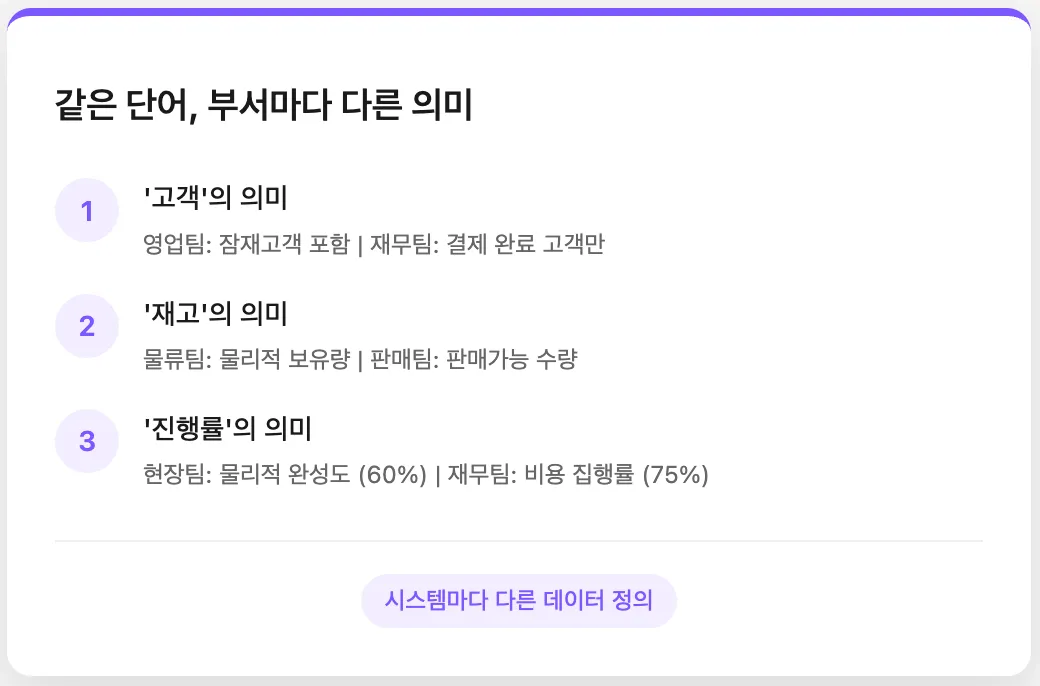
A company has many systems that generate data. And each system uses the same words to mean different things.
Inside a single company, each system speaks its own "language." Picture a meeting where sales speaks English, finance speaks Chinese and the shop floor speaks Japanese, with no interpreter.
Take a manufacturing plant. Sensors record equipment conditions such as temperature, pressure and vibration in real time. PLCs (Programmable Logic Controllers, which control production equipment) accumulate line control data, and the MES (Manufacturing Execution System) manages work orders and production output. The ERP (Enterprise Resource Planning system) handles inventory, cost and shipping information.
The problem is that even "defect rate" means something different in each system. Sensors measure values in real time, the MES aggregates them by day, and the ERP rolls them into monthly reports. Which number is the real one? AI cannot tell.
Construction projects have the same issue. Take the word "progress." The site manager means physical completion (60%), the finance team goes by cost spent (75%), and the PMO talks about schedule progress (55%).
One project, three different numbers. If you tell an AI, "Report the project's progress," which basis will it use?
Retail and services are no exception. Look at "inventory" alone: the warehouse counts physical stock, the sales system looks at stock available to sell, and accounting tracks book inventory.
Bring AI into this situation and every department gets a different answer, the insights can't be trusted, and in the end people have to check everything again by hand.
The core problem:
The same term, defined differently by each department
Different aggregation rules in each system
Unclear links between data
AI cannot understand the context
Why AI agent adoption still rarely succeeds after billions of dollars of investment
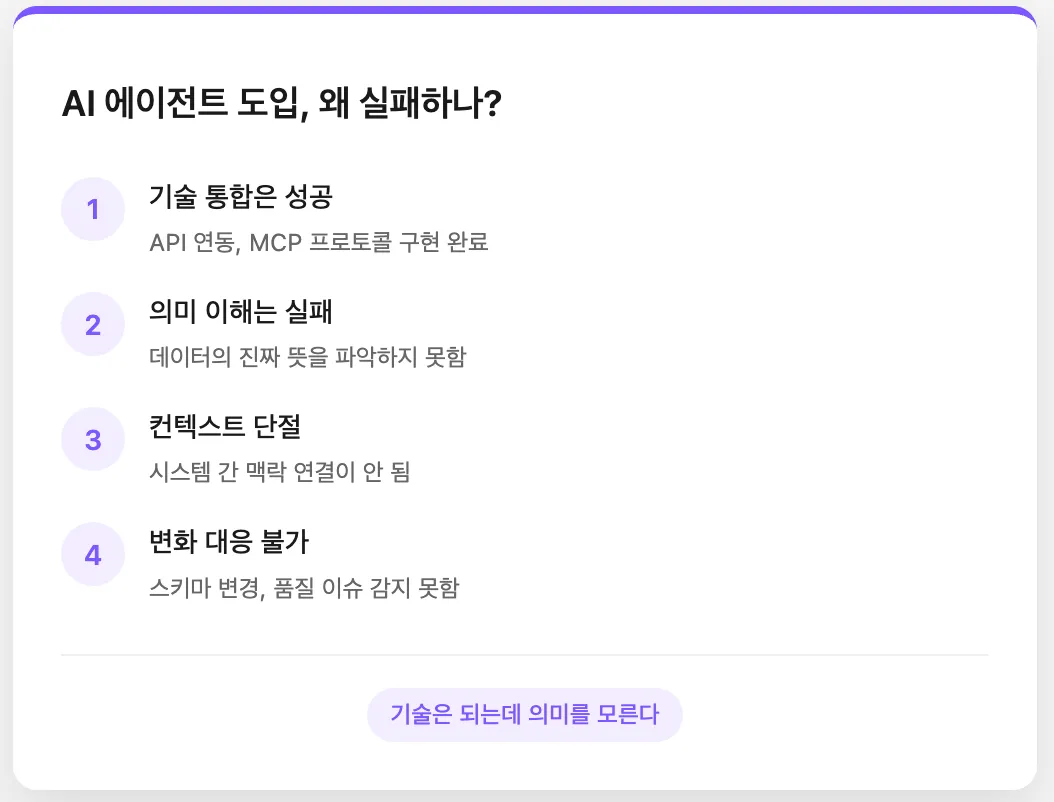
Companies around the world are pouring billions of dollars into AI agents. Yet real business success stories are extremely rare. You can build an impressive demo, but putting it to work in daily operations is a different story.
AI solution specialists put it this way:
"Technical integration, such as API connections and MCP (Model Context Protocol), gets solved. The real problem is that AI doesn't understand what business data 'means.'"
Let's look at one concrete problem: classifying personal information (PII). One system classifies national ID numbers as sensitive data, while another treats them as little more than a customer ID.
What happens if an AI agent doesn't know about that difference? You risk violating the GDPR or Korea's Personal Information Protection Act. This is not just a technical problem. It leads straight to legal risk.
On top of that, system schemas change all the time, and data collection brings its own quality issues. AI cannot detect and respond to these changes on its own. That is where hallucinations come from: the AI makes up data that doesn't exist or infers relationships that aren't there.
So what is the fix? This is where ontology comes in.
An ontology defines business concepts, sets up the hierarchy between terms and makes the relationships between data explicit. Put simply, it is the official dictionary of a company's data. Like onboarding material for new hires, it states clearly what each word means at this company.
AI experts describe ontology as "the real guardrail for AI."
A train that leaves its rails derails. In the same way, AI without the "safe data path" of an ontology can race off in the wrong direction. The ontology restricts the AI's path so it finds only the right data and follows only the relationships that have been defined.
The core reasons AI agents fail
Technical integration succeeds (APIs, MCP, etc.)
Understanding what the data "means" fails
Context is cut off between systems
Changes can't be detected or handled
What is an ontology? A knowledge system that gives data "meaning"
Let's look a little more closely at what ontology means.
The term comes from philosophy, where it refers to the study of being. It combines the Greek "onto-" (being) and "logia" (study). In philosophy it is the branch that asks, "What exists?" and "What is the nature of the things that exist?"
When it moved into AI and information science, ontology took on a practical meaning. It became "a knowledge system that defines the knowledge of a specific domain in a standardized way so that computers can understand and process it." In plain terms, it is a "knowledge map" that formally agrees on what the things (objects) in our world are and how they relate to each other.
In computer science, an ontology spells out, in a form a computer can read, "what exists in the domain we deal with, and how those things are connected."
When new employees join a company, they get a work manual: material that explains "this is how we use this term here" and "this task connects to that department in this way." An ontology plays exactly that role. The only difference is that the manual is written for AI, not for people.
The four building blocks of an ontology
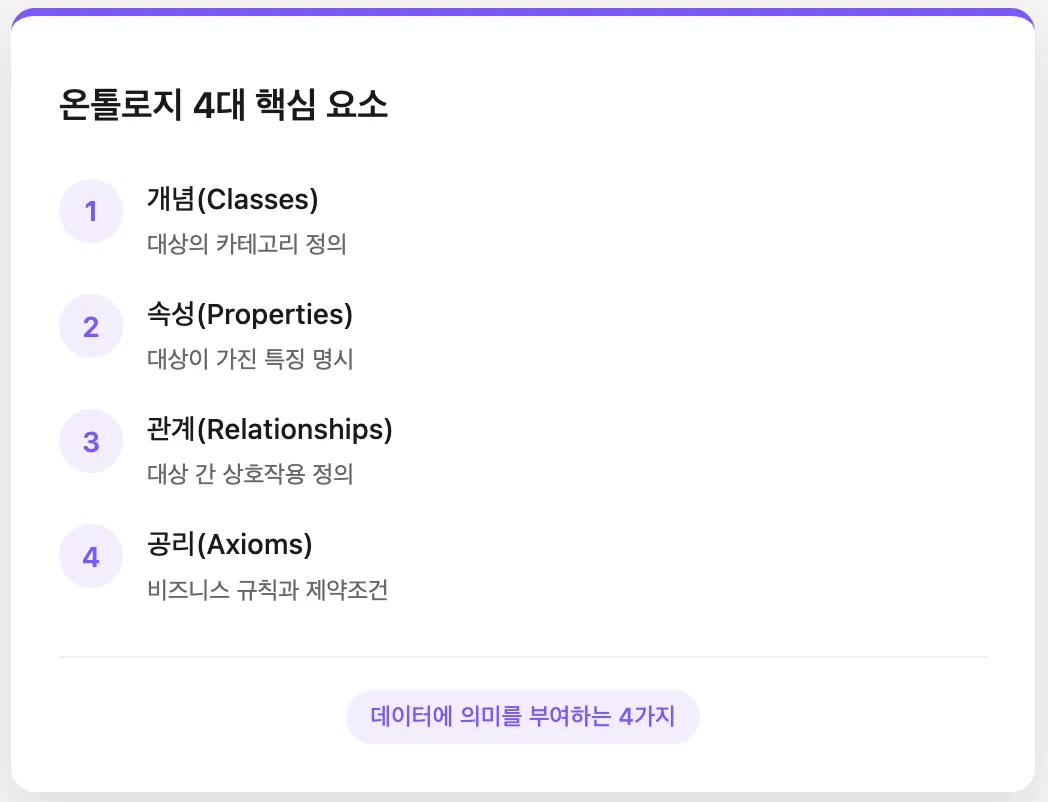
An ontology is complete once it defines four core elements.
First, concepts (classes). These are categories of things, such as "person," "car," "customer" or "product." A concept answers the question "What is a customer?" Does it include prospects? Does it mean only customers under contract? Does it extend to end users? The ontology defines each of these views explicitly.
Second, properties (attributes). These define the characteristics a thing has: a person has a "name" and an "age," a product has a "price" and a "stock quantity." The ontology also specifies each property's data type and whether it is required or optional.
Third, relationships. These define how things interact and connect. They state relationships such as "a customer creates an order," "an order contains products" and "a product is shipped from inventory." Once these relationships are defined, AI can join multiple tables automatically and understand complex business logic.
Fourth, axioms (rules). These are constraints that are always true, in other words business rules: "Shipping cannot start before payment is complete," or "Orders of KRW 1 million or more cannot be placed without manager approval." Axioms like these are what keep AI from acting against business policy.
The four building blocks of an ontology:
Concepts (classes): categories of things (e.g., customer, product, order)
Properties: characteristics of things (e.g., name, price, quantity)
Relationships: connections between things (e.g., customer-purchases-product)
Axioms: business rules (e.g., ship after payment)
How is an ontology different from a plain database?

This raises an important question: "So how is this different from an ordinary database?"
The decisive difference is intelligent reasoning. An ordinary database returns exactly what we ask for and nothing more. Ask for "Customer A's order history" and it shows just that data. An ontology-based system, by contrast, can follow the defined relationships and infer things we never asked about directly.
Here is an example. Ask, "When Customer A's account manager is on vacation, who can approve in their place?" An ordinary database can't answer that. But if the ontology knows the "account manager, team lead, department head" hierarchy and the rule "designate a delegate during vacation," it can find the answer by moving through several layers of relationships (multi-hop reasoning).
That is why ontology matters in the age of AI agents. It offers three core kinds of value.
First, a single source of truth. Terms that each department defines differently ("customer," "inventory," "progress" and so on) are defined clearly by business domain, which prevents confusion. It becomes clear how sales' "customer" differs from finance's "customer," and which definition to use in which situation.
Second, multi-hop reasoning. To answer a complex question such as "Which sales reps are linked to customers who bought Product B but didn't buy again within three months?", the system explores multi-step links between pieces of knowledge. In plain SQL this would take a complex query dozens of lines long, but an ontology follows the relationships automatically to find the answer.
Third, hallucination prevention. When AI tries to invent a fake relationship that isn't defined in the ontology, the system checks and blocks it, acting as a "guardrail." It stops the AI from making up customers who don't exist or reporting stock for products that aren't there.
The three core values of an ontology:
Single source of truth (SSOT): one set of terms across departments, no confusion
Multi-hop reasoning: answers complex questions through automated inference
Hallucination prevention: blocks AI from generating fake data
Ontologies are usually implemented as graph databases.
Why graphs? A traditional relational database has a fixed structure of tables and columns, while a graph database can express relationships flexibly as nodes and edges.
The simplest approach is a triplestore, which stores data as subject-predicate-object, for example "customer-buys-product." It suits simple relationships.
If you need to handle more complex business rules, you use a labeled property graph. Neo4j is a leading example. It can express multi-hop relations and is also useful for uncovering hidden relationships.
AI experts explain that "this kind of graph structure helps companies discover hidden relationships and answer complex questions." A complex query such as "Which sales reps are linked to customers who bought our product but didn't buy again within three months?" is easy to solve with a graph.
How graph databases are implemented
Triplestore: a simple subject-predicate-object structure
Labeled property graph: expresses complex multi-step relationships
Advantages: flexible relationships, discovery of hidden patterns
Real examples: industry-standard ontologies
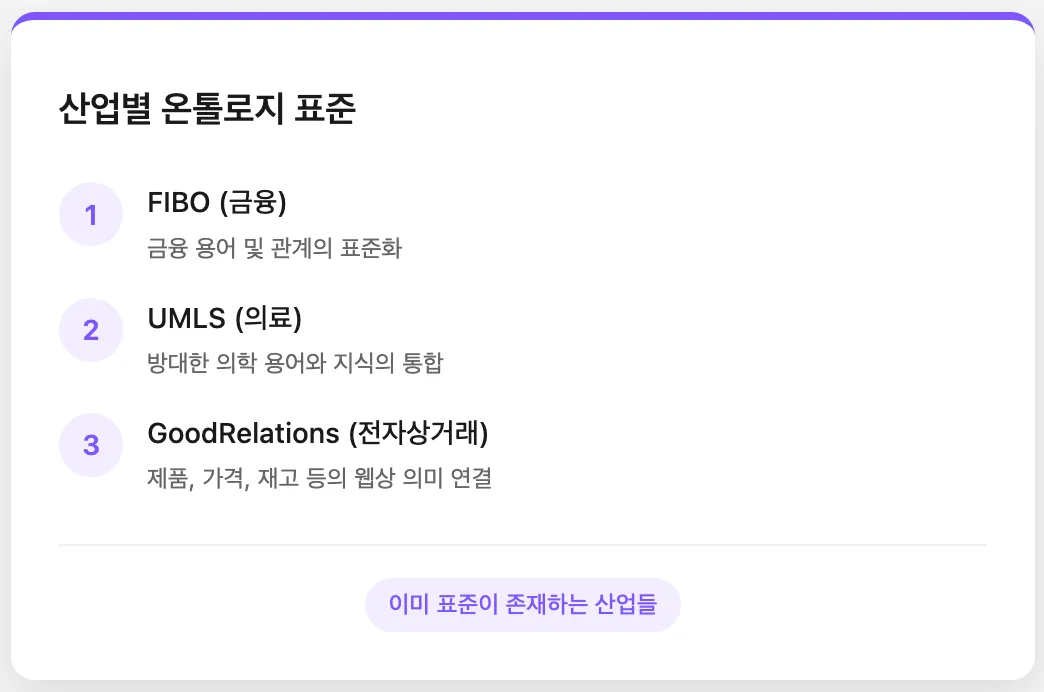
Some industries already have public ontologies.
In finance, FIBO (Financial Industry Business Ontology) standardizes financial concepts such as financial products, transactions and markets. In healthcare, UMLS (Unified Medical Language System) integrates medical terms for diseases, drugs, procedures and more. In e-commerce, an ontology called GoodRelations is used to link information such as products, prices and inventory by meaning on the web.
Public ontologies like these are a good starting point. But most companies have their own processes and terminology, so the standard ontology has to be customized. It needs to reflect the company's own business rules, such as its manufacturing processes, quality standards and customer segments.
Examples of industry-standard ontologies:
Field | Ontology | Purpose |
|---|---|---|
Finance | FIBO | Standardizes financial terms and relationships |
Healthcare | UMLS | Integrates a vast body of medical terms and knowledge |
E-commerce | GoodRelations | Links products, prices, inventory and more by meaning on the web |
Customization required: reflect the company's own processes
How does an ontology-based AI system work?
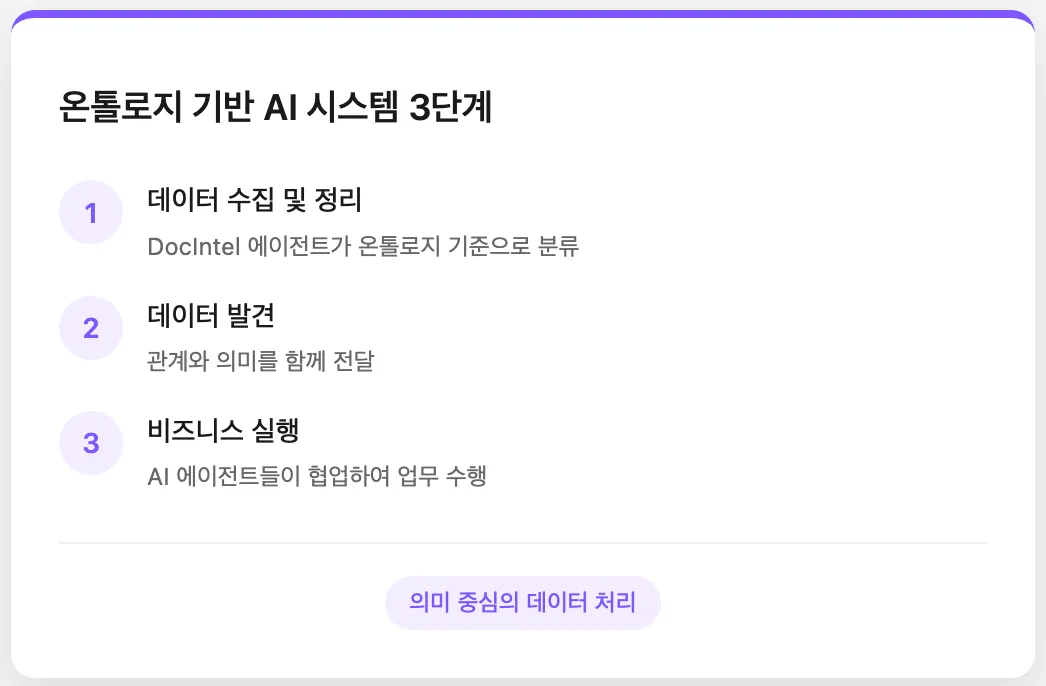
So how do you actually apply an ontology to an AI system?
Let's look at a concrete architecture proposed by global AI solution companies.
The overall flow has three stages. First, in the data collection and cleanup stage, a document intelligence (DocIntel) agent processes structured and unstructured data. The data is classified against the ontology and stored in a graph database such as Neo4j.
Next comes the data discovery stage. A data discovery agent follows the ontology to find the right data. The key is that it doesn't just find data; it passes along relationships and meaning with it. It provides context such as "this data means this, and it connects to that data in this way."
Finally, there is the business process execution stage. The AI agents that do the actual work communicate with one another over the A2A (Agent to Agent) protocol and provide the user interface through the AG-UI protocol.
Preventing hallucinations
The biggest advantage of an ontology is that it prevents AI hallucinations. With an ontology in place, AI follows only the defined paths. It cannot make up irrelevant data.
Here is a concrete example. Suppose the AI hallucinates a "customer" who doesn't exist. In an ontology-based system, every customer must have connected data such as "orders," "payments" and "deliveries." A fake customer produced by a hallucination won't have any of that connected data, so the system can detect the anomaly right away and remove it.
This is the guardrail role AI experts talk about: a safe path the AI cannot stray from.
How hallucinations are prevented:
AI can only explore defined paths
Entities without connected data are detected automatically
Actions that break business rules are blocked
Anomalies are detected and removed in real time
Scalability and maintenance
Another advantage of an ontology is that it is easy to extend. When you add new assets, relationships or policies, the AI agents learn them automatically. Rules are applied across the whole system rather than set entity by entity, so you can adapt flexibly as the business changes.
Say a new product category appears. Add a hierarchy such as "New product > Category X" to the ontology, and every AI agent recognizes the information automatically. There is no need to update each agent separately.
Advantages of an ontology-based system:
Automatic learning: new rules are reflected in agents automatically
Central management: rules apply system-wide, not entity by entity
Flexible expansion: quick response to business change
The practical considerations in building an ontology: time and cost

Building an ontology does involve trade-offs. The initial definition takes several months, data discovery and running a graph database add overhead, and there is the organizational challenge of getting departments to agree on terminology.
So does every company need to build an ontology?
AI industry experts' view is that "for a large enterprise, this overhead is worth it." The up-front investment is large, but over the long run the accuracy and reliability of AI systems improve significantly.
An ontology is close to essential when data is spread across many systems, terminology varies widely between departments and the industry is one where compliance matters.
What to consider when building an ontology
Time: 3-6 months for the initial definition
Cost: graph database infrastructure and operating costs
Organization: a process for departments to agree on terms
ROI: long-term value demonstrated at large enterprises
Clean up the data first, then bring in AI
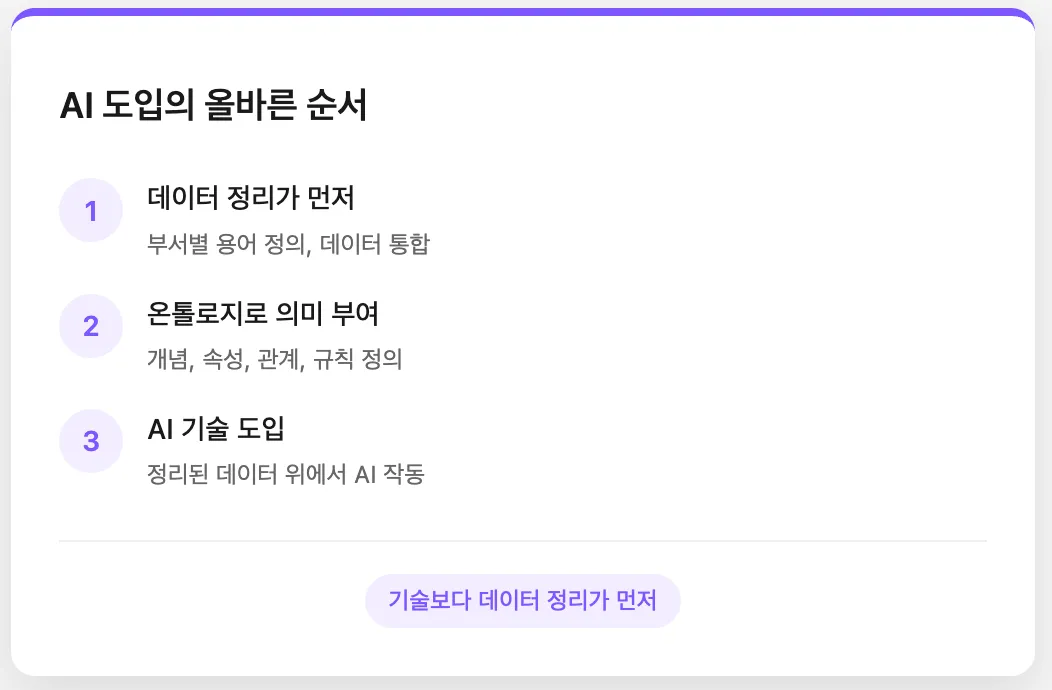
Order matters if you want AI agents to succeed. First, clean up the data. Then give it meaning with an ontology. Only after that will AI work properly.
Building a demo is easy. Applying it to the real business is a different story. Boring data cleanup comes before flashy AI technology.
If you are considering AI, start with these questions.
"Who does the word 'customer' actually mean at our company?"
"If every department gives a different answer, what answer will the AI give?"
Before you weigh up a flashy AI tech stack, start with the boring but essential work of cleaning up your data. That is the real shortcut to AI success.
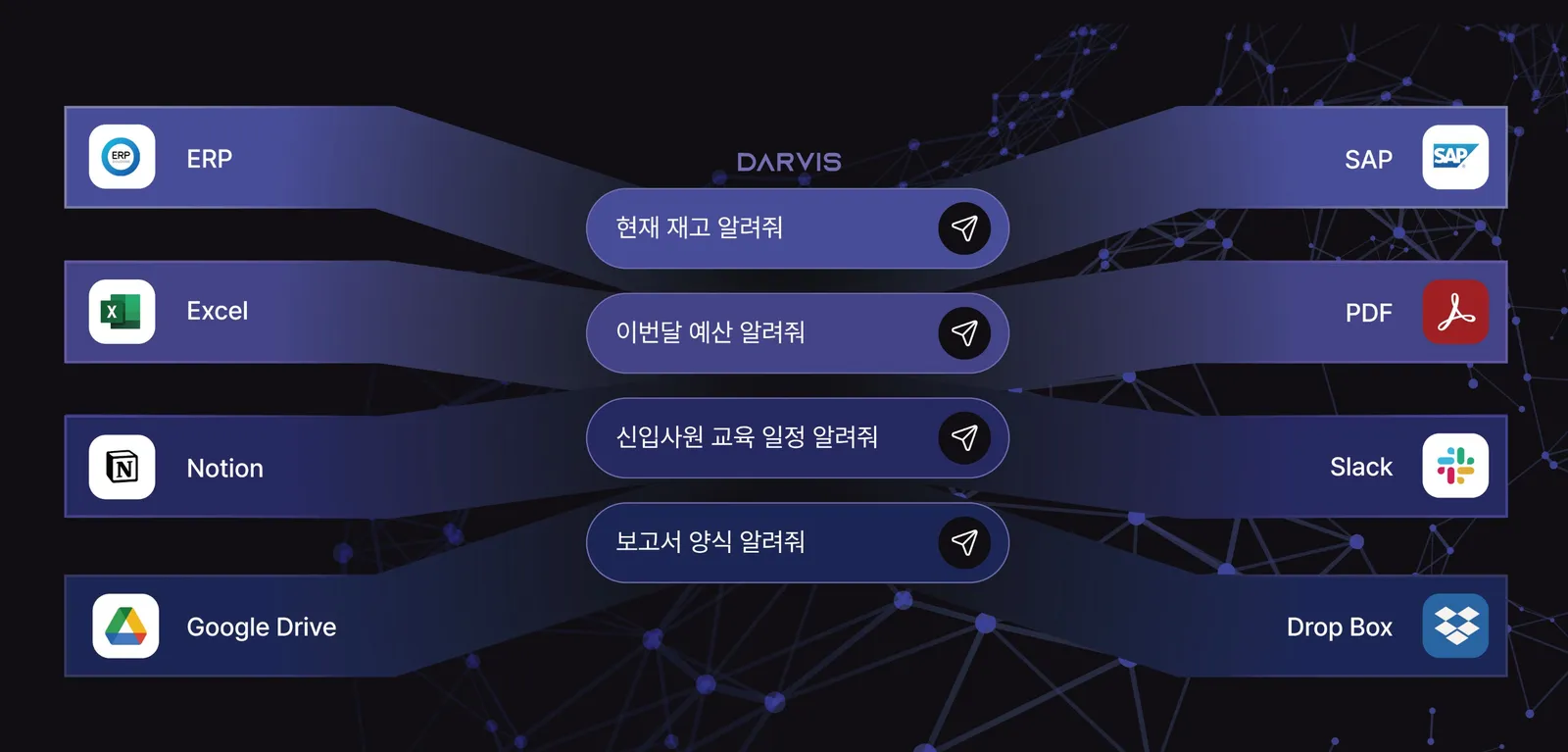
DFINITE's DARVIS works the same way. Before it uses Text-to-SQL to turn natural language into SQL, the first thing it does is map the data schema. Which tables exist? What does each column mean? How are the tables related? Without this "data map," even the smartest AI will write the wrong SQL.
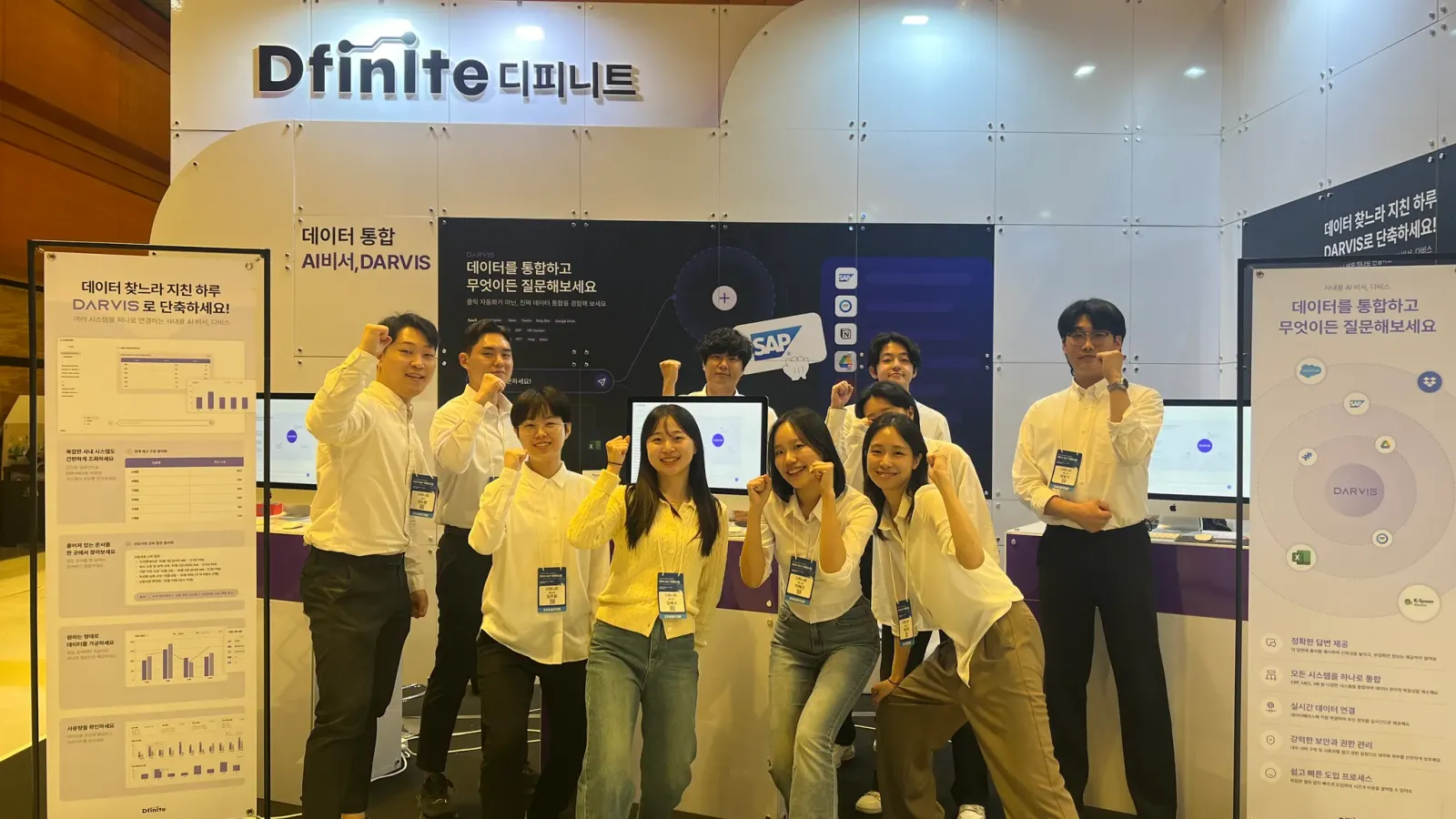
If you are struggling to build an ontology or put data governance on a systematic footing, talk to DFINITE. We understand the complex data environments of legacy industries such as manufacturing, construction and the public sector, and we provide insights you can put into practice.
We join scattered data with an ontology, flag what drifts first, and keep the evidence behind every decision.