
MCP explained simply, for anyone (2025 edition)
MCP (Model Context Protocol) explained simply: the concept, adoption cases such as Shinhan Bank and Hyundai Motor, and 30% productivity gains.

Among companies looking at AI services, one term keeps coming up lately: "MCP." Requests to "explain MCP simply" have surged. Why? Because MCP's impact on corporate AI strategy is that significant.
This post explains MCP step by step, from the basic concept to real-world use cases and a guide for companies adopting it. We start with simple analogies for readers who have never heard the term, and go on to the deeper points practitioners need.
MCP explained simply: what is MCP?
One minute from now, you will be able to explain MCP.
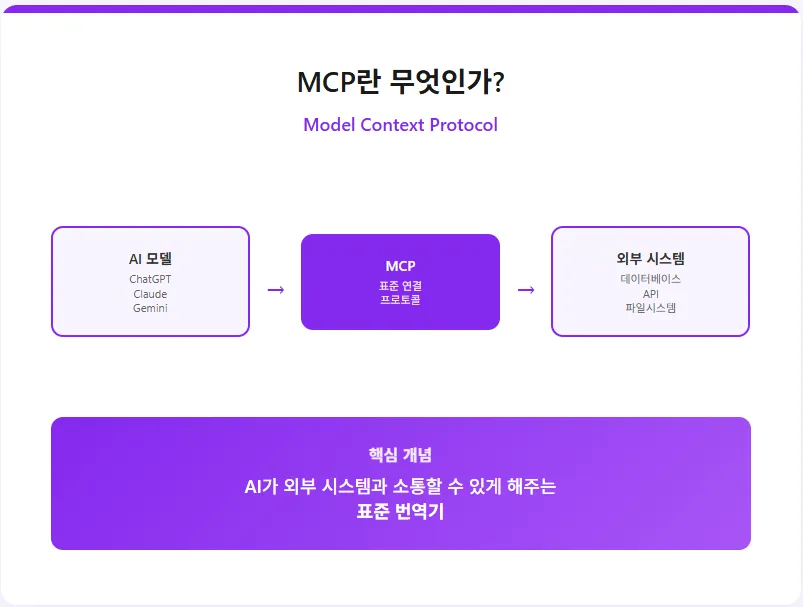
Put as simply as possible, MCP (Model Context Protocol) is "the smartphone app store for AI."
A smartphone on its own handles basics like calls and notes. It becomes truly useful once you install a subway app, a banking app, or games. The app store lets you install and manage all of those apps in the same way.
AI works the same way. It is good at conversation, but it does not connect directly to company databases or external systems. MCP helps AI "talk" to those external systems. Think of it as a common language.
Another analogy is a plug adapter. Outlets have different shapes in different countries, but one universal adapter lets you use power anywhere. Like that adapter, MCP is a "universal adapter" that lets AI connect to any system.
That should give you at least a rough idea of what MCP does.
A more precise definition of MCP for practitioners
To define the concept properly: MCP (Model Context Protocol) is a standardized connection interface between AI models and external resources.
The key word here is "protocol." A protocol is a set of common rules that different systems follow when they exchange information. Just as HTTP is the protocol used to exchange web pages on the internet, MCP defines the rules for communication between AI and external systems.
With it, AI can move beyond being a simple text generator and evolve into an intelligent agent that handles real work.
MCP explained simply: where it came from and where it stands
Who created it, and when?
MCP is an open-source standard protocol that Anthropic announced in November 2024. Anthropic is the company behind Claude AI and focuses its research on making AI safer and more useful.
What stands out is that Anthropic released MCP as open source instead of keeping it proprietary. This can be read as a commitment to building a common standard for the progress of the whole AI industry. Anthropic CEO Dario Amodei has in fact said he hopes "MCP will become the USB-C of the AI ecosystem."
Big Tech joined quickly
After Anthropic's announcement, major AI companies adopted MCP remarkably fast.
OpenAI (ChatGPT): announced MCP compatibility support shortly after the announcement
Google (Gemini): added MCP integration to the Gemini API
Microsoft (Copilot): supports the MCP standard on its Azure AI platform
Meta: working on MCP compatibility for its Llama models
Open-source communities such as Hugging Face, LangChain and LlamaIndex then added MCP support as well, and MCP has now become the de facto industry standard. As of the end of 2024, more than 60% of AI development projects worldwide were estimated to be considering or adopting MCP.
Why are AI companies adopting MCP?
The limits of the old plugin systems
Before MCP, each AI model used its own plugin system. That created problems for companies.
Suppose, for example, that a financial company is building an AI customer-service offering:
Plugin for ChatGPT integration (development cost: KRW 50 million, time: 2 months)
Plugin for Claude integration (development cost: KRW 45 million, time: 1.5 months)
Plugin for Gemini integration (development cost: KRW 40 million, time: 1.5 months)
As in this example, using the feature across several AI systems took a total of KRW 135 million and five months. Add the maintenance cost for each one, and the burden grew even heavier.
The bigger problem was the complexity of security management. Each AI needed its own security setup, so unified management was close to impossible. For IT departments, it was a nightmare.
MCP explained simply, and what a protocol is
A quick aside: what is a plugin?
A plugin is a small extension that adds new features to an existing program.
Think of DLC (expansion packs) that add character skins or new maps to a game, or browser extensions that block ads or add translation. In AI, too, features such as shopping search, weather lookup and calendar integration could be added as plugins.
But the problem was that each AI had a different plugin structure. A plugin built for ChatGPT could not be used in Claude.
Why MCP is innovative
That is why MCP was an innovative approach that went beyond the limits of plugins.
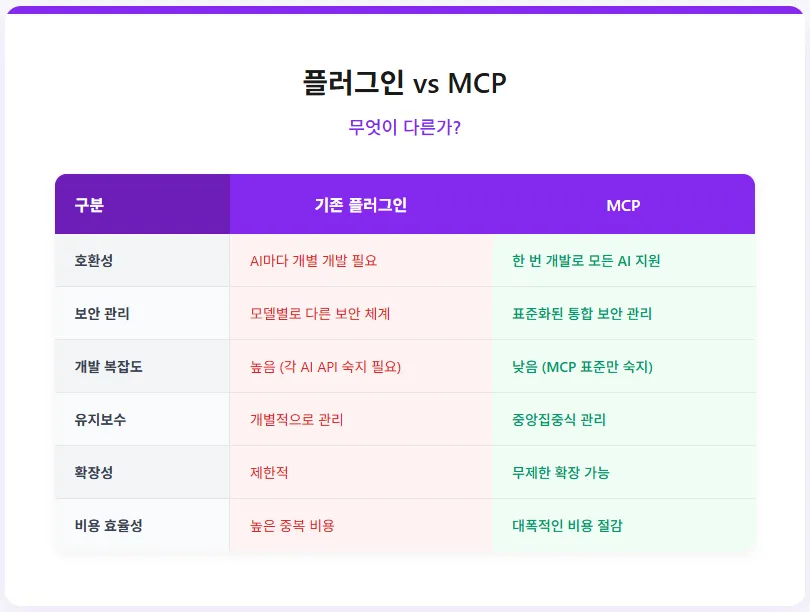
Plugins had to be developed separately for each AI, each model needed its own security setup, and development was complex. As a result, scalability was limited and duplicate costs were high.
With MCP, one build supports every AI, security can be managed in a standardized, unified way, development becomes simpler, and costs can drop sharply.
MCP's advantage is especially clear in scalability. When a new AI model supports MCP, it can immediately use every MCP connector already built. This is speeding up the growth of the AI ecosystem as a whole.
The solution MCP offers
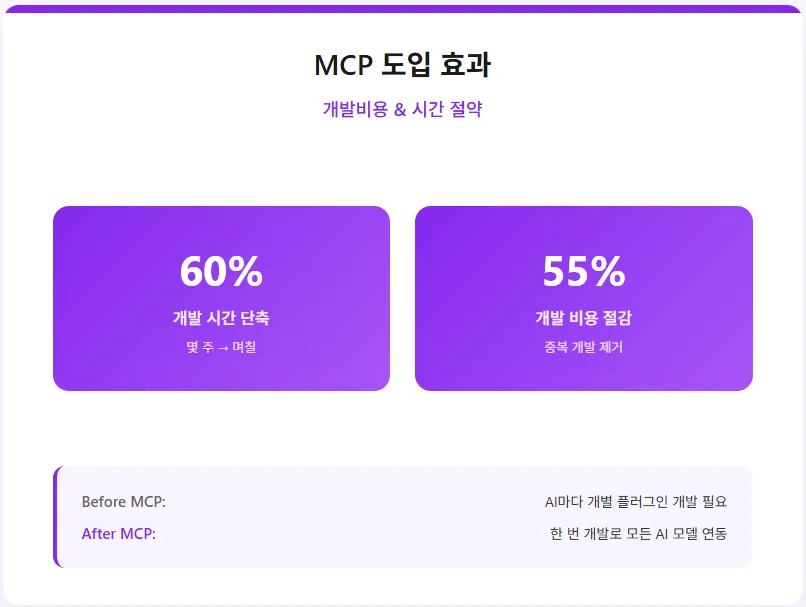
In short, adopting MCP replaces model-by-model development with a build-once approach.
"Build once → use in every AI"
Under that principle, the financial company in the example above would look like this:
Plugin built on the MCP standard (development cost: KRW 60 million, time: 2.5 months)
Usable right away in ChatGPT, Claude and Gemini
Development cost falls by 55% and development time by 50%. More important, when new AI models appear, they can be connected right away with no additional development.
On security, MCP provides standardized authentication and permission management, so IT administrators can control all AI data access from a single dashboard.
Real MCP use cases and results
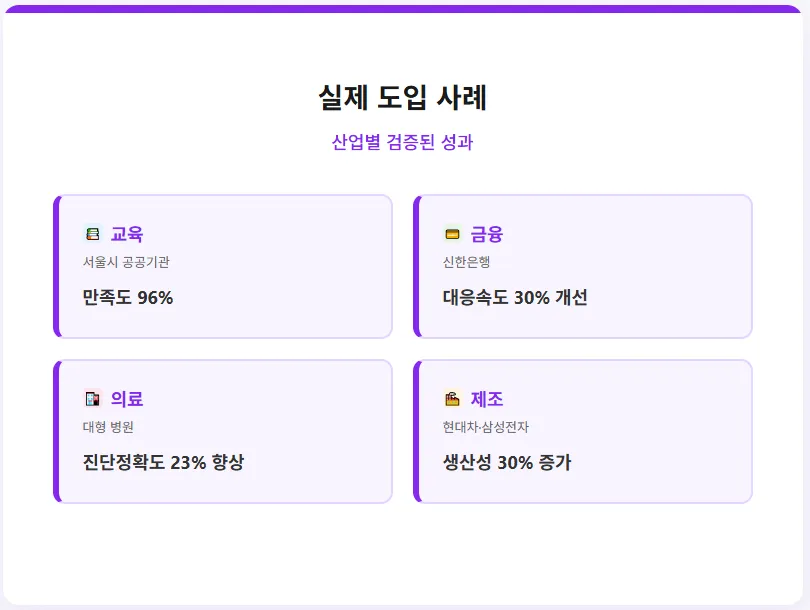
Education: Seoul city public institutions
In its 2025 "Advanced Generative AI Training," the Seoul Metropolitan Government used MCP for about 300 public officials. Administrative materials and policy cases were collected and integrated in real time and used directly to build the course materials, and the program achieved 96% training satisfaction.
Finance: Shinhan Bank
Shinhan Bank offers personalized services through an MCP-based AI chatbot that analyzes customer financial data and consultation records in real time. It improved customer response speed by 30% and cut operating costs by 20%.
Healthcare: a large hospital
A large Korean hospital introduced a diabetic retinopathy screening system that combines MCP with AI image analysis, and diagnostic accuracy improved by more than 23%.
Manufacturing: Hyundai Motor and Samsung Electronics
Major manufacturers collect and analyze real-time process data with MCP-based digital twin systems, achieving a 30% increase in productivity and operating cost reductions of more than 20%.
Expected benefits of adopting MCP
As these cases show, MCP has raised efficiency. In general, the expected benefits of adopting MCP are as follows.
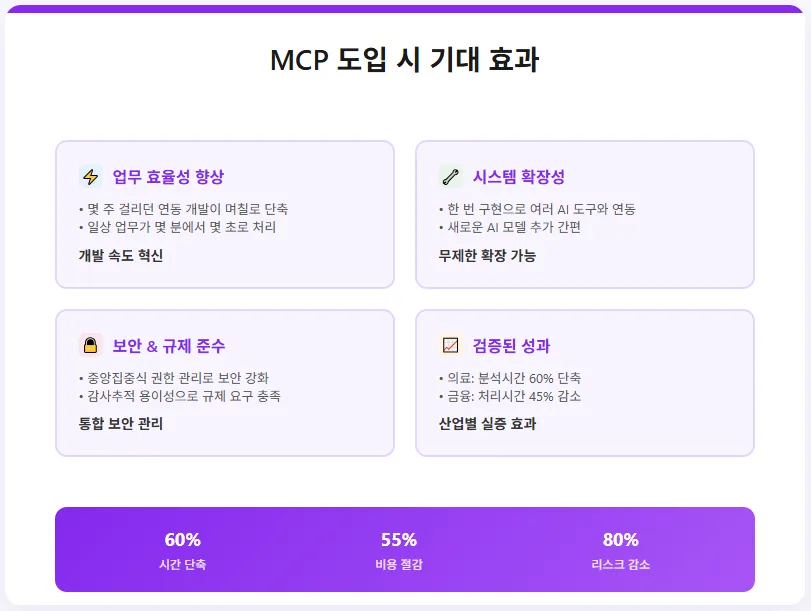
Better work efficiency
Integration work that took weeks is cut to days
Routine tasks (calendar booking, report generation and so on) go from minutes to seconds
System scalability
One implementation connects to multiple AI tools
New data sources or AI models are easy to add
Security and regulatory compliance
Centralized permission management strengthens security
Easier audit trails help meet corporate regulatory requirements
Results demonstrated by industry
Healthcare: 60% less time for drug-development analysis
Finance: 45% less time to handle customer inquiries
Manufacturing: removing vendor lock-in increases the real return on investment
What companies should consider when adopting MCP
Pre-adoption checklist
So what should a company consider when it wants to adopt MCP? Here is a short summary of the points worth reviewing.
Technical review
Compatibility with existing systems: check whether your current ERP, CRM and databases support MCP integration
Network infrastructure: review bandwidth and security settings in preparation for more API calls
Data structure: assess whether data formats need to be reorganized to fit the MCP standard
Legacy systems: plan how older systems will connect through MCP
Organizational readiness
Security policy: clearly define the scope of AI's data access rights
Employee training plan: design MCP technical training and a change-management program
Governance: set AI usage guidelines and make accountability clear
Performance metrics: set KPIs to measure ROI
Let's wrap up.
Explained simply, MCP is "the USB-C of the AI industry." It is a standard interface that connects different AI models with many kinds of systems, and it changes the game for companies by sharply cutting the cost of adopting AI and raising efficiency.
With MCP, we can expect the following benefits:
1. Standardization: build once, use in every AI
2. Cost savings: 60% savings on development costs and 30% or more on operating costs
3. Stronger security: unified permission management and transparent monitoring
4. Future readiness: flexible adaptation to new changes in AI technology
Now you can explain MCP!
As major AI companies adopt MCP, new solutions are coming out every day. Want more AI insights as fun and useful as today's?
Then see the related posts below for more on the latest AI trends and how to apply them in practice. We will keep sharing AI insights that are easy and fun to read.
Thank you!
We join scattered data with an ontology, flag what drifts first, and keep the evidence behind every decision.